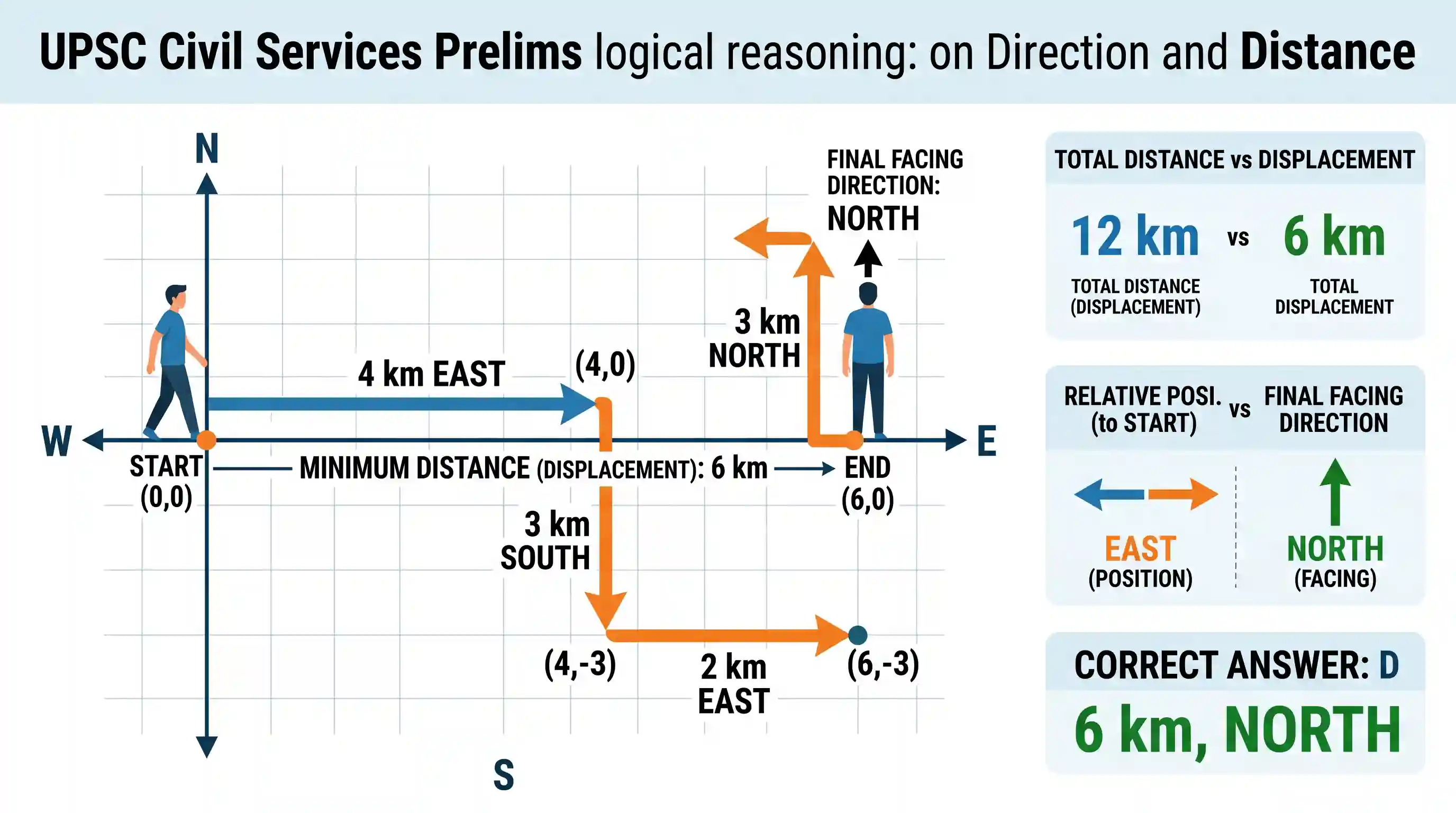
A person facing the East travels 4 km straight and then turns right and travels 3 km, then further turns left and travels 2 km and finally turns left and travels 3 km. The minimum distance between the final point and the initial point, and the direction in which the person is facing at the final point are, respectively

- A12 km, East
- B6 km, East
- C8 km, North
- D6 km, NorthCorrect
Explanation
According to the Cartesian coordinate system (formally introduced by mathematician René Descartes in 1637), which provides the authoritative mathematical framework for mapping spatial reasoning problems in the UPSC CSAT, we can precisely track the person's movements on a two-dimensional plane. Let the starting point be the origin (0, 0).
- Initial Movement: The person starts facing East and travels 4 km. The coordinates become (4, 0), and the person faces East.
- First Turn: Turning right from East changes the orientation to South. Travelling 3 km South alters the position to (4, -3).
- Second Turn: A left turn from South reorients the person to face East. Travelling 2 km East shifts the coordinates to (6, -3).
- Final Turn: A left turn from East changes the orientation to North. Travelling 3 km North alters the y-coordinate by +3, bringing the final position to (6, 0).
Minimum Distance: The straight-line displacement between the initial point (0, 0) and the final point (6, 0) is 6 km. Final Facing Direction: During the final leg of the journey, the person moves towards the North, meaning their final orientation is North. Therefore, Option D is correct.
Analysis of Incorrect Options:
- Option A (12 km, East): Incorrectly calculates the total distance traversed (4 + 3 + 2 + 3 = 12 km) rather than the shortest displacement, and misstates the final facing direction.
- Option B (6 km, East): Correctly calculates the displacement but confuses the person's location relative to the origin (which is East) with the actual direction the person is facing (North).
- Option C (8 km, North): Correctly identifies the final orientation but miscalculates the minimum distance, likely by erroneously manipulating the coordinate vectors.
Takeaway: Always distinguish between the "direction with respect to the starting point" and the "direction the person is currently facing." Sketching a Cartesian plane with clear vector additions is the most reliable strategy to prevent orientation and distance errors.
Related questions
More UPSC Prelims practice from the same subject and topic.
- Prelims 2026CSATother
Two identical straight rods are painted in five distinct colours so that each of them gets divided into five equal parts along the length. In one of them, the portions are marked P1, P2, P3, P4 and P5…
- Prelims 2026CSATother
Seven persons A, B, C, D, E, F and G travel by three cars X, Y, Z. A and another two of them travel by X. Only E travels with G. C travels by Z, but B does not travel by Y. Besides, A and B do not tra…
- Prelims 2026CSATother
There are four statements X, Y, Z and W. Their relations are as follows : If X is incorrect, then so is Z; if Y is incorrect, then W is correct; if W is correct, then X is incorrect. Which of the foll…
- Prelims 2026CSATother
Consider the following statements : Every red is blue. Every blue is green. Every green is yellow. Which of the following statements denoted by P, Q and R are correct? P. Every blue is yellow. Q. Ever…
- Prelims 2026CSATother
Seven cubes are identical in shape. Out of these, the weight of each of the six cubes is equal and the weight of the remaining cube is less than the weight of any other cube. A balance is used to iden…
- Prelims 2026CSATother
Eight persons P, Q, R, S, T, U, V and W sit around a round table in eight different seats placed with equal distance between any two consecutive seats. Both P and R are adjacent to Q. Both T and R are…