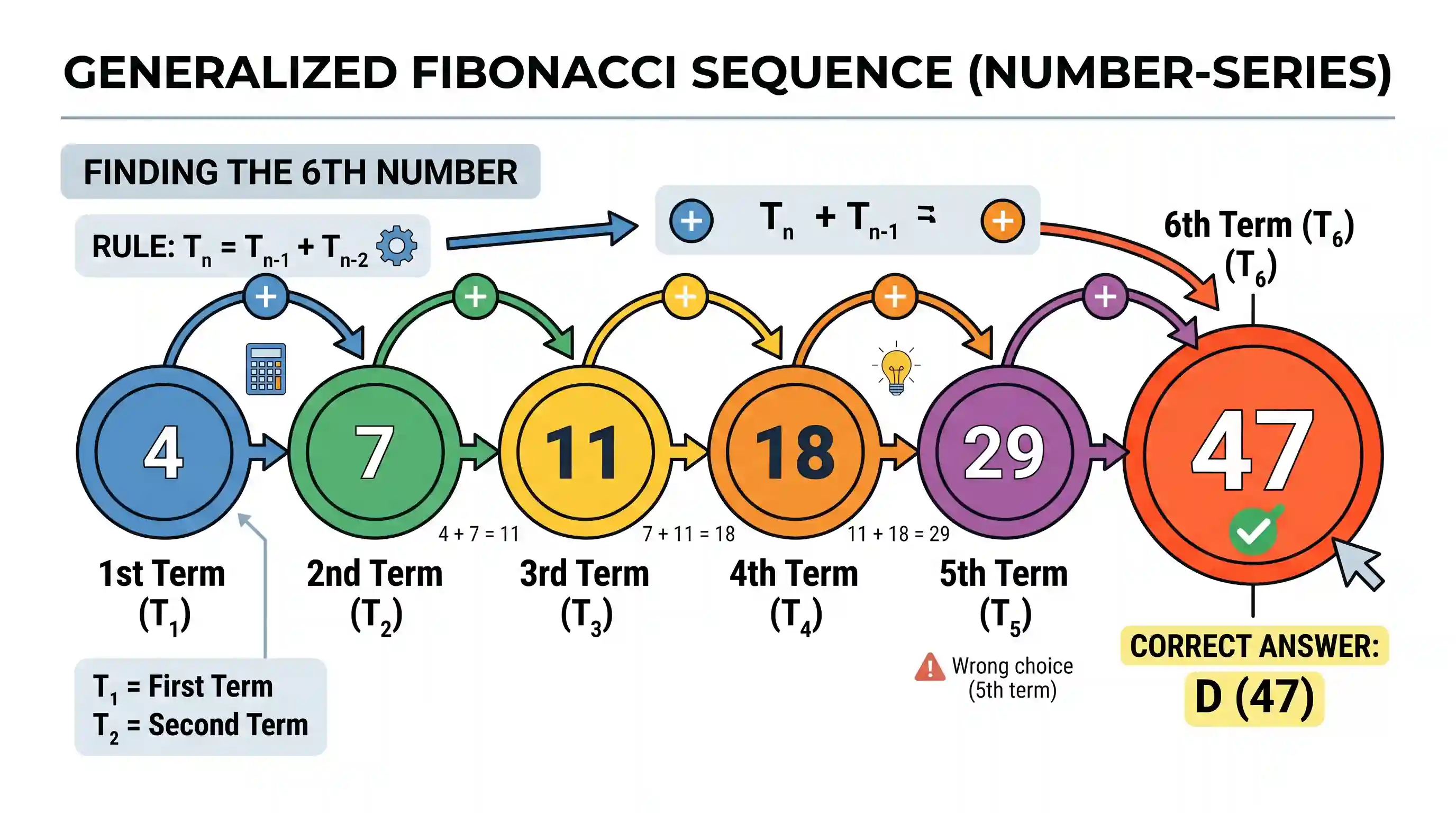
In a sequence of numbers, each number other than the first two is the sum of the two immediately preceding numbers from it. If the first two numbers in the sequence are 4 and 7, then the sixth number is

- A29
- B37
- C43
- D47Correct
Explanation
The problem describes a generalized Fibonacci sequence, which is a type of second-order linear recurrence relation where each term is the sum of the two preceding terms (Tₙ = Tₙ₋₁ + Tₙ₋₂). This additive sequence rule is historically notable, having been widely introduced to Western mathematics by Leonardo of Pisa (Fibonacci) in his 1202 book Liber Abaci.
Given the starting terms:
- 1st number (T₁) = 4
- 2nd number (T₂) = 7
Applying the sequence rule step-by-step:
- 3rd number (T₃) = 4 + 7 = 11
- 4th number (T₄) = 7 + 11 = 18
- 5th number (T₅) = 11 + 18 = 29
- 6th number (T₆) = 18 + 29 = 47
Therefore, the sixth number in the sequence is 47, making Option D correct.
Why the other options are wrong:
- Option A is incorrect because 29 represents the fifth number (T₅) in the sequence, not the required sixth term.
- Option B is incorrect; 37 is a mathematical miscalculation resulting from failing to add the immediately preceding valid terms (18 and 29).
- Option C is incorrect as 43 does not correspond to any correct summation of preceding terms in this specific recurrence relation.
Takeaway: For short mathematical sequences in aptitude tests, explicitly list and number each term sequentially (labeling them T₁ to Tₙ). This straightforward habit prevents common "off-by-one" mistakes, such as accidentally selecting the 5th term when the 6th is asked for.
Related questions
More UPSC Prelims practice from the same subject and topic.
- Prelims 2026GS1other
Which of the following statements with regard to the Grand Slam Tennis Tournaments is/are correct ? 1. The tournaments have a shared governance structure establishing the partnership among the four Gr…
- Prelims 2026GS1other
Ms. X is a mid-level civil service official working in the urban development department of a major city. Recently, she was involved in approving a contract for a public infrastructure project — a new …
- Prelims 2026GS1other
Which one of the following pairs is not correctly matched? (Indian Army Corps) : (Headquarters)
- Prelims 2026CSATother
For ⅓ < x < y < 2, which of the following statements is/are always correct? I. x + 1/x < y + 1/y II. √(1 + y²)/y < √(1 + x²)/x Select the answer using the code given below.
- Prelims 2026CSATother
What is the minimum number of times one needs to measure to get 298 litres of water from a tank, if the measuring cylinders have capacities 1 litre, 6 litres, 25 litres and 100 litres?
- Prelims 2026CSATother
There are four types of weights, namely 1 kg, 2 kg, 5 kg and 10 kg. What is the maximum number of different ways one can measure 20 kg, if at least eight but not more than eleven weights of 1 kg are t…