The ratio of male to female workers in two companies A and B is 13 : 10 and 7 : 5, respectively. If both the companies have the same number of female workers, then what is the ratio of the total number of workers in A to those in B?

- A24 : 23
- B23 : 24Correct
- C18 : 17
- D27 : 18
Explanation
Correct Option: B (23 : 24)
The problem evaluates fundamental concepts of Ratio and Proportion, a foundational topic in the UPSC Civil Services Aptitude Test (CSAT).
Given the data:
- Company A (Male : Female) = 13 : 10
- Company B (Male : Female) = 7 : 5
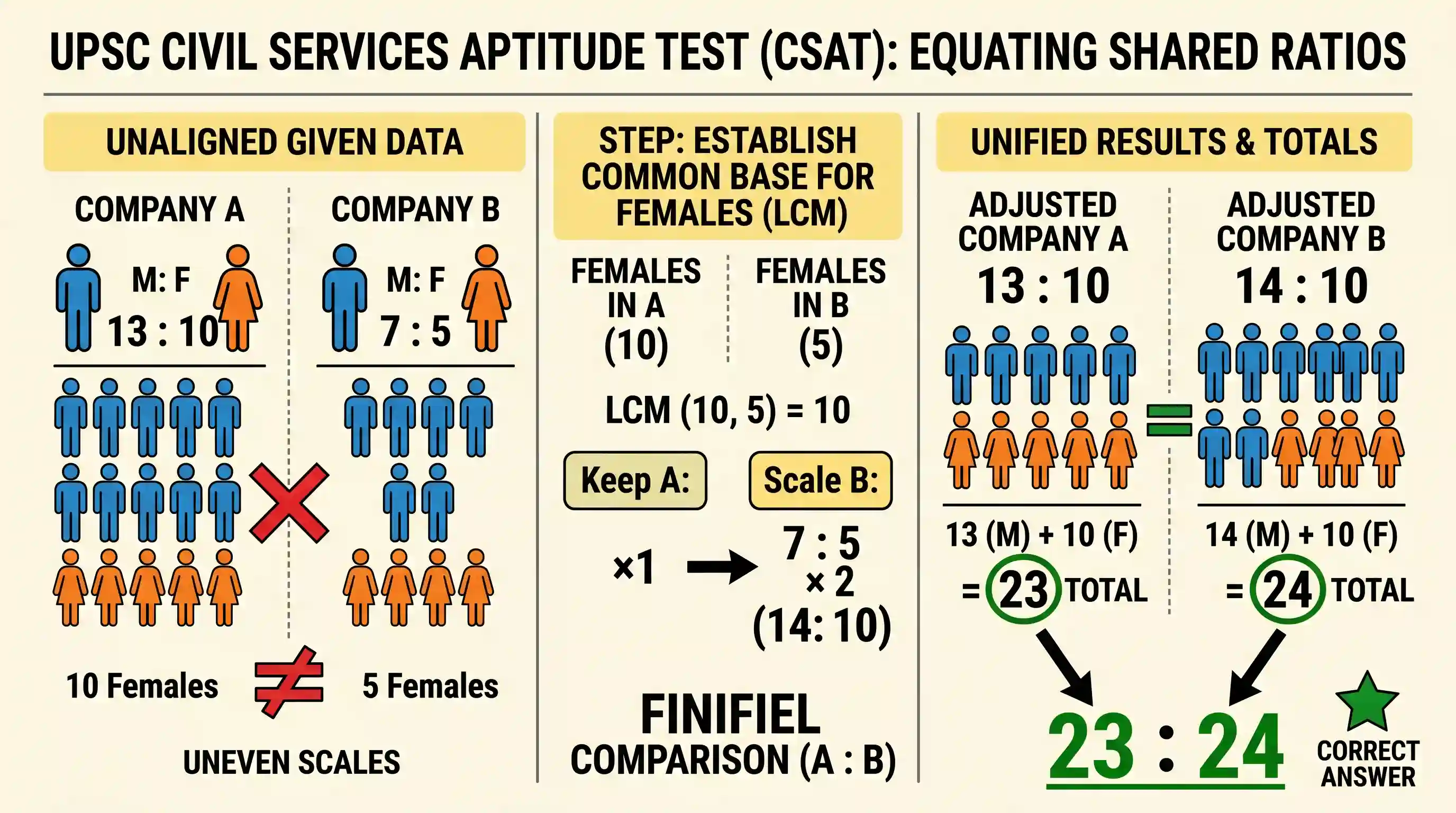
The core condition states that the absolute number of female workers in both companies is equal. To equate the female ratio components (10 and 5) across both companies, we must determine their Least Common Multiple (LCM), which is mathematically 10.
- Company A's ratio already uses 10 for females, so it remains unchanged at 13 : 10.
- Company B's ratio must be proportionately scaled. Multiplying both the antecedent (7) and consequent (5) by 2 yields a new equivalent ratio of 14 : 10.
Now that the units share a unified, comparable scale:
- Total workers in Company A = 13 (Males) + 10 (Females) = 23 units.
- Total workers in Company B = 14 (Males) + 10 (Females) = 24 units. Therefore, the ratio of the total number of workers in Company A to Company B is exactly 23 : 24.
Incorrect Options:
- Option A (24 : 23) is incorrect. This represents the inverse ratio (Total B : Total A), which acts as a common trap for candidates who calculate correctly but fail to align their final answer with the sequence requested in the prompt.
- Option C (18 : 17) is mathematically invalid. It serves as a distractor for those who erroneously manipulate the raw figures without first establishing a common baseline.
- Option D (27 : 18) is incorrect. It is a random distractor likely derived by arbitrarily adding the unadjusted numbers across the two equations.
Concluding Takeaway: When comparing separate mathematical ratios that share a common baseline entity, always establish a unified comparative scale by finding the LCM of that common entity before executing any additions or comparisons.
Related questions
More UPSC Prelims practice from the same subject and topic.
- Prelims 2026GS1other
Which of the following statements with regard to the Grand Slam Tennis Tournaments is/are correct ? 1. The tournaments have a shared governance structure establishing the partnership among the four Gr…
- Prelims 2026GS1other
Ms. X is a mid-level civil service official working in the urban development department of a major city. Recently, she was involved in approving a contract for a public infrastructure project — a new …
- Prelims 2026GS1other
Which one of the following pairs is not correctly matched? (Indian Army Corps) : (Headquarters)
- Prelims 2026CSATother
For ⅓ < x < y < 2, which of the following statements is/are always correct? I. x + 1/x < y + 1/y II. √(1 + y²)/y < √(1 + x²)/x Select the answer using the code given below.
- Prelims 2026CSATother
What is the minimum number of times one needs to measure to get 298 litres of water from a tank, if the measuring cylinders have capacities 1 litre, 6 litres, 25 litres and 100 litres?
- Prelims 2026CSATother
There are four types of weights, namely 1 kg, 2 kg, 5 kg and 10 kg. What is the maximum number of different ways one can measure 20 kg, if at least eight but not more than eleven weights of 1 kg are t…