A toy T jumps forward or backward. In each forward jump, it moves 5' forward whereas in each backward jump, it moves 2' backward. If in 31 jumps, T moves exactly 15' forward, then what is the difference of the number of forward and backward jumps?

- A6
- B7
- C8
- D9Correct
Explanation
Correct Option: D (9)
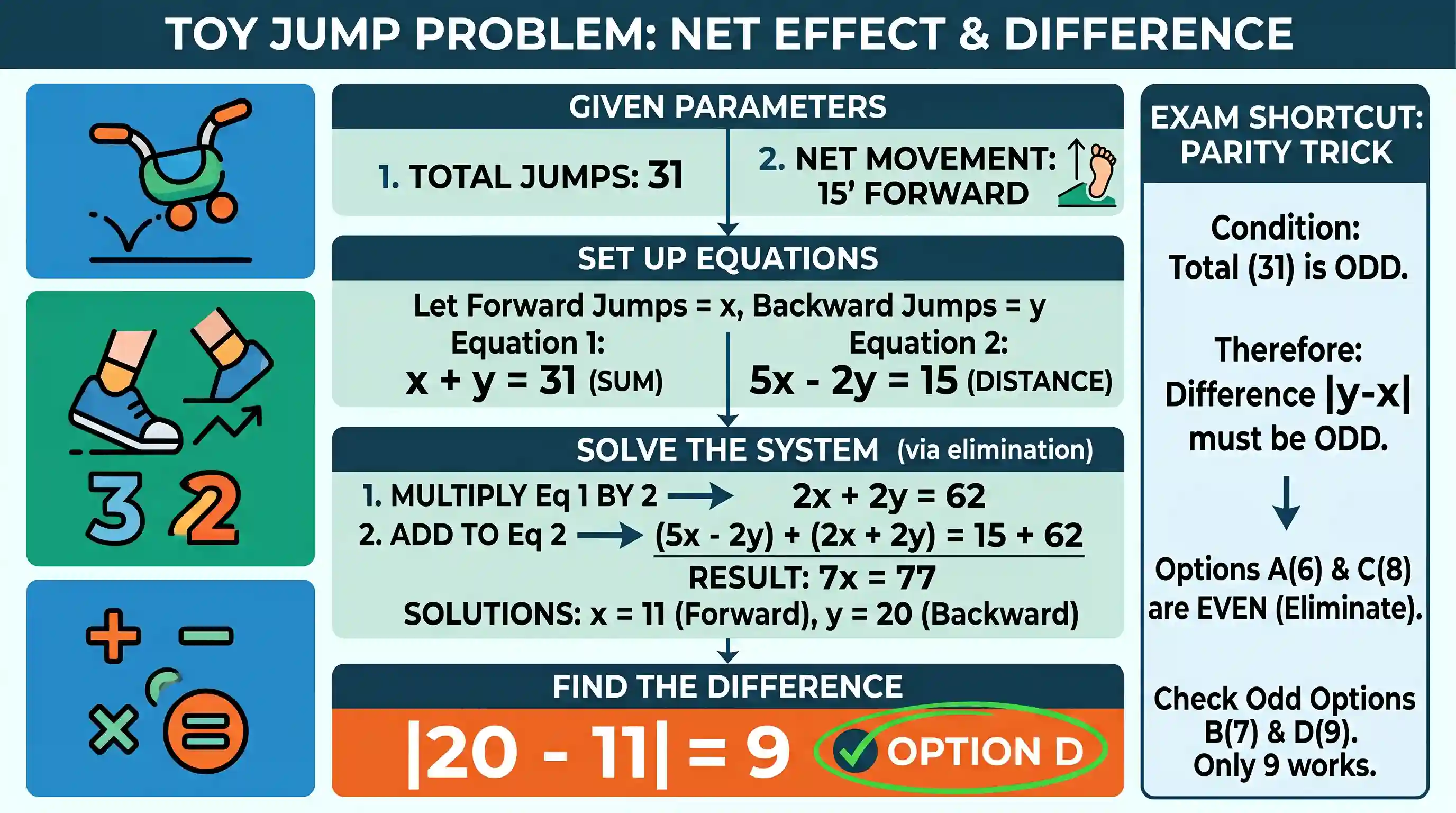
This problem evaluates an aspirant's proficiency in formulating and solving simultaneous linear equations, a fundamental topic in UPSC CSAT aptitude tests. Let the number of forward jumps be x and the number of backward jumps be y. Based on the problem's parameters, we can establish two mathematical conditions:
- The total number of jumps is 31: x + y = 31
- The net movement is exactly 15 feet forward. Since each forward jump yields +5 feet and each backward jump yields -2 feet: 5x - 2y = 15
To solve the system, multiply the first equation by 2, yielding 2x + 2y = 62. Adding this to the second equation eliminates y, resulting in 7x = 77, which gives x = 11. Substituting x = 11 back into the first equation provides y = 20. The question asks for the numerical difference between the number of forward and backward jumps: |20 - 11| = 9. Thus, Option D is rigorously proven to be correct.
Why incorrect options are wrong:
- Option A (6): Incorrect because if the difference were 6 (y - x = 6 and x + y = 31), solving it would yield 2y = 37, meaning y = 18.5. A fractional number of jumps is mathematically invalid here.
- Option B (7): Incorrect because if the difference were 7, solving y - x = 7 and x + y = 31 yields y = 19 and x = 12. The net movement would then be 5(12) - 2(19) = 60 - 38 = 22 feet, which contradicts the mandated 15 feet.
- Option C (8): Incorrect as an even difference (8) combined with an odd sum (31) again results in fractional jumps (2y = 39, so y = 19.5), violating the discrete integer nature of jumps.
Concluding Takeaway: For 'net effect' word problems, systematically translate the conditions into linear equations. A helpful shortcut is to verify the parity (odd/even nature) of sums and differences; countable entities like 'jumps' must result in integers, immediately eliminating options that produce fractions.
Related questions
More UPSC Prelims practice from the same subject and topic.
- Prelims 2026CSATother
There are four types of weights, namely 1 kg, 2 kg, 5 kg and 10 kg. What is the maximum number of different ways one can measure 20 kg, if at least eight but not more than eleven weights of 1 kg are t…
- Prelims 2026GS1other
Which of the following statements with regard to the Grand Slam Tennis Tournaments is/are correct ? 1. The tournaments have a shared governance structure establishing the partnership among the four Gr…
- Prelims 2026GS1other
Ms. X is a mid-level civil service official working in the urban development department of a major city. Recently, she was involved in approving a contract for a public infrastructure project — a new …
- Prelims 2026GS1other
Which one of the following pairs is not correctly matched? (Indian Army Corps) : (Headquarters)
- Prelims 2026CSATother
For ⅓ < x < y < 2, which of the following statements is/are always correct? I. x + 1/x < y + 1/y II. √(1 + y²)/y < √(1 + x²)/x Select the answer using the code given below.
- Prelims 2026CSATother
What is the minimum number of times one needs to measure to get 298 litres of water from a tank, if the measuring cylinders have capacities 1 litre, 6 litres, 25 litres and 100 litres?