X travels 6 km on a bicycle with average speeds of 5 km per hour, 10 km per hour and 4 km per hour during the first 1 km, the next 2 km and the remaining 3 km, respectively. Y travels the same distances with average speeds of 4 km per hour, 10 km per hour and 5 km per hour, respectively. How many minutes early will Y complete the journey if both X and Y start at the same time?

- A3
- B4
- C5
- D6Correct
Explanation
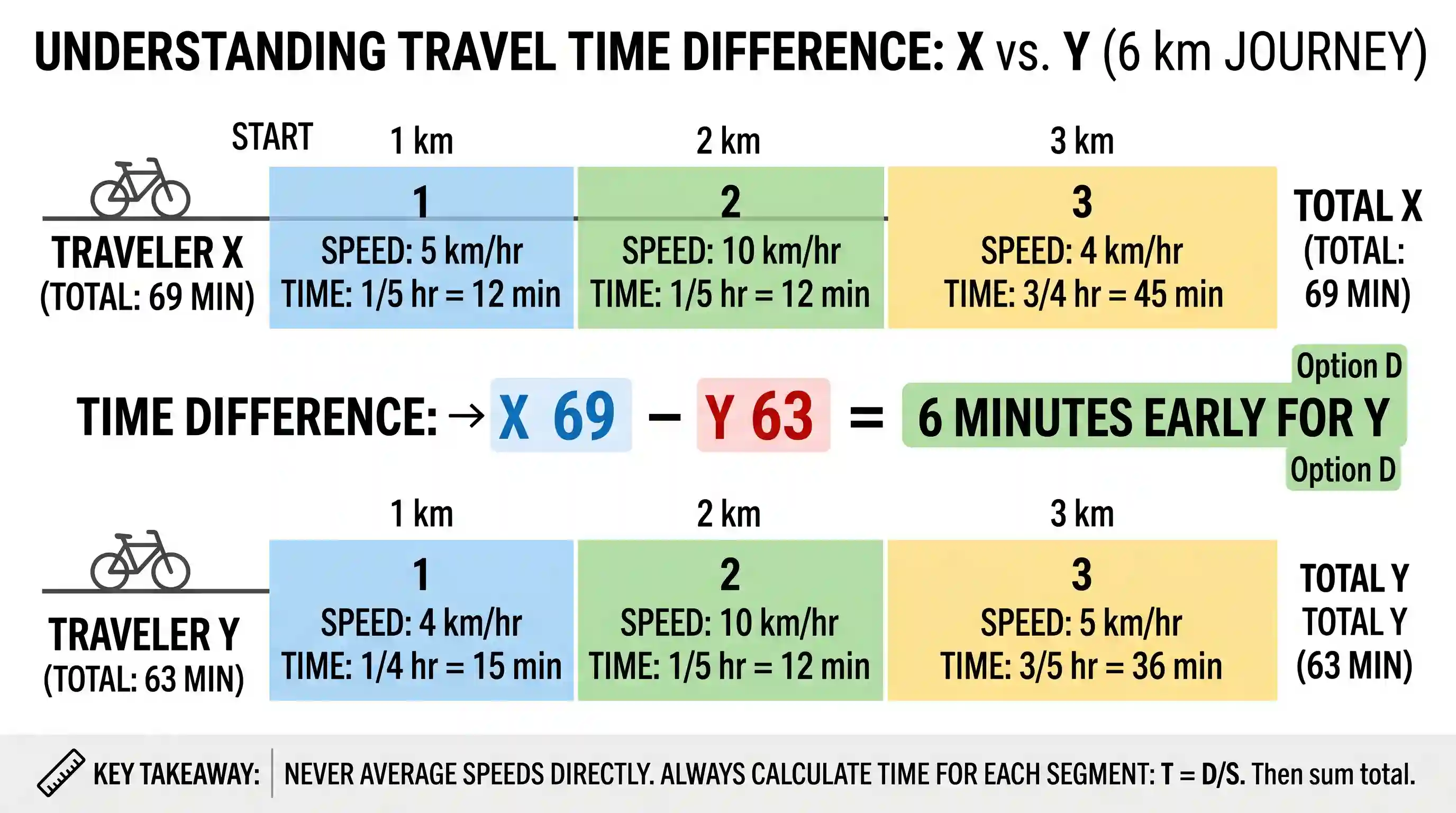
The fundamental principle to solve this problem relies on the kinematic equation: Time = Distance ÷ Speed. To find the total time taken by each individual, we must calculate the time taken for each distinct segment of the journey independently and sum them up.
Calculations for X:
- First 1 km at 5 km/hr: Time = 1/5 hour
- Next 2 km at 10 km/hr: Time = 2/10 = 1/5 hour
- Remaining 3 km at 4 km/hr: Time = 3/4 hour Total Time for X = 1/5 + 1/5 + 3/4 = 2/5 + 3/4 = (8 + 15) / 20 = 23/20 hours. To convert this into minutes: (23/20) × 60 = 69 minutes.
Calculations for Y:
- First 1 km at 4 km/hr: Time = 1/4 hour
- Next 2 km at 10 km/hr: Time = 2/10 = 1/5 hour
- Remaining 3 km at 5 km/hr: Time = 3/5 hour Total Time for Y = 1/4 + 1/5 + 3/5 = 1/4 + 4/5 = (5 + 16) / 20 = 21/20 hours. To convert this into minutes: (21/20) × 60 = 63 minutes.
Conclusion: The difference in time taken is 69 minutes - 63 minutes = 6 minutes. Since Y takes less time, Y completes the journey 6 minutes early, making Option D the correct answer.
- Option A (3) is incorrect. This is a common distractor resulting from the erroneous mathematical practice of averaging the raw speeds without accounting for unequal distances.
- Option B (4) is incorrect. This arises if an aspirant misallocates the distances to the wrong speed denominators during calculation.
- Option C (5) is incorrect. This typically results from simple arithmetic errors when calculating the lowest common multiple (LCM) of the fractions.
Takeaway: Never average speeds directly when distances vary. Always calculate the specific time for each segment independently using T = D/S before finding the total sum.
Related questions
More UPSC Prelims practice from the same subject and topic.
- Prelims 2026CSATother
X and Y are two runners who run for the same duration of time on the same circular track. They started running at the same time in the same direction with uniform speeds. When X completed 7 rounds, Y …
- Prelims 2026CSATother
A train has to complete a journey of 800 km. If it meets a minor accident, its speed becomes half of the existing speed. If there is a mechanical defect, the speed becomes one-fourth of the existing s…
- Prelims 2026GS1other
Which of the following statements with regard to the Grand Slam Tennis Tournaments is/are correct ? 1. The tournaments have a shared governance structure establishing the partnership among the four Gr…
- Prelims 2026GS1other
Ms. X is a mid-level civil service official working in the urban development department of a major city. Recently, she was involved in approving a contract for a public infrastructure project — a new …
- Prelims 2026GS1other
Which one of the following pairs is not correctly matched? (Indian Army Corps) : (Headquarters)
- Prelims 2026CSATother
For ⅓ < x < y < 2, which of the following statements is/are always correct? I. x + 1/x < y + 1/y II. √(1 + y²)/y < √(1 + x²)/x Select the answer using the code given below.