A train has to complete a journey of 800 km. If it meets a minor accident, its speed becomes half of the existing speed. If there is a mechanical defect, the speed becomes one-fourth of the existing speed. On its way, the train meets with a minor accident after 200 km; and 400 km thereafter, it develops a mechanical defect. Had the train developed the mechanical defect after 200 km and met the minor accident 400 km thereafter, it would have taken 4 more hours to reach its destination. What was the original speed of the train in km per hour?

- A200Correct
- B190
- C150
- D100
Explanation
Correct Answer: Option A (200)
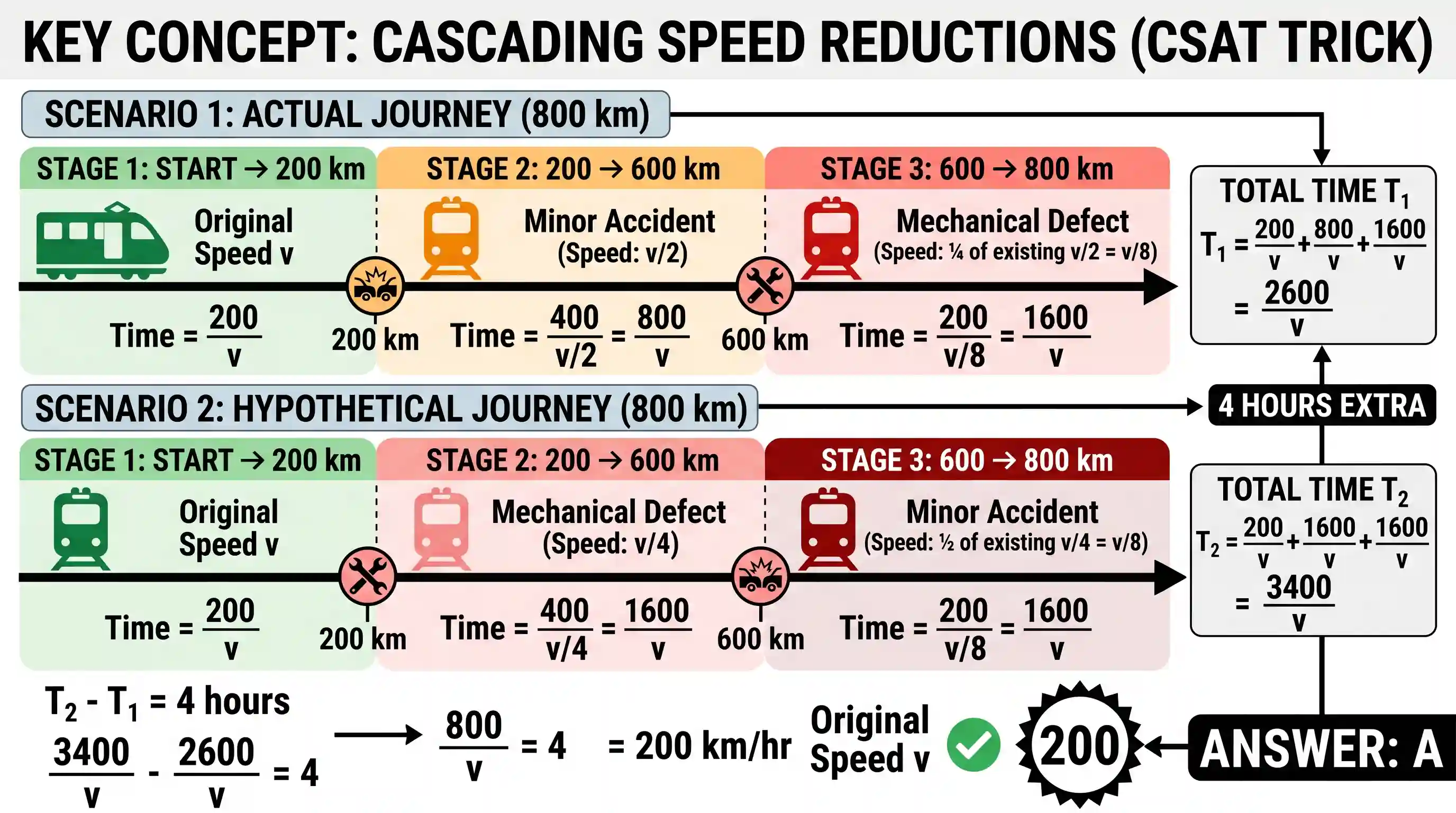
To solve this UPSC CSAT Time, Speed, and Distance problem, we must carefully interpret the phrase "existing speed," which dictates a cascading effect on the train's velocity rather than a standard reduction from the initial speed.
Let the original speed be v km/hr. The total distance is 800 km.
Scenario 1:
- First 200 km at speed v: Time = 200/v
- Next 400 km after a minor accident (speed becomes v/2): Time = 400/(v/2) = 800/v
- Remaining 200 km after a mechanical defect (speed becomes ¼ of the existing v/2, i.e., v/8): Time = 200/(v/8) = 1600/v
- Total Time T₁ = 200/v + 800/v + 1600/v = 2600/v
Scenario 2:
- First 200 km at speed v: Time = 200/v
- Next 400 km after mechanical defect (speed becomes v/4): Time = 400/(v/4) = 1600/v
- Remaining 200 km after minor accident (speed becomes ½ of the existing v/4, i.e., v/8): Time = 200/(v/8) = 1600/v
- Total Time T₂ = 200/v + 1600/v + 1600/v = 3400/v
We are given that Scenario 2 takes 4 hours longer (T₂ - T₁ = 4). 3400/v - 2600/v = 4 ⟹ 800/v = 4 ⟹ v = 200 km/hr.
Why other options are incorrect:
- Option B (190) & Option C (150): Mathematically incorrect; substituting these into the derived equation 800/v yields 4.21 hours and 5.33 hours respectively, not 4.
- Option D (100): This is a deliberate distractor. Aspirants arrive at 100 km/hr if they incorrectly assume the "existing speed" always refers to the initial starting speed v, which incorrectly sets up the equation as 400/v = 4.
Takeaway: In Quantitative Aptitude problems involving sequential events, modifiers like "existing" or "remaining" require cascaded calculations (compounding fractional changes) rather than applying deductions to the initial base value.
Related questions
More UPSC Prelims practice from the same subject and topic.
- Prelims 2026CSATother
X and Y are two runners who run for the same duration of time on the same circular track. They started running at the same time in the same direction with uniform speeds. When X completed 7 rounds, Y …
- Prelims 2026CSATother
X travels 6 km on a bicycle with average speeds of 5 km per hour, 10 km per hour and 4 km per hour during the first 1 km, the next 2 km and the remaining 3 km, respectively. Y travels the same distanc…
- Prelims 2026GS1other
Which of the following statements with regard to the Grand Slam Tennis Tournaments is/are correct ? 1. The tournaments have a shared governance structure establishing the partnership among the four Gr…
- Prelims 2026GS1other
Ms. X is a mid-level civil service official working in the urban development department of a major city. Recently, she was involved in approving a contract for a public infrastructure project — a new …
- Prelims 2026GS1other
Which one of the following pairs is not correctly matched? (Indian Army Corps) : (Headquarters)
- Prelims 2026CSATother
For ⅓ < x < y < 2, which of the following statements is/are always correct? I. x + 1/x < y + 1/y II. √(1 + y²)/y < √(1 + x²)/x Select the answer using the code given below.