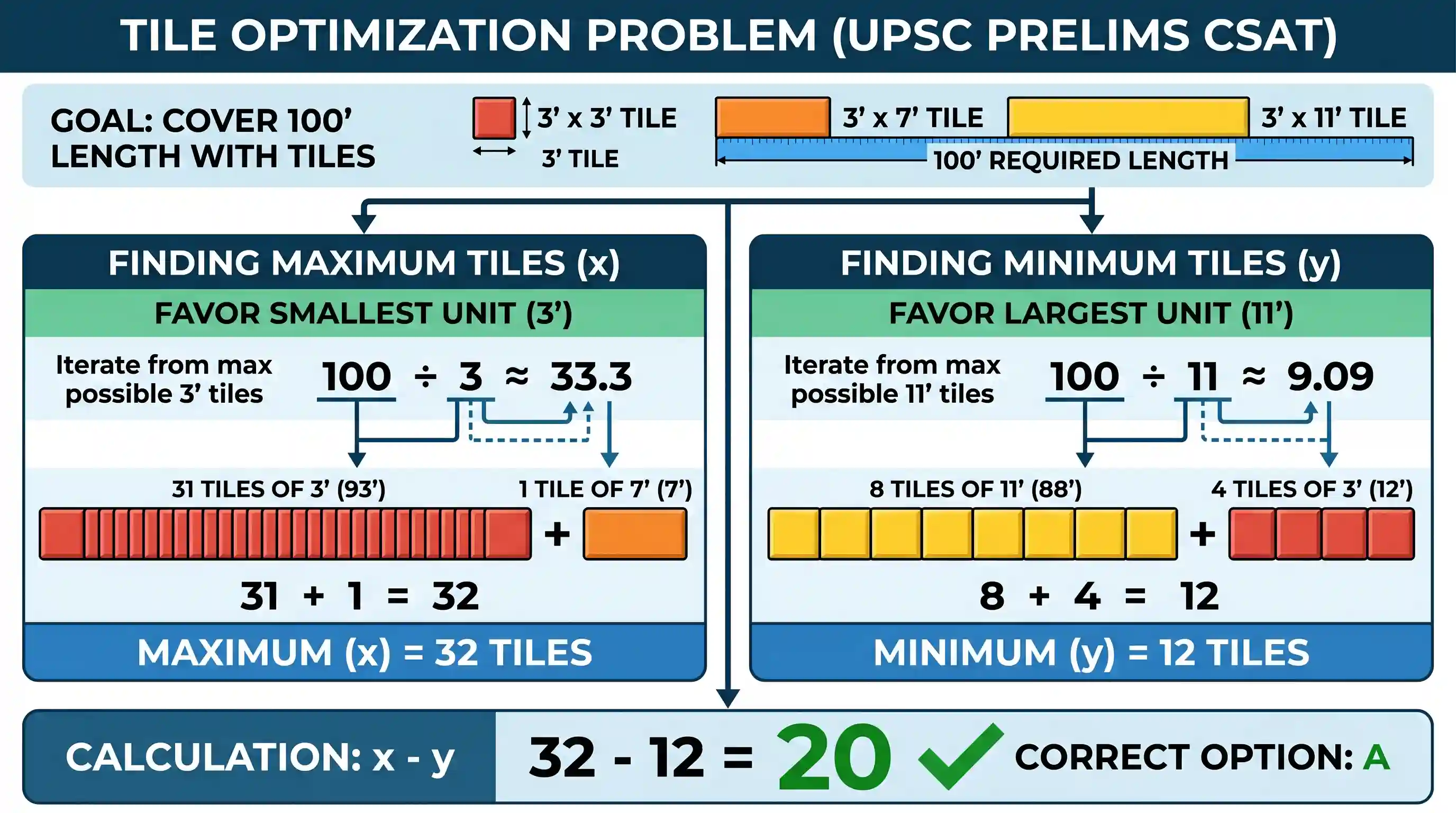
There are three types of rectangular tiles : 3' × 3', 3' × 7' and 3' × 11'. An area of rectangular shape of dimensions 3' × 100' is to be covered using these tiles without breaking them. If x and y are the maximum and minimum numbers of tiles of various sizes, respectively, that can be used to cover the area exactly, then x - y is

- A20Correct
- B12
- C10
- D7
Explanation
Since the width of the area and all tile types is a uniform 3', this problem simplifies to a one-dimensional linear Diophantine equation. We need to find non-negative integers a, b, and c representing the number of 3', 7', and 11' length tiles such that their sum equals the 100' length:
3a + 7b + 11c = 100
Finding the Maximum (x): To maximize the total number of tiles, we must use the smallest tile (3') as much as possible.
- Max possible a is 100 / 3 = 33 (remainder 1, which cannot be filled by 7' or 11' tiles).
- Try a = 32: sum is 96, remainder is 4 (cannot be filled).
- Try a = 31: sum is 93, remainder is 7. This is exactly covered by one 7' tile (b = 1, c = 0).
- Therefore, the maximum number of tiles is x = 31 + 1 + 0 = 32 tiles.
Finding the Minimum (y): To minimize the total number of tiles, we maximize the use of the largest tile (11').
- Max possible c is 100 / 11 = 9 (remainder 1, cannot be filled).
- Try c = 8: sum is 88, remainder is 12. This is exactly covered by four 3' tiles (a = 4, b = 0).
- Therefore, the minimum number of tiles is y = 4 + 0 + 8 = 12 tiles.
Finally, the requested difference is x - y = 32 - 12 = 20.
Why the other options are incorrect:
- Option B (12): This is incorrect because 12 is the minimum number of tiles (y) itself, rather than the difference x - y.
- Option C (10): This is incorrect and would only result from arithmetic errors, such as mistakenly finding a sub-optimal maximum of 22 tiles (22 - 12 = 10).
- Option D (7): This is incorrect; it is a distractor likely stemming from falsely assuming a different combination constraint or incorrectly subtracting the tile lengths rather than tile counts.
Takeaway: In optimization problems involving lengths or denominations (like the Coin Change problem), apply a Greedy Approach. Maximize the count by favoring the smallest unit, and minimize the count by favoring the largest unit, stepping back iteratively until the remainder is perfectly satisfied.
Related questions
More UPSC Prelims practice from the same subject and topic.
- Prelims 2026GS1other
Which of the following statements with regard to the Grand Slam Tennis Tournaments is/are correct ? 1. The tournaments have a shared governance structure establishing the partnership among the four Gr…
- Prelims 2026GS1other
Ms. X is a mid-level civil service official working in the urban development department of a major city. Recently, she was involved in approving a contract for a public infrastructure project — a new …
- Prelims 2026GS1other
Which one of the following pairs is not correctly matched? (Indian Army Corps) : (Headquarters)
- Prelims 2026CSATother
For ⅓ < x < y < 2, which of the following statements is/are always correct? I. x + 1/x < y + 1/y II. √(1 + y²)/y < √(1 + x²)/x Select the answer using the code given below.
- Prelims 2026CSATother
What is the minimum number of times one needs to measure to get 298 litres of water from a tank, if the measuring cylinders have capacities 1 litre, 6 litres, 25 litres and 100 litres?
- Prelims 2026CSATother
There are four types of weights, namely 1 kg, 2 kg, 5 kg and 10 kg. What is the maximum number of different ways one can measure 20 kg, if at least eight but not more than eleven weights of 1 kg are t…