In a recruitment process, the selection of candidates is based on their performance in three components. The weightages of the components 1, 2 and 3 are 0.2, 0.3 and 0.5, respectively. Use the data given below and find the cutoff score if exactly three candidates are to be selected : | Candidate | Score in component 1 | Score in component 2 | Score in component 3 | | :---: | :---: | :---: | :---: | | 1 | 5 | 4 | 6 | | 2 | 4 | 6 | 5 | | 3 | 3 | 2 | 8 | | 4 | 9 | 4 | 3 | | 5 | 8 | 8 | 2 |

- A5.1Correct
- B5.2
- C5.3
- D5.4
Explanation
To find the cutoff score, we must first calculate the weighted average score for each candidate using the given weightages for components 1, 2, and 3 (0.2, 0.3, and 0.5, respectively).
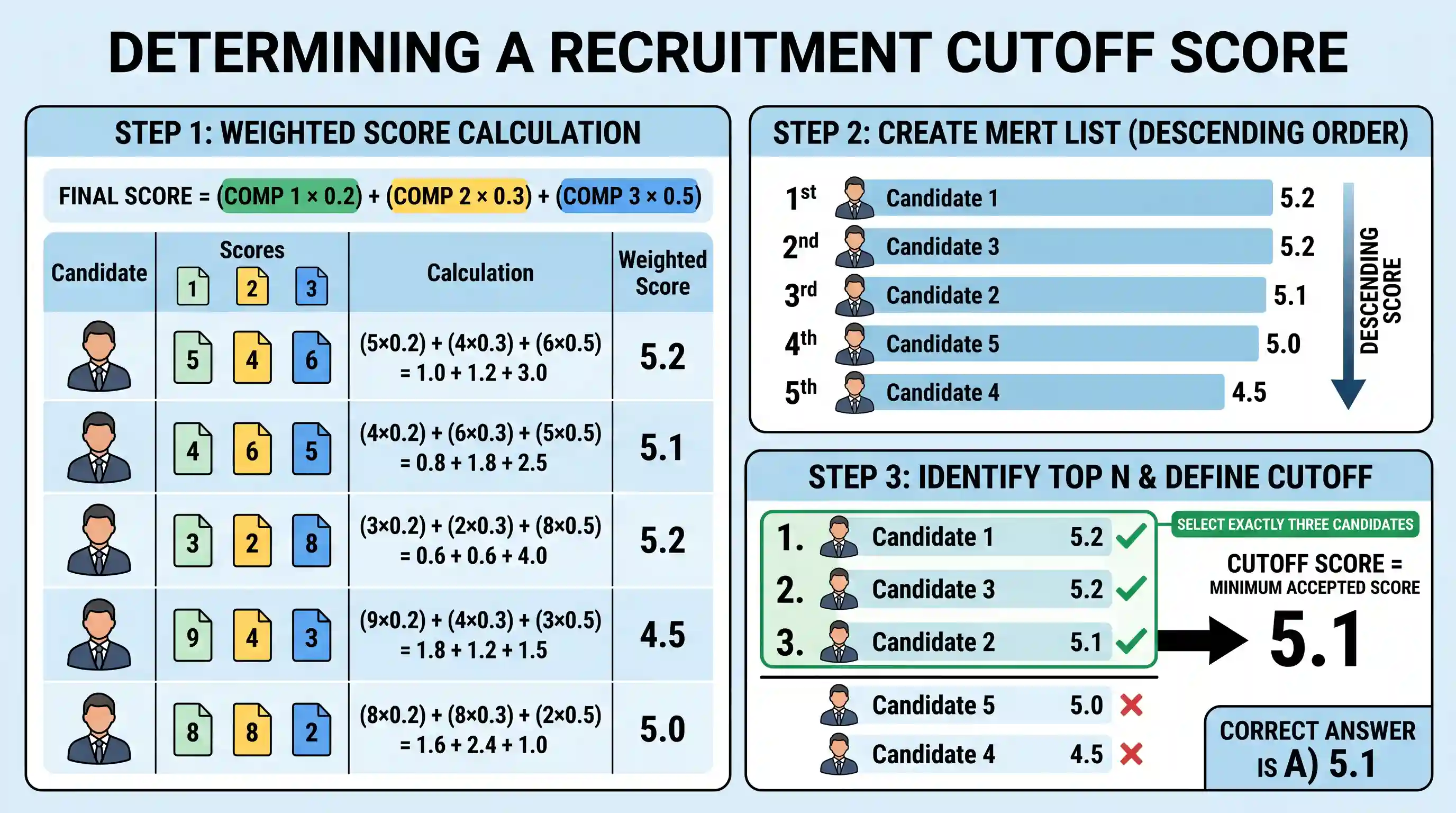
The formula for a candidate's final score is: Final Score = (Component 1 × 0.2) + (Component 2 × 0.3) + (Component 3 × 0.5)
Calculating the final score for each candidate yields the following results:
- Candidate 1: (5 × 0.2) + (4 × 0.3) + (6 × 0.5) = 1.0 + 1.2 + 3.0 = 5.2
- Candidate 2: (4 × 0.2) + (6 × 0.3) + (5 × 0.5) = 0.8 + 1.8 + 2.5 = 5.1
- Candidate 3: (3 × 0.2) + (2 × 0.3) + (8 × 0.5) = 0.6 + 0.6 + 4.0 = 5.2
- Candidate 4: (9 × 0.2) + (4 × 0.3) + (3 × 0.5) = 1.8 + 1.2 + 1.5 = 4.5
- Candidate 5: (8 × 0.2) + (8 × 0.3) + (2 × 0.5) = 1.6 + 2.4 + 1.0 = 5.0
Arranging the scores in descending order, we get: 5.2 (Candidate 1), 5.2 (Candidate 3), 5.1 (Candidate 2), 5.0 (Candidate 5), and 4.5 (Candidate 4). Since exactly three candidates are to be selected, the top three scorers (Candidates 1, 3, and 2) will be chosen. The cutoff score is mathematically defined as the minimum score required to be among the selected candidates. Here, the lowest score among the top three is 5.1. Therefore, Option A is correct.
- Option B (5.2) is incorrect because setting the cutoff at 5.2 would only qualify two candidates (1 and 3) instead of the exactly three required.
- Option C (5.3) is incorrect because this score is mathematically higher than the maximum score achieved by any candidate (5.2), meaning no one would be selected.
- Option D (5.4) is similarly incorrect; it is an arbitrary distractor value that exceeds the highest achieved score.
Takeaway: In competitive selection processes, calculating a 'cutoff' score to select N candidates requires computing the precise weighted averages, ranking them in descending order, and identifying the N-th highest score on the merit list.
Related questions
More UPSC Prelims practice from the same subject and topic.
- Prelims 2026CSATother
What is the minimum number of times one needs to measure to get 298 litres of water from a tank, if the measuring cylinders have capacities 1 litre, 6 litres, 25 litres and 100 litres?
- Prelims 2026CSATother
Three variables x, y and z take values 2, 3, 4 or 5 such that their values are always distinct. If M and N denote the largest possible value and the smallest possible value, respectively, for the expr…
- Prelims 2026CSATother
Suppose x, y and z are variables taking positive real numbers as their possible values. It is given that y is directly proportional to x² and x is inversely proportional to z. For z = 7/25, the values…
- Prelims 2026CSATother
In an objective type question paper, 5 marks are awarded for a correct answer and 2 marks are deducted for a wrong answer. A student attempted all the questions and got a score of 69. Had he been awar…
- Prelims 2026CSATother
The digit in the unit place of the number 6¹²⁹ × 7³⁰⁷ is
- Prelims 2026CSATother
An alloy P contains 20% copper and 80% zinc by weight. Another alloy Q contains 60% copper and 40% zinc by weight. A third alloy R is to be prepared from P and Q so that it contains equal amount of co…