Three variables x, y and z take values 2, 3, 4 or 5 such that their values are always distinct. If M and N denote the largest possible value and the smallest possible value, respectively, for the expression {(x × y) + z}; then M - N is

- A11
- B12
- C13Correct
- D14
Explanation
Correct Option: (C) 13
This question tests the arithmetic principles of combinatorial optimization, specifically maximizing and minimizing algebraic expressions. It aligns perfectly with the quantitative aptitude framework standard to the UPSC Civil Services Aptitude Test (CSAT).
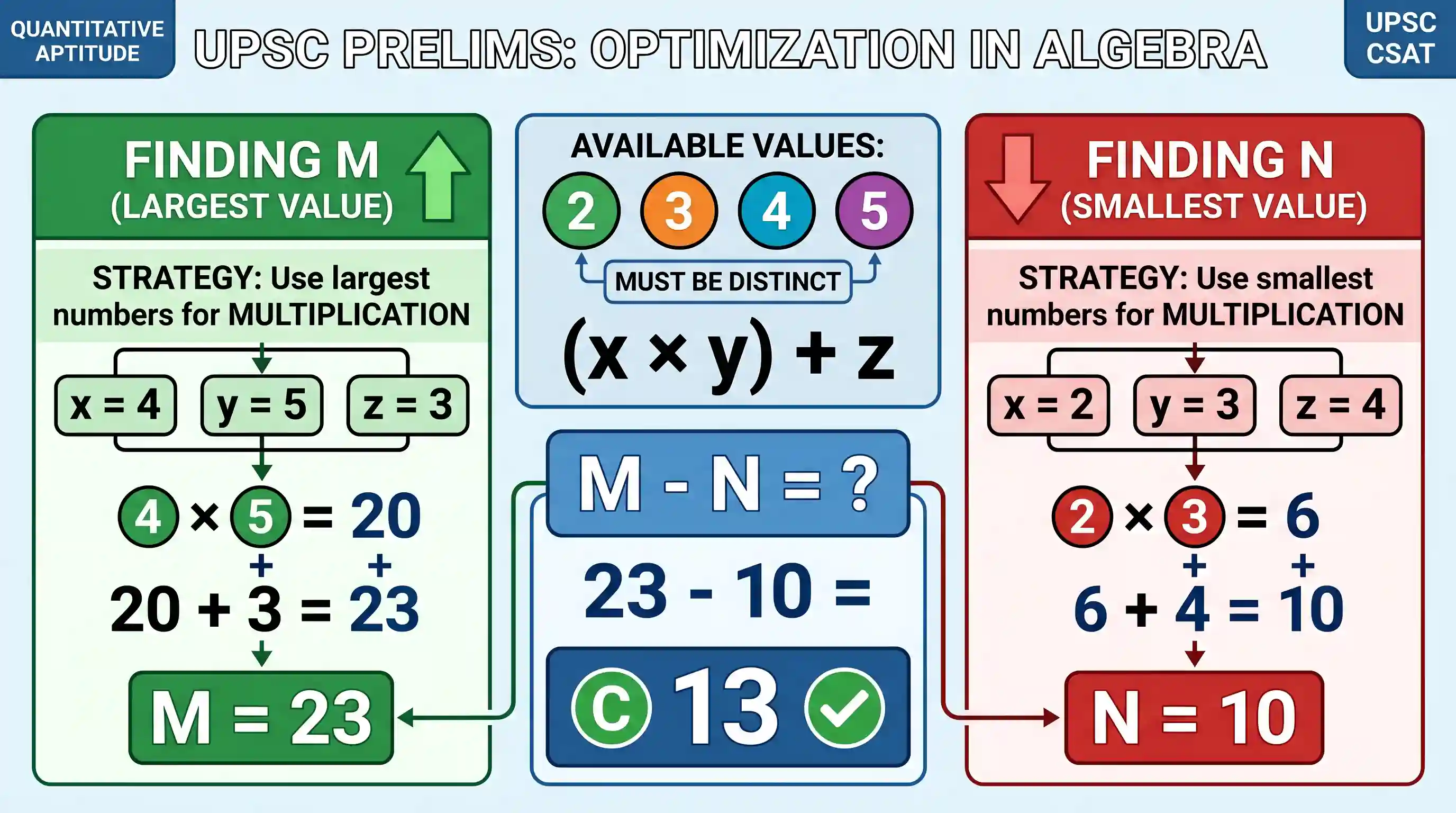
To evaluate the expression E = (x × y) + z using distinct values from the set {2, 3, 4, 5}, we must systematically find the maximum (M) and minimum (N) possible values.
Finding the Largest Value (M): To maximize a sum containing a product, assign the largest available integers to the multiplicands. The largest numbers in our set are 4 and 5. Let x = 4 and y = 5, giving x × y = 20. The remaining values for z are {2, 3}. To maximize the overall expression, we select the largest remaining value, z = 3. Thus, M = 20 + 3 = 23.
Finding the Smallest Value (N): Conversely, to minimize the expression, assign the smallest available integers to the multiplicands. The smallest numbers in the set are 2 and 3. Let x = 2 and y = 3, giving x × y = 6. The remaining values for z are {4, 5}. To minimize the total sum, we pick the smallest remaining value, z = 4. Thus, N = 6 + 4 = 10.
Calculating the difference: M - N = 23 - 10 = 13. Option C is correct.
Why the other options are incorrect:
- Option A (11): Incorrect. This typically results from a simple arithmetic error during subtraction or a failure to correctly identify the true upper or lower bounding values.
- Option B (12): Incorrect. This occurs if an aspirant incorrectly calculates N = 11 by misassigning variables (x=2, y=4 ⇒ 8 + 3 = 11), leading to 23 - 11 = 12.
- Option D (14): Incorrect. This stems from calculating N = 9 by violating the "always distinct" constraint and reusing the number 3 (2 × 3 + 3 = 9), resulting in 23 - 9 = 14.
Takeaway: In optimization problems involving sums and products, multiplication scales faster than addition. Always assign extreme values (largest or smallest) to the multiplied variables first to accurately establish your limits.
Related questions
More UPSC Prelims practice from the same subject and topic.
- Prelims 2026CSATother
What is the minimum number of times one needs to measure to get 298 litres of water from a tank, if the measuring cylinders have capacities 1 litre, 6 litres, 25 litres and 100 litres?
- Prelims 2026CSATother
Suppose x, y and z are variables taking positive real numbers as their possible values. It is given that y is directly proportional to x² and x is inversely proportional to z. For z = 7/25, the values…
- Prelims 2026CSATother
In an objective type question paper, 5 marks are awarded for a correct answer and 2 marks are deducted for a wrong answer. A student attempted all the questions and got a score of 69. Had he been awar…
- Prelims 2026CSATother
The digit in the unit place of the number 6¹²⁹ × 7³⁰⁷ is
- Prelims 2026CSATother
An alloy P contains 20% copper and 80% zinc by weight. Another alloy Q contains 60% copper and 40% zinc by weight. A third alloy R is to be prepared from P and Q so that it contains equal amount of co…
- Prelims 2026CSATother
In a recruitment process, the selection of candidates is based on their performance in three components. The weightages of the components 1, 2 and 3 are 0.2, 0.3 and 0.5, respectively. Use the data gi…