Passage: HMPV causes milder illness with deaths being very rare and with no long-term post-viral symptoms. Question: Which of the following statements reflect the logical and rational inferences that can be drawn from the passage? 1. HMPV has, historically, had longer documentation of studies when compared with SARS-CoV-2. 2. The two viruses are different from each other and this results in markedly different outcomes amongst those affected. 3. Long-term impacts of the two viruses are dissimilar and this is an important differentiator between them. 4. One of the common factors between the two viruses is seasonal specificity. Select the answer using the code given below.

- A1 and 2 only
- B1, 2 and 3Correct
- C3 and 4
- D1 and 3 only
Explanation
The correct answer is Option B (1, 2, and 3 only).
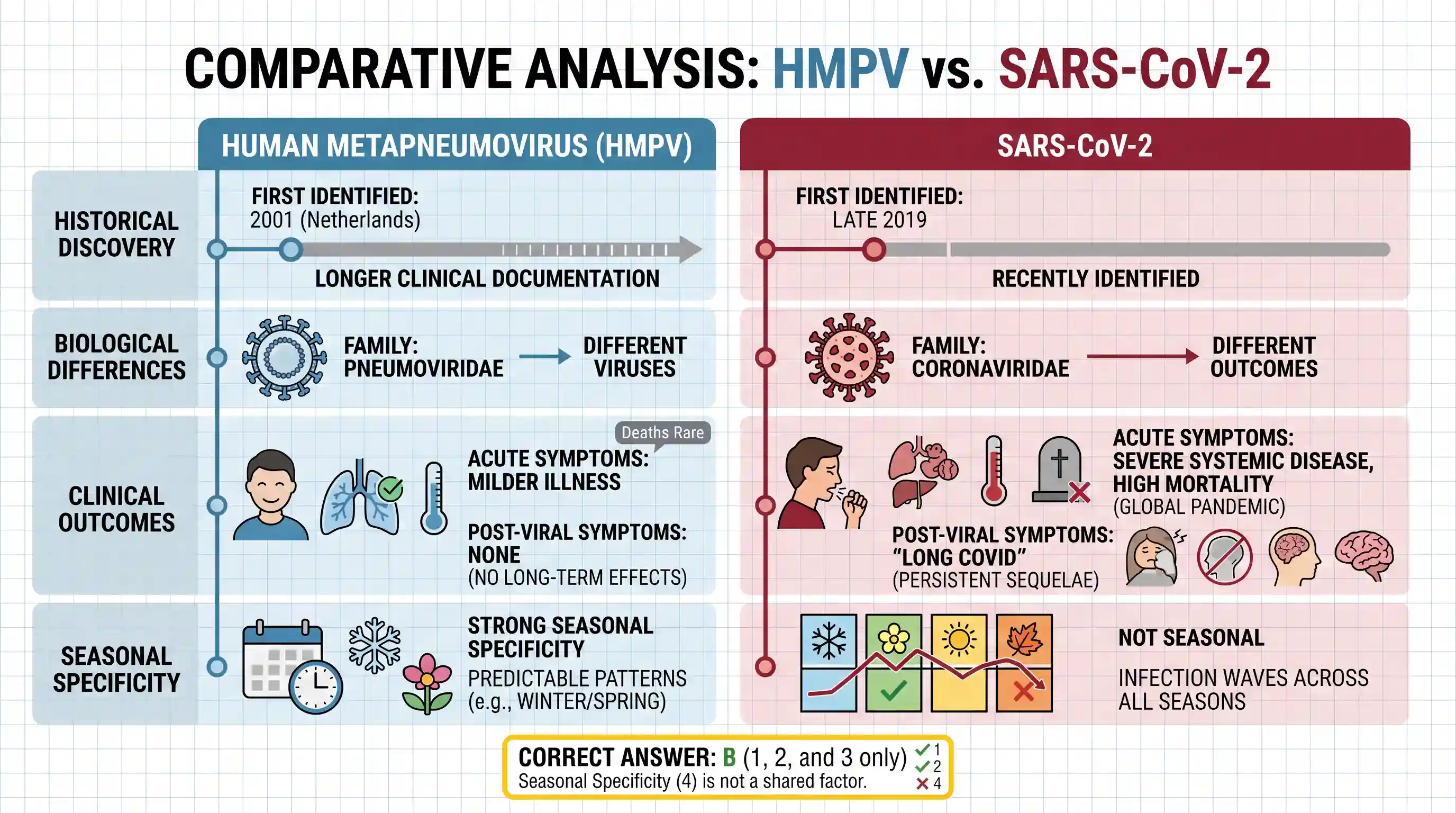
Statement 1 is a logical inference: Human Metapneumovirus (HMPV) was first identified in 2001 by researchers in the Netherlands. In contrast, SARS-CoV-2, the pathogen responsible for the COVID-19 pandemic, was first identified in late 2019. Therefore, HMPV historically possesses a significantly longer timeline of clinical documentation.
Statement 2 is a logical inference: The two viruses belong to entirely different taxonomic families; HMPV is from the Pneumoviridae family, whereas SARS-CoV-2 belongs to the Coronaviridae family. This fundamental biological difference yields markedly different clinical outcomes. As the passage notes, HMPV primarily causes milder respiratory illness with rare fatalities, whereas SARS-CoV-2 has caused a global pandemic with high mortality and severe systemic complications.
Statement 3 is a logical inference: The passage explicitly highlights that HMPV results in "no long-term post-viral symptoms". This serves as a major differentiator from SARS-CoV-2, which is widely documented to cause long-lasting post-viral sequelae commonly known as "Long COVID."
Statement 4 is incorrect: While HMPV displays strong seasonal specificity—typically peaking during winter and early spring in predictable patterns—SARS-CoV-2 has continuously driven major infection waves across all seasons regardless of the time of year. Thus, seasonal specificity is not a shared characteristic.
Takeaway: When analyzing comparative epidemiological passages, understanding pathogen taxonomy (e.g., Pneumoviridae vs. Coronaviridae), historical discovery timelines (2001 vs. 2019), and post-viral sequelae helps in accurately inferring biological differences.
Related questions
More UPSC Prelims practice from the same subject and topic.
- Prelims 2026GS1science-technology
Which of the following statements about DHRUV64 is/are correct? 1. It is the third chip fabricated under the DIR-V Programme with an overall aim to enable the creation of microprocessors for India. 2.…
- Prelims 2026GS1science-technology
'X', born in the UK, was conferred the Nobel Prize in 2025. He was a professor in an American university when this prize was announced. Identify 'X':
- Prelims 2026GS1science-technology
Which one of the following pairs of semiconductor plants in India and their locations is not correctly matched ?
- Prelims 2026GS1science-technology
Which of the following statements with regard to India's indigenous new high resolution weather model, the 'Bharat Forecast System,' is/are correct? 1. Its objective is to generate forecasts at the Pa…
- Prelims 2026GS1science-technology
Which of the following statements regarding the features of blockchain technology are correct? 1. Records stored in the database may be made visible to relevant stakeholders without risk of alteration…
- Prelims 2026GS1science-technology
Which of the following statements with regard to genetic medicine is/are correct ? 1. Genetic medicines correct/compensate for the faulty genes responsible for disease. 2. Engineered viruses and lipid…