Passage: HMPV causes milder illness with deaths being very rare and with no long-term post-viral symptoms. Question: Which of the following reflect the intent of the writer in the above passage? 1. To evolve methodologies for objective analysis of the two viruses 2. To establish the epidemiological similarities and differences between the two viruses 3. To offer a better understanding of the remedies of HMPV when analysed in conjunction with SARS-CoV-2 Select the answer using the code given below.

- A1 and 2
- B2 and 3
- C1 and 3
- DNone of the aboveCorrect
Explanation
Correct Answer: D (None of the above)
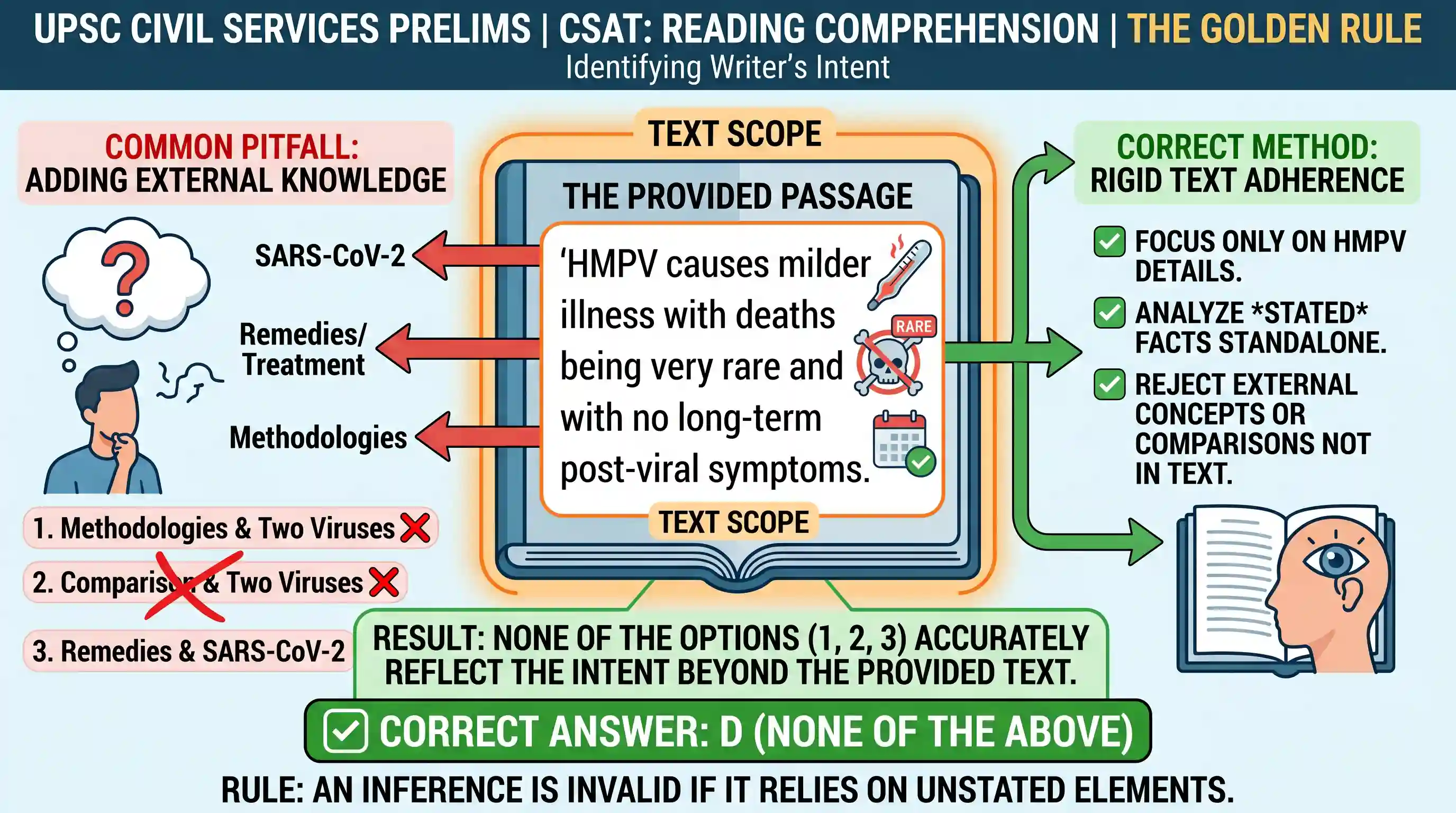
Why the correct option is correct: In UPSC Reading Comprehension, identifying the writer's intent must be based strictly on the provided passage. The passage states a single, standalone fact: Human Metapneumovirus (HMPV) causes mild illness, rarely leads to death, and lacks long-term post-viral symptoms. Because the text explicitly focuses only on HMPV, any statement introducing a comparison with a second virus falls outside the scope of the text. Thus, none of the given statements accurately reflect the writer's intent in the provided passage.
Why the other statements are incorrect:
- Statement 1 is incorrect: The passage does not outline any "methodologies" or "objective analysis," nor does it mention "two viruses."
- Statement 2 is incorrect: Establishing epidemiological similarities and differences requires a comparative analysis of at least two viruses. The passage describes the clinical characteristics of HMPV alone.
- Statement 3 is incorrect: The passage mentions neither "remedies" (treatments) nor "SARS-CoV-2" (the virus causing COVID-19). While real-world medical discussions often contrast HMPV's lack of post-viral symptoms with "Long COVID," the text itself does not supply this comparative context.
Factual Context: Human Metapneumovirus (HMPV) is a respiratory pathogen discovered in 2001 that belongs to the Pneumoviridae family. While it often causes mild upper respiratory tract infections similar to a common cold, it can be more severe in infants, immunocompromised individuals, and the elderly.
Concluding Takeaway: Golden Rule of CSAT RC: When a question asks for the intent, assumption, or corollary of a passage, entirely discard external knowledge. If an entity (like SARS-CoV-2) is not mentioned in the text, options relying on it are automatically incorrect.
Related questions
More UPSC Prelims practice from the same subject and topic.
- Prelims 2026CSATother
Passage: India is starting to deploy AI for critical use cases such as weather forecasting, pest detection and control, and crop yield optimisation. However, penetration is limited to a small subset o…
- Prelims 2026CSATother
Passage: India is starting to deploy AI for critical use cases such as weather forecasting, pest detection and control, and crop yield optimisation. However, penetration is limited to a small subset o…
- Prelims 2026CSATother
Passage: Previous waves of customer-service technology, including email and those pesky voice menus, stoked concerns of job losses, only for them to fail to materialise. AI could yet prove different. …
- Prelims 2026CSATother
Passage: Cattle from the nearby villages came to the common ground to graze, and there was still a cool freshness in the air. Hori took several deep breaths and thought of sitting down for a while, si…
- Prelims 2026CSATother
Passage: Cattle from the nearby villages came to the common ground to graze, and there was still a cool freshness in the air. Hori took several deep breaths and thought of sitting down for a while, si…
- Prelims 2026CSATother
Passage: Was it the sun-dappled ambience, the strawberries and cream, the frustration of Flavio Cobolli's unforced errors against Serbian Novak Djokovic on Centre Court or simply the crushing weight o…