Passage: Was it the sun-dappled ambience, the strawberries and cream, the frustration of Flavio Cobolli's unforced errors against Serbian Novak Djokovic on Centre Court or simply the crushing weight of being a 64-year-old man in the third act of a very public life? Whatever the reason, Hugh Grant, the actor, deserves empathy. There he was, in the Royal Box at Wimbledon, flanked by Britain's well-dressed and well-rested spectators, watching the men's singles quarterfinals, when the actor did something quietly radical : head at a tilt, eyes closed, utterly unbothered, he took a nap. So praise be to Grant for serving up an unexpected ace. In that small, delicious moment, he didn't merely catch forty winks, he made an elegant case for surrender. Not to laziness, but to limits. To the body's quiet wisdom over society's relentless performance metrics. Wimbledon had its tennis. The perpetually sleep-deprived discovered a leading man, not of action, but of rest. Question: Which of the following statements is/are correct? 1. Radical action can also be attributed to mild surrender where one acts against societal expectations. 2. Submitting to one's limitations, given the effect of age and other factors, ought not to be conflated with laziness. 3. 'Leading man' usually refers to one who plays the lead role in a movie; in this instance the implication is that Hugh Grant is performing the role of not an action hero, but that of a resting one! Select the answer using the code given below.

- A1 and 2 onlyCorrect
- B2 and 3 only
- C1, 2 and 3
- D3 only
Explanation
The correct answer is Option A (1 and 2 only).
Context: The passage reflects on a viral moment from July 2025, when 64-year-old actor Hugh Grant was photographed napping in the Royal Box at Wimbledon during a quarterfinal match between Novak Djokovic and Flavio Cobolli.
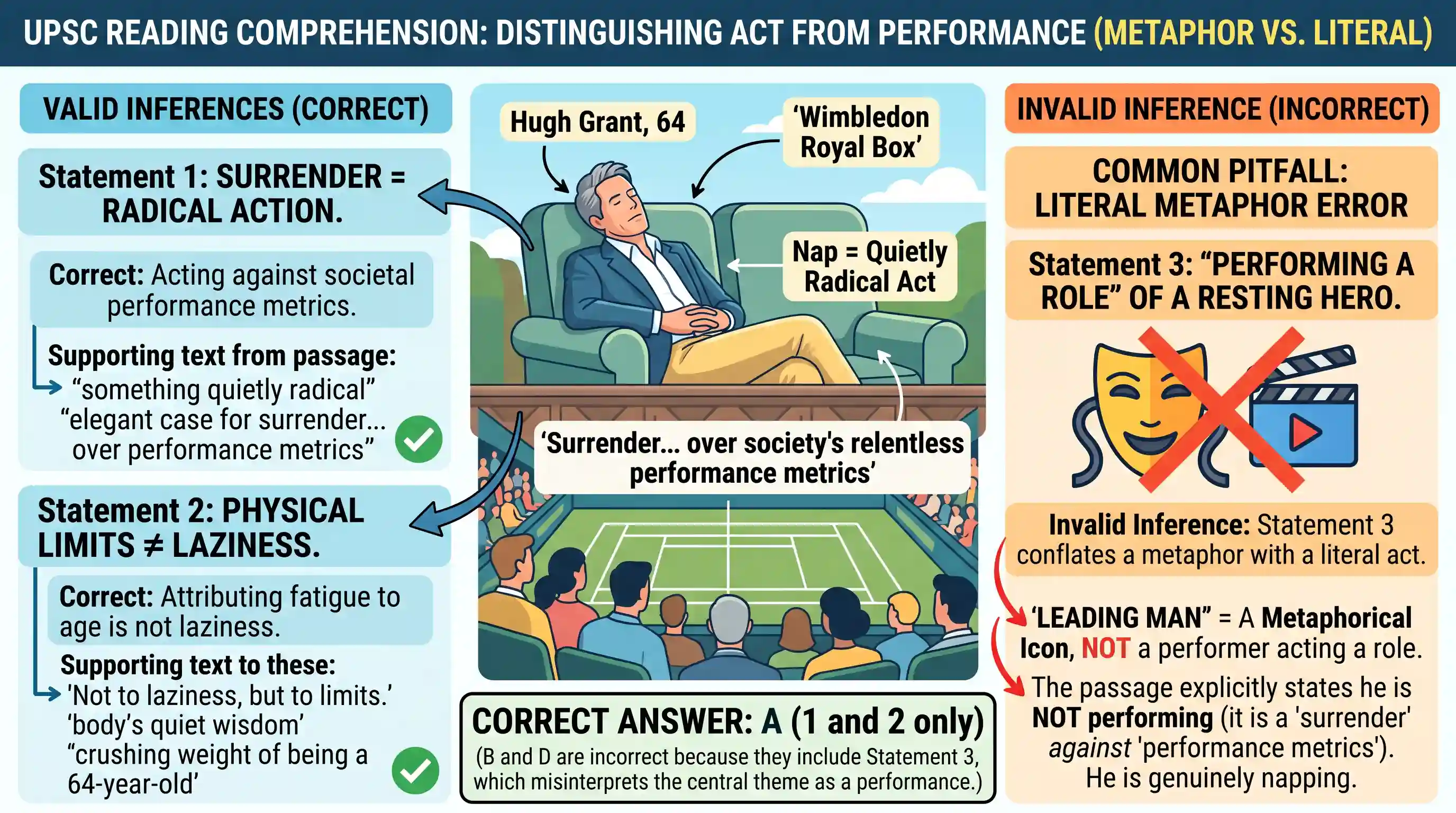
Why Statement 1 is correct: The passage describes Grant's nap in a highly public setting as "quietly radical." It states that he made an "elegant case for surrender... over society's relentless performance metrics." This validates the inference that a mild act of surrender against societal expectations can indeed be deemed radical.
Why Statement 2 is correct: The author defends the actor's fatigue by attributing it to "the crushing weight of being a 64-year-old man" and strictly clarifies that this surrender was "Not to laziness, but to limits. To the body's quiet wisdom." This directly supports the statement that yielding to physical limitations and age should not be conflated with laziness.
Why Statement 3 is incorrect: The statement incorrectly concludes that Grant is "performing the role" of a resting hero. The author uses the phrase "leading man" metaphorically to say that sleep-deprived people found a real-life icon of rest in Grant. The core argument of the passage is that the nap was an authentic, involuntary "surrender" to the body's needs, expressly acting as a rebellion against "performance metrics." Therefore, he was not acting or performing; he was genuinely resting.
Takeaway: In reading comprehension, beware of options that confuse metaphorical stylistic devices with literal actions. The passage praises the absence of performance, making any claim about "performing a role" fundamentally contradictory to the author's central point.
Related questions
More UPSC Prelims practice from the same subject and topic.
- Prelims 2026CSATother
Passage: HMPV causes milder illness with deaths being very rare and with no long-term post-viral symptoms. Question: Which of the following reflect the intent of the writer in the above passage? 1. To…
- Prelims 2026CSATother
Passage: India is starting to deploy AI for critical use cases such as weather forecasting, pest detection and control, and crop yield optimisation. However, penetration is limited to a small subset o…
- Prelims 2026CSATother
Passage: India is starting to deploy AI for critical use cases such as weather forecasting, pest detection and control, and crop yield optimisation. However, penetration is limited to a small subset o…
- Prelims 2026CSATother
Passage: Previous waves of customer-service technology, including email and those pesky voice menus, stoked concerns of job losses, only for them to fail to materialise. AI could yet prove different. …
- Prelims 2026CSATother
Passage: Cattle from the nearby villages came to the common ground to graze, and there was still a cool freshness in the air. Hori took several deep breaths and thought of sitting down for a while, si…
- Prelims 2026CSATother
Passage: Cattle from the nearby villages came to the common ground to graze, and there was still a cool freshness in the air. Hori took several deep breaths and thought of sitting down for a while, si…