Passage: India is starting to deploy AI for critical use cases such as weather forecasting, pest detection and control, and crop yield optimisation. However, penetration is limited to a small subset of tech-savvy farmers. In the US and in Europe, generative AI tools have started offering precision farming at scale, integrating large datasets to provide real-time agronomic insights. For at-scale integration and accessibility of AI tools in India, it would be helpful to develop Indian languages-based AI tools for smallholder farmers, partner with AgTechs to create affordable AI solutions, and disseminate AI-based advisory services through government programmes. Question: Which of the following assumptions is/are valid? 1. Agricultural productivity has marched ahead in the West because of the economies of scale facilitated by the adoption of AI tools. 2. Affordable AI tools rendered available in local languages can help AI-based solutions reach more and more small farmers. 3. Though penetration is as yet low, critical application areas deploying AI tools are already in use in India. Select the answer using the code given below.

- A1, 2 and 3
- B2 only
- C1 and 3 only
- D2 and 3 onlyCorrect
Explanation
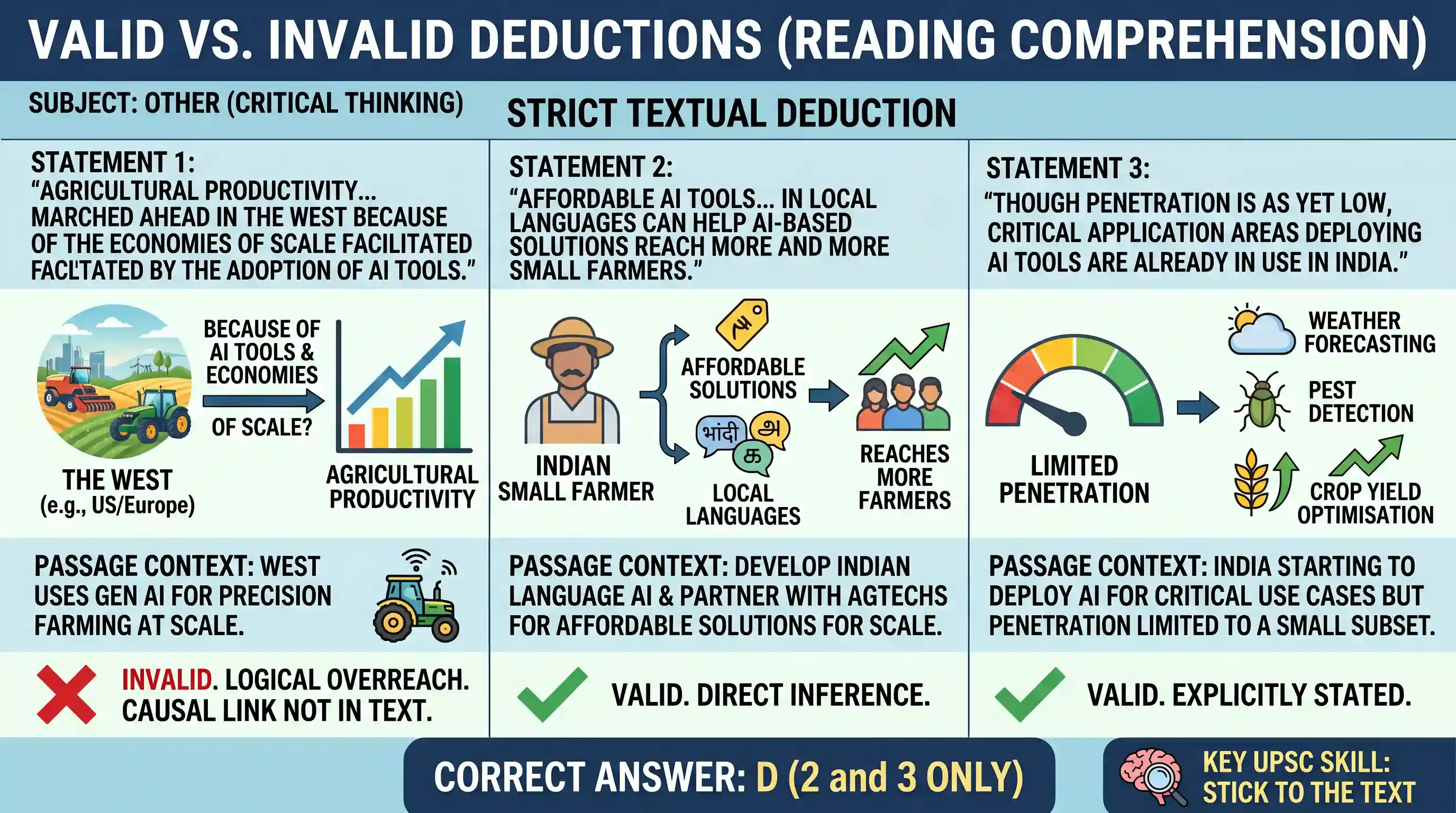
Option D is the correct answer because it accurately identifies Assumptions 2 and 3 as valid deductions from the passage.
Why the correct option is correct:
- Assumption 2 is valid: The passage explicitly recommends that to achieve "at-scale integration and accessibility," it is helpful to "develop Indian languages-based AI tools for smallholder farmers" and create "affordable AI solutions." This implies that affordability and local language availability are key drivers for expanding AI reach among small farmers. In India's actual administrative context, this aligns with initiatives like the PM-Kisan AI chatbot Kisan e-Mitra, which leverages AI and multi-lingual models to assist farmers in their regional languages.
- Assumption 3 is valid: The passage directly states that "India is starting to deploy AI for critical use cases" (such as weather forecasting and pest detection) but notes that "penetration is limited." This confirms that while adoption is currently low, critical AI applications are indeed in use. This reflects real-world deployments like the World Economic Forum’s AI for Agriculture Innovation (AI4AI) and Telangana’s Saagu Baagu project, which have piloted critical AI advisories despite relatively low overall national penetration.
Why the wrong options are incorrect:
- Assumption 1 is invalid: The passage states that the US and Europe are using generative AI for "precision farming at scale." However, it never asserts that Western agricultural productivity "has marched ahead" because of the economies of scale facilitated specifically by AI tools. Deducing historical macro-productivity trends solely from the recent introduction of AI is a logical overreach that extends beyond the provided text. Therefore, options containing statement 1 (A and C) are incorrect.
Takeaway: In UPSC Reading Comprehension, strictly avoid extrapolating broad causal relationships that are not explicitly defined in the text, even if they seem practically plausible. Always stick to the boundaries of the passage.
Related questions
More UPSC Prelims practice from the same subject and topic.
- Prelims 2026CSATother
Passage: HMPV causes milder illness with deaths being very rare and with no long-term post-viral symptoms. Question: Which of the following reflect the intent of the writer in the above passage? 1. To…
- Prelims 2026CSATother
Passage: India is starting to deploy AI for critical use cases such as weather forecasting, pest detection and control, and crop yield optimisation. However, penetration is limited to a small subset o…
- Prelims 2026CSATother
Passage: Previous waves of customer-service technology, including email and those pesky voice menus, stoked concerns of job losses, only for them to fail to materialise. AI could yet prove different. …
- Prelims 2026CSATother
Passage: Cattle from the nearby villages came to the common ground to graze, and there was still a cool freshness in the air. Hori took several deep breaths and thought of sitting down for a while, si…
- Prelims 2026CSATother
Passage: Cattle from the nearby villages came to the common ground to graze, and there was still a cool freshness in the air. Hori took several deep breaths and thought of sitting down for a while, si…
- Prelims 2026CSATother
Passage: Was it the sun-dappled ambience, the strawberries and cream, the frustration of Flavio Cobolli's unforced errors against Serbian Novak Djokovic on Centre Court or simply the crushing weight o…