Suppose x, y and z are variables taking positive real numbers as their possible values. It is given that y is directly proportional to x² and x is inversely proportional to z. For z = 7/25, the values of x and y are 5 and 50, respectively. If y = 98, what is z equal to?

- A1/7
- B1/5Correct
- C5/7
- D1
Explanation
This problem relies on the algebraic properties of direct and inverse variation.
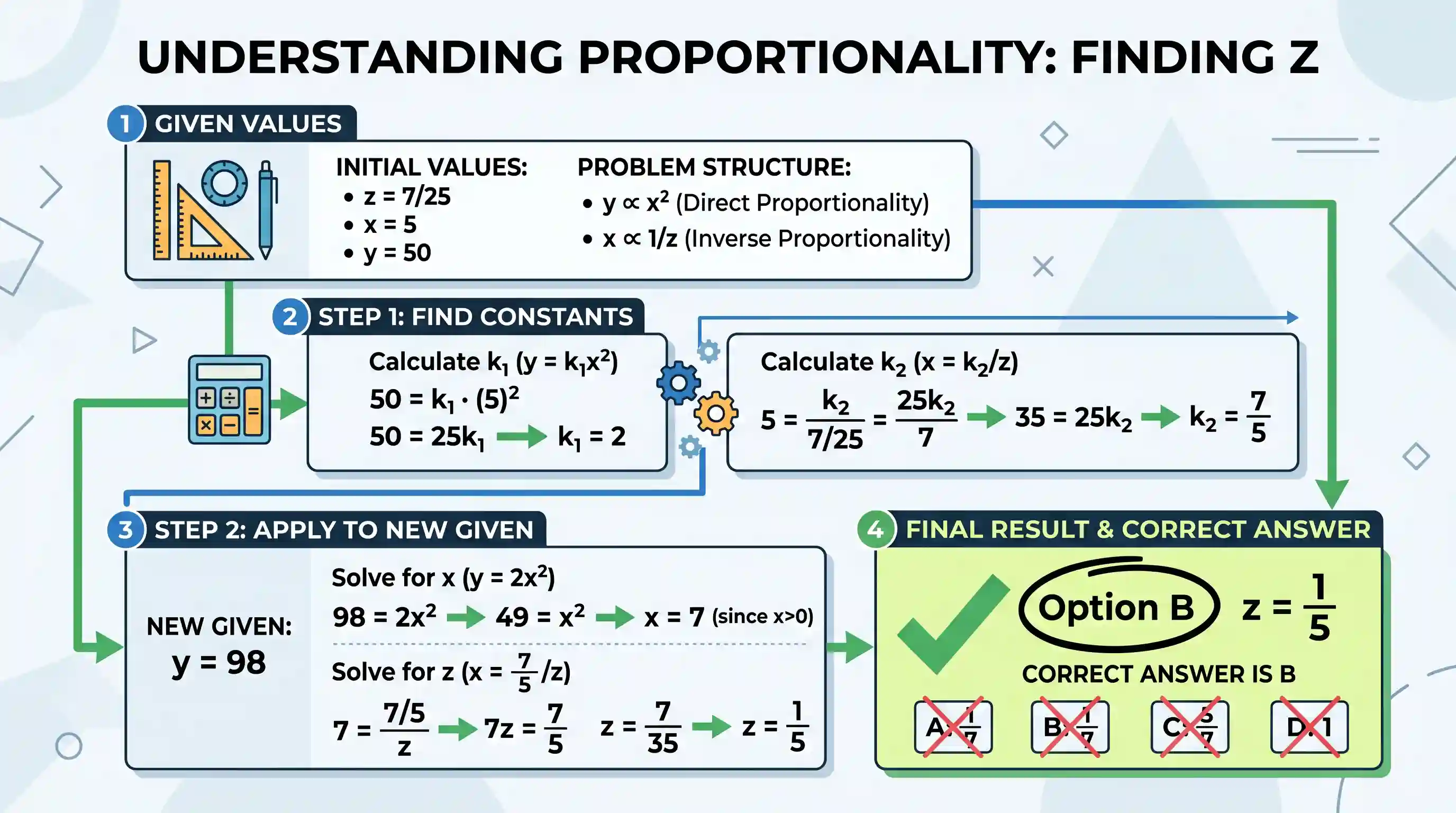
According to the fundamental rules of direct variation, when y is directly proportional to x², it is mathematically expressed as y = k₁x², where k₁ is a constant of proportionality. Similarly, inverse variation dictates that when x is inversely proportional to z, it is expressed as x = k₂/z, where k₂ is another constant.
First, we determine k₂ using the given conditions x = 5 and z = 7/25. Substituting these into the second equation gives 5 = k₂/(7/25). Solving for k₂ yields k₂ = 5 × 7/25 = 7/5. Therefore, the exact relationship is x = (7/5)/z.
Next, we determine k₁ using the initial conditions x = 5 and y = 50. Substituting these into the first equation gives 50 = k₁(5)², which simplifies to 50 = 25k₁, meaning k₁ = 2. Therefore, the exact relationship is y = 2x².
To find z when y = 98, we must first solve for x: 98 = 2x² ⇒ x² = 49. Since the variables only take positive real numbers, x = 7. Substituting x = 7 into the inverse variation equation: 7 = (7/5)/z ⇒ 7z = 7/5 ⇒ z = ⅕. Thus, Option B is correct.
Why the other options are incorrect:
- Option A (1/7): Occurs if an aspirant erroneously assumes k₂ = 1 and solves 7 = 1/z, yielding 1/7.
- Option C (5/7): Results from incorrectly taking the reciprocal of the constant k₂ (7/5) without solving the final equation algebraically.
- Option D (1): Occurs if an aspirant ignores calculating the respective constants of proportionality altogether.
Takeaway: When solving chain proportionality questions, always calculate the individual constants of proportionality (k₁, k₂) using the initial baseline values before attempting to solve for the final target variable.
Related questions
More UPSC Prelims practice from the same subject and topic.
- Prelims 2026CSATother
What is the minimum number of times one needs to measure to get 298 litres of water from a tank, if the measuring cylinders have capacities 1 litre, 6 litres, 25 litres and 100 litres?
- Prelims 2026CSATother
Three variables x, y and z take values 2, 3, 4 or 5 such that their values are always distinct. If M and N denote the largest possible value and the smallest possible value, respectively, for the expr…
- Prelims 2026CSATother
In an objective type question paper, 5 marks are awarded for a correct answer and 2 marks are deducted for a wrong answer. A student attempted all the questions and got a score of 69. Had he been awar…
- Prelims 2026CSATother
The digit in the unit place of the number 6¹²⁹ × 7³⁰⁷ is
- Prelims 2026CSATother
An alloy P contains 20% copper and 80% zinc by weight. Another alloy Q contains 60% copper and 40% zinc by weight. A third alloy R is to be prepared from P and Q so that it contains equal amount of co…
- Prelims 2026CSATother
In a recruitment process, the selection of candidates is based on their performance in three components. The weightages of the components 1, 2 and 3 are 0.2, 0.3 and 0.5, respectively. Use the data gi…