Passage: Cattle from the nearby villages came to the common ground to graze, and there was still a cool freshness in the air. Hori took several deep breaths and thought of sitting down for a while, since he'd be dying of heat in the scorching 'loo' wind the rest of the day. A number of farmers were eager to lease this bit of land and had offered a good price, but Rai Sahib—God bless him—had plainly told them it was reserved for grazing and would not be relinquished for any price. If he'd been one of those selfish Zamindars, he'd have said the cattle could go to hell, that there was no reason for him to miss the chance to make a little money. But the Rai Sahib still held to the old values, feeling that any landlord who didn't look after his tenants was less than human. Question: Which of the following conclusions is/are correct? 1. All landlords essentially have some goodness trapped within them. 2. The common grazing grounds of a village are intended for use by the cattle of that village. 3. Landlords who believe in tradition tend to be more concerned about their tenants. 4. Winds later in the day tend to be cooler post the hot winds of the morning. Select the answer using the code given below.

- A1 and 3
- B2 and 4
- C3 onlyCorrect
- D2 only
Explanation
The passage provided is an excerpt from the English translation of Munshi Premchand's classic novel Godaan. It describes a rural setting and highlights the contrasting attitudes of Zamindars (landlords) toward their tenants.
Why the correct option is correct:
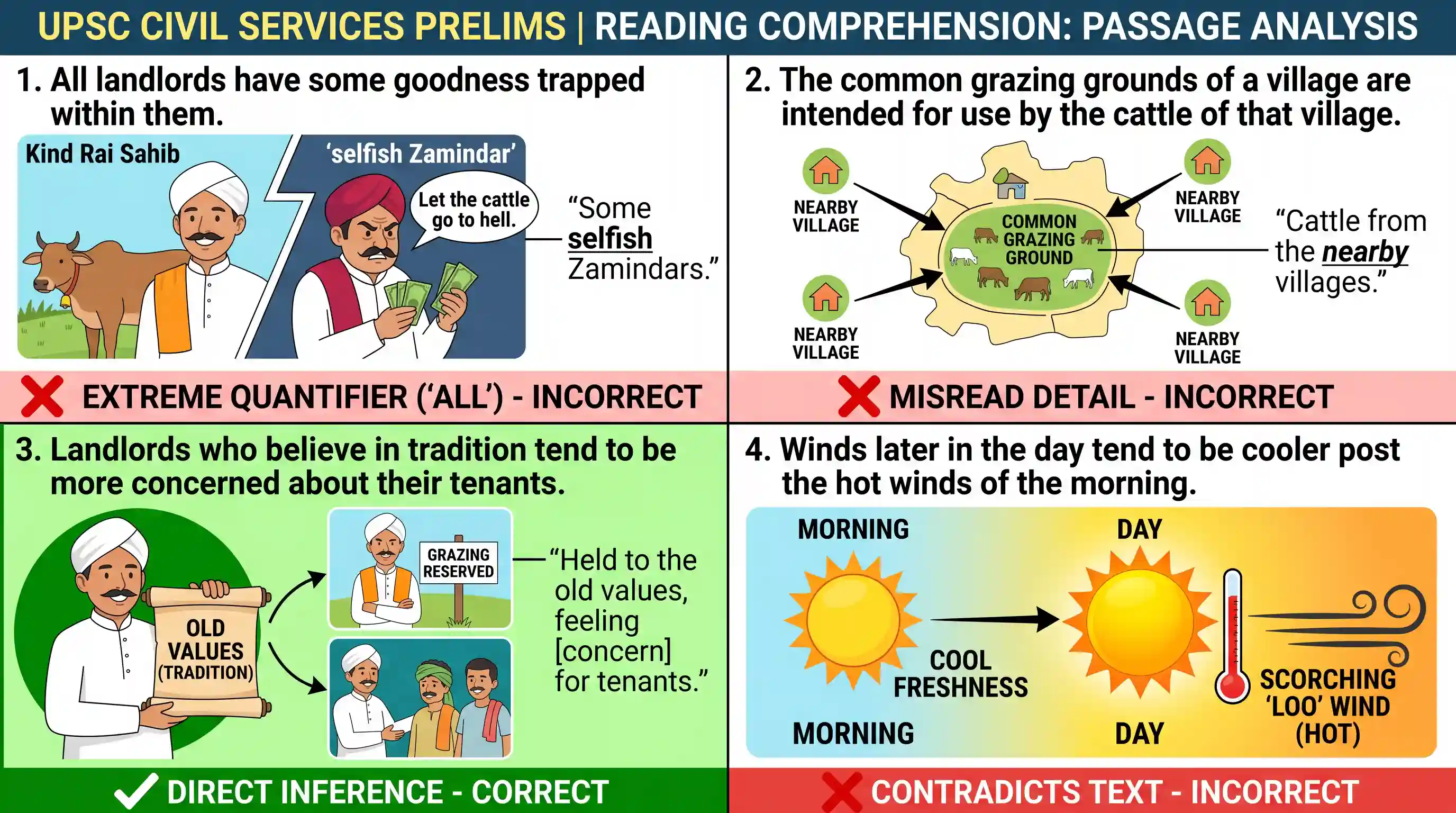
- Statement 3 is correct because it directly mirrors the concluding sentence of the passage: "But the Rai Sahib still held to the old values [traditions], feeling that any landlord who didn't look after his tenants was less than human." This confirms that landlords adhering to traditional values tend to show greater concern for their tenants. Thus, C (3 only) is the correct answer.
Why the incorrect options are wrong:
- Statement 1 is incorrect: The passage explicitly mentions "those selfish Zamindars" who would have let the cattle "go to hell" for the sake of making money. This invalidates the extreme absolute claim that all landlords possess inherent goodness.
- Statement 2 is incorrect: The passage specifically notes that "Cattle from the nearby villages came to the common ground to graze." This contradicts the claim that the grounds are strictly meant for the cattle of that specific village alone.
- Statement 4 is incorrect: The text states there was a "cool freshness" in the morning, but Hori expected to be "dying of heat in the scorching 'loo' wind the rest of the day." Therefore, the winds later in the day become hotter, not cooler.
Concluding Takeaway: In UPSC CSAT Reading Comprehension, beware of extreme quantifiers like "All" or "None." Always cross-check specific details (such as the timing of the hot winds or the exact users of a resource) directly against the text to eliminate distractors.
Related questions
More UPSC Prelims practice from the same subject and topic.
- Prelims 2026CSATother
Passage: HMPV causes milder illness with deaths being very rare and with no long-term post-viral symptoms. Question: Which of the following reflect the intent of the writer in the above passage? 1. To…
- Prelims 2026CSATother
Passage: India is starting to deploy AI for critical use cases such as weather forecasting, pest detection and control, and crop yield optimisation. However, penetration is limited to a small subset o…
- Prelims 2026CSATother
Passage: India is starting to deploy AI for critical use cases such as weather forecasting, pest detection and control, and crop yield optimisation. However, penetration is limited to a small subset o…
- Prelims 2026CSATother
Passage: Previous waves of customer-service technology, including email and those pesky voice menus, stoked concerns of job losses, only for them to fail to materialise. AI could yet prove different. …
- Prelims 2026CSATother
Passage: Cattle from the nearby villages came to the common ground to graze, and there was still a cool freshness in the air. Hori took several deep breaths and thought of sitting down for a while, si…
- Prelims 2026CSATother
Passage: Was it the sun-dappled ambience, the strawberries and cream, the frustration of Flavio Cobolli's unforced errors against Serbian Novak Djokovic on Centre Court or simply the crushing weight o…