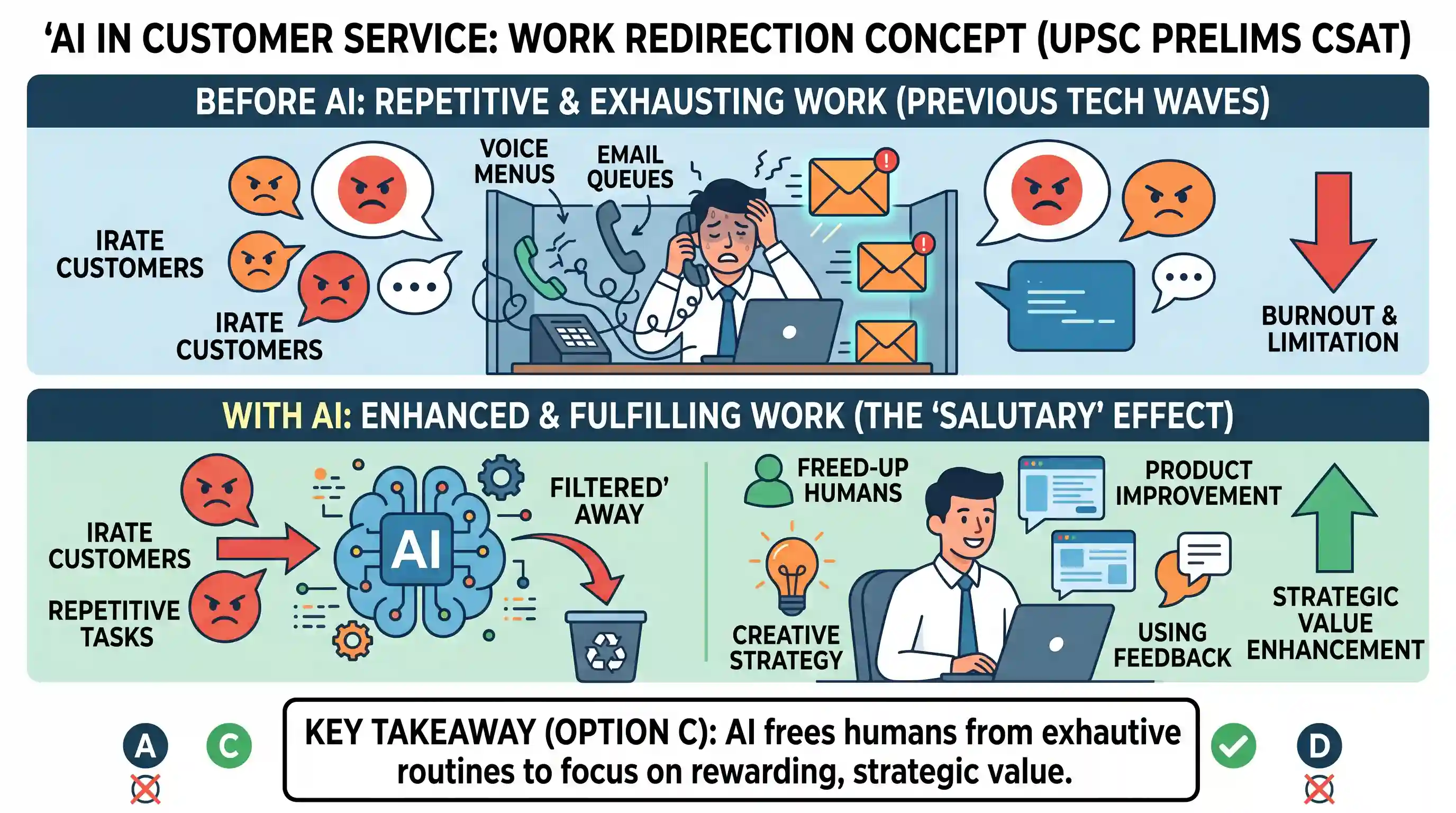
Passage: Previous waves of customer-service technology, including email and those pesky voice menus, stoked concerns of job losses, only for them to fail to materialise. AI could yet prove different. And if it does, its effects may be salutary. Human agents could be freed up to spend more time on creative and rewarding tasks, like using feedback to make products and services better—and thereby spend less time listening to irate customers! Question: Which one among the following statements most appropriately reflects the point of view of the given passage?

- AIf AI were to take over customer service, there would be no work left for human subjects to do.
- BIrritating voice menus and email could not achieve human redundancy to the extent that AI might.
- CThe value of human intervention in the workplace affected by AI might be enhanced through redirection towards more fulfilling tasks.Correct
- DUnlike previous waves in customer-service technology, AI has raised the alarm of worker replacement.
Explanation
The correct answer is Option C.
Why Option C is correct: The central theme of the passage explores the potential impact of Artificial Intelligence (AI) on customer service jobs. While it acknowledges traditional fears of worker replacement, the author highlights a "salutary" (beneficial) outcome: AI could automate the exhausting work of dealing with irate customers, thereby freeing up human agents for "creative and rewarding tasks" like product improvement. Option C most accurately captures this optimistic viewpoint. This mirrors real-world economic projections; for instance, the McKinsey Global Institute's 2023 report on the economic potential of generative AI corroborates this perspective, noting that while AI will heavily automate routine customer operations, its true value lies in augmenting human capabilities and redeploying workers toward strategic, creative, and complex problem-solving roles.
Why the other options are incorrect:
- Option A: This directly contradicts the passage. The text explicitly states that humans would "spend more time on creative and rewarding tasks," proving there would still be highly valuable work left for humans to do.
- Option B: While the passage mentions that past technologies failed to cause job losses, the core message is not just about comparing the extent of redundancy. Option B completely misses the author's primary focus, which is the positive redirection of human effort into fulfilling roles.
- Option D: This statement is factually incorrect according to the text. The opening sentence clearly states that previous waves of technology also "stoked concerns of job losses," meaning AI is not unique in raising these alarms.
Takeaway: In Reading Comprehension, the most appropriate reflection of a passage captures its core argument or tone. Distractor options often rely on contradicting explicit premises (like A and D) or obsessing over minor comparative details (like B) while missing the author's main constructive point.
Related questions
More UPSC Prelims practice from the same subject and topic.
- Prelims 2026CSATother
Passage: Sport is not just about winning medals or getting jobs through a sports quota. Today's generation is struggling with issues like depression and anxiety. Parents often say that their children …
- Prelims 2026GS1other
Which of the following statements with regard to the Grand Slam Tennis Tournaments is/are correct ? 1. The tournaments have a shared governance structure establishing the partnership among the four Gr…
- Prelims 2026GS1other
Ms. X is a mid-level civil service official working in the urban development department of a major city. Recently, she was involved in approving a contract for a public infrastructure project — a new …
- Prelims 2026GS1other
Which one of the following pairs is not correctly matched? (Indian Army Corps) : (Headquarters)
- Prelims 2026CSATother
For ⅓ < x < y < 2, which of the following statements is/are always correct? I. x + 1/x < y + 1/y II. √(1 + y²)/y < √(1 + x²)/x Select the answer using the code given below.
- Prelims 2026CSATother
What is the minimum number of times one needs to measure to get 298 litres of water from a tank, if the measuring cylinders have capacities 1 litre, 6 litres, 25 litres and 100 litres?