Which of the following statements with regard to the arrival of Amur Falcons at Doyang Lake in Nagaland each year from Mongolia is/are correct ? 1. It showcases how sustained local conservation efforts can contribute to the arrival and protection of international migratory birds. 2. It reflects the global success of advanced tracking technologies that guide migratory birds back to their stopover sites. 3. It confirms that Amur Falcons have adapted to permanent residency in India due to favourable habitat changes. Select the answer using the code given below :

- A1 onlyCorrect
- B1 and 2
- C2 and 3
- D3 only
Explanation
The correct answer is A (1 only).
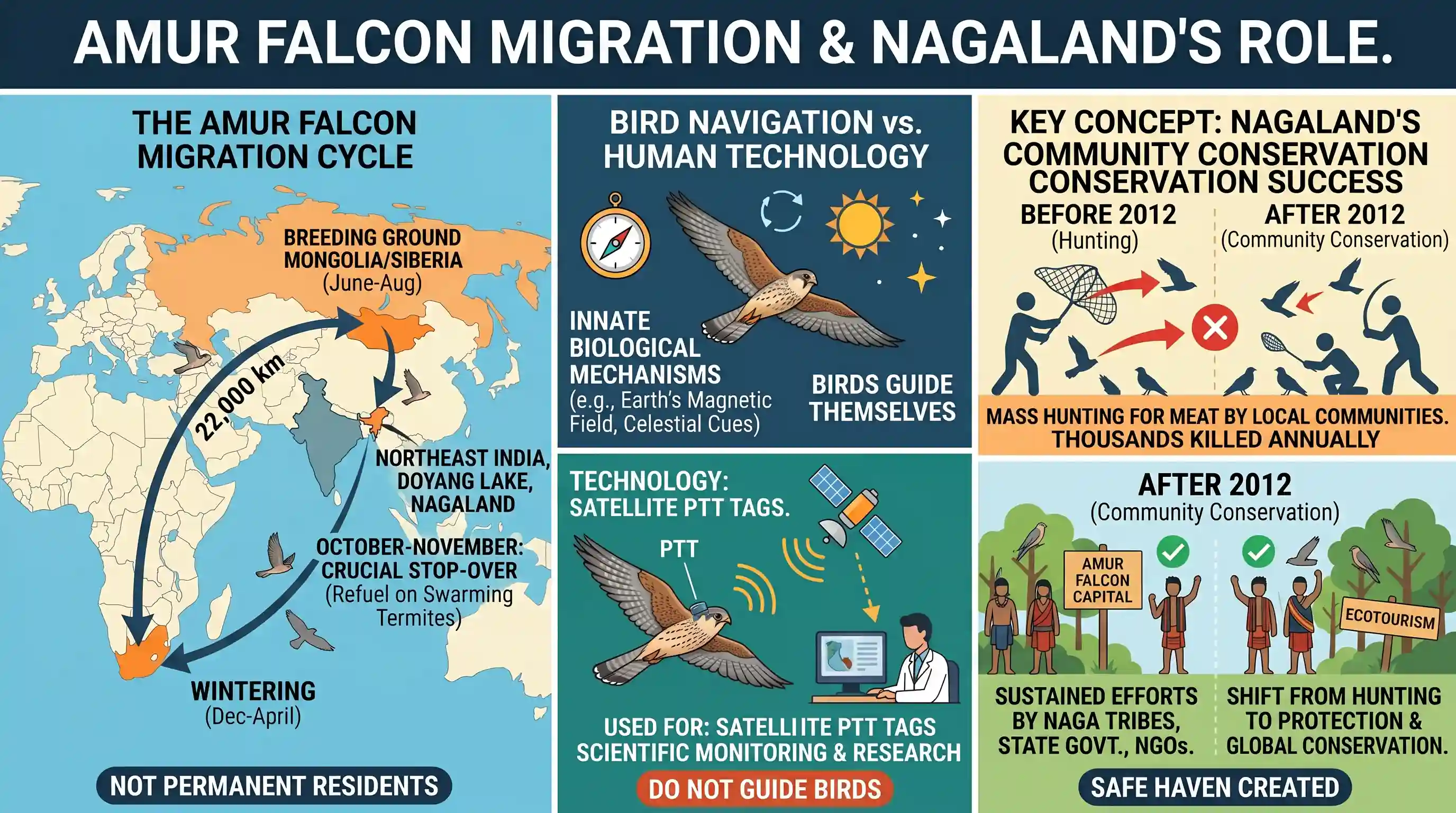
Statement 1 is correct: The arrival and safe roosting of millions of Amur Falcons at Doyang Lake in Nagaland is a globally recognized community conservation success story. Until 2012, thousands of these falcons were hunted for meat during their stopover. However, sustained local conservation efforts—driven by local Naga tribes (particularly in Pangti village), the state government, and wildlife NGOs—transformed the region. Today, mass hunting has ceased, and the region is celebrated as the "Amur Falcon Capital of the World".
Statement 2 is incorrect: Advanced tracking technologies, such as lightweight satellite Platform Transmitter Terminals (PTTs), have been successfully used by scientists to monitor and study the falcons' arduous 22,000 km migration routes. However, these devices only track movement; they do not guide the birds back to their stopovers. Migratory birds navigate using innate biological mechanisms, such as earth's magnetic fields and celestial cues.
Statement 3 is incorrect: Amur Falcons have not adapted to permanent residency in India. They are transcontinental, long-distance migrants. They breed in Eastern Asia (Mongolia, Siberia, Northern China) and winter in Southern Africa. Their presence in northeastern India during October and November is strictly a temporary stopover. They pause to rest and gorge on seasonal insects (like swarming termites) to build fat reserves before their massive non-stop flight across the Indian Ocean.
Takeaway: The Amur Falcon (Falco amurensis) undertakes one of the longest over-water migrations of any raptor. Nagaland's Doyang Lake exemplifies how shifting local communities from hunting to ecotourism can create safe havens for international migratory species.
Related questions
More UPSC Prelims practice from the same subject and topic.
- Prelims 2026GS1environment
With respect to the Western Hoolock Gibbons, which of the following statements is/are correct? 1. A Sanctuary in North-east India is home to this ape species listed as Endangered in the International …
- Prelims 2026GS1environment
With reference to Madhav National Park, which of the following statements is/are correct ? 1. It was declared a Tiger Reserve in India in 2025. 2. Sakhya Sagar, which is designated as a Ramsar Site, i…
- Prelims 2026GS1environment
Consider the following statements about Rhynchostylis retusa (Foxtail orchid) : 1. It is an epiphytic orchid. 2. The species is endemic to North-east India. 3. It is the State flower of Arunachal Prad…
- Prelims 2026GS1environment
At the United Nations Ocean Conference (UNOC) held in June, 2025 in France, the Food and Agricultural Organization (FAO) of the United Nations demonstrated its leading voice on marine and ocean issues…
- Prelims 2026GS1environment
Which one of the following is the first Plan Vivo certified Reducing Emissions from Deforestation and Forest Degradation (REDD+) project in India ?
- Prelims 2026GS1environment
Consider the following statements with reference to India's response to climate change : I. India's Long-Term Low Emission Development Strategy (LT-LEDS) is a crucial tool for achieving net-zero emiss…