Consider the following statements about platforms for multilateral co-operation : 1. The 'Colombo Process' is a regional consultative process in which member states take binding decisions by consensus. 2. The 'Abu Dhabi Dialogue' is a voluntary non-binding consultative process among Asian countries of labour origin and destination to facilitate regional cooperation on contractual labour mobility. 3. The 'Global Forum for Migration and Development', created upon the proposal of a former UN Secretary General, is a voluntary forum whose decisions are non-binding in nature. Which of the statements given above is/are correct ?

- A1, 2 and 3
- B1 and 3 only
- C2 and 3 onlyCorrect
- D2 only
Explanation
Correct Answer: Option C (2 and 3 only)
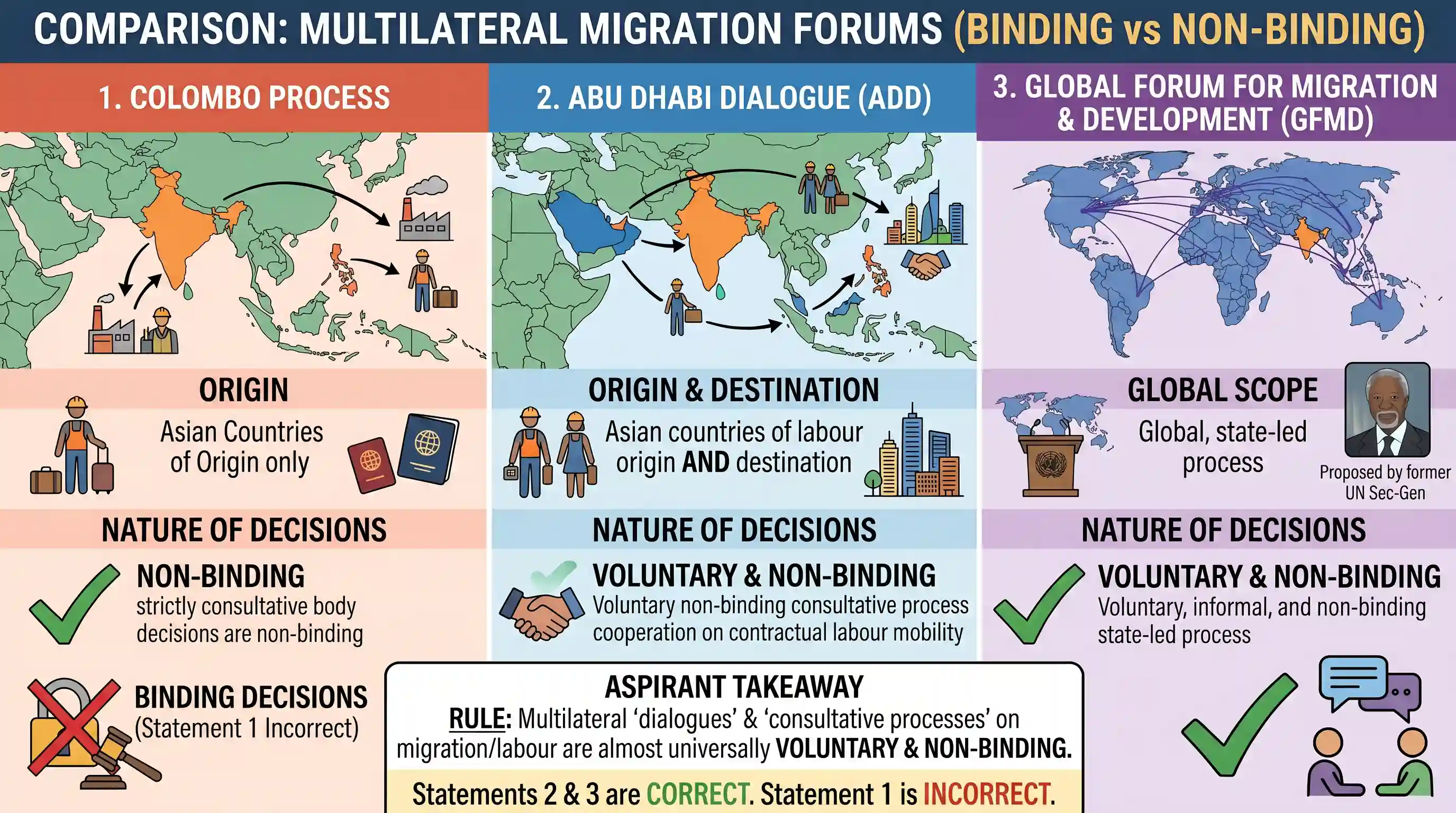
Statement 1 is incorrect: The Colombo Process, established in 2003, is a Regional Consultative Process on the management of overseas employment and contractual labour for Asian countries of origin (including India, Bangladesh, and the Philippines). While member states do discuss policy and operate by consensus, the forum is strictly a consultative body, and its decisions are non-binding.
Statement 2 is correct: The Abu Dhabi Dialogue (ADD), launched in 2008, is a voluntary and non-binding consultative process. It uniquely bridges the gap between Asian countries of labour origin (members of the Colombo Process) and major destination countries (specifically Gulf Cooperation Council nations and Malaysia) to facilitate regional cooperation on contractual labour mobility, fair recruitment, and worker protection.
Statement 3 is correct: The Global Forum for Migration and Development (GFMD) was established following a proposal by former UN Secretary-General Kofi Annan during the 2006 UN General Assembly High-Level Dialogue on International Migration and Development. It functions as a voluntary, informal, and non-binding state-led process designed to address the interconnections between global migration and development.
Aspirant Takeaway: As a general rule for Prelims, multilateral "dialogues" and "consultative processes" focused on migration and labour mobility (such as the Colombo Process, Abu Dhabi Dialogue, and GFMD) are almost universally voluntary and non-binding. This structural choice ensures maximum state participation by respecting national sovereignty over domestic immigration policies.
Related questions
More UPSC Prelims practice from the same subject and topic.
- Prelims 2026GS1current-affairs
The Chancellor of the Federal Republic of Germany visited India in January, 2026. Which of the following is/are not correct in terms of outcomes of this visit? 1. Signing of a Memorandum of Understand…
- Prelims 2026GS1current-affairs
Which of the following connectivity projects is/are a part of cooperation between India and the ASEAN member countries ? 1. Kaladan Multi-Modal Transit Transport Project 2. IMT Trilateral Highway 3. A…
- Prelims 2026GS1current-affairs
Which of the following is/are the most significant implication(s) of obtaining Oeko-Tex certification for Eri Silk in the global textile industry ? 1. It allows Indian exporters to compete in high-end…
- Prelims 2026GS1current-affairs
Match List I with List II and select the answer using the code given below the Lists : List I (INTERPOL Notice) A. Silver Notice B. Blue Notice C. Black Notice D. Green Notice List II (Description) 1.…
- Prelims 2026GS1current-affairs
The Bureau of Indian Standard (BIS) recently introduced a national standard to test and assess bomb disposal system. Which of the following statements with regard to this system is/are correct? 1. The…
- Prelims 2026GS1current-affairs
Consider the following statements with regard to the film 'Boong' : 1. The film has recently won the British Academy of Film and Television Arts (BAFTA) Award in the Children's and Family Film categor…