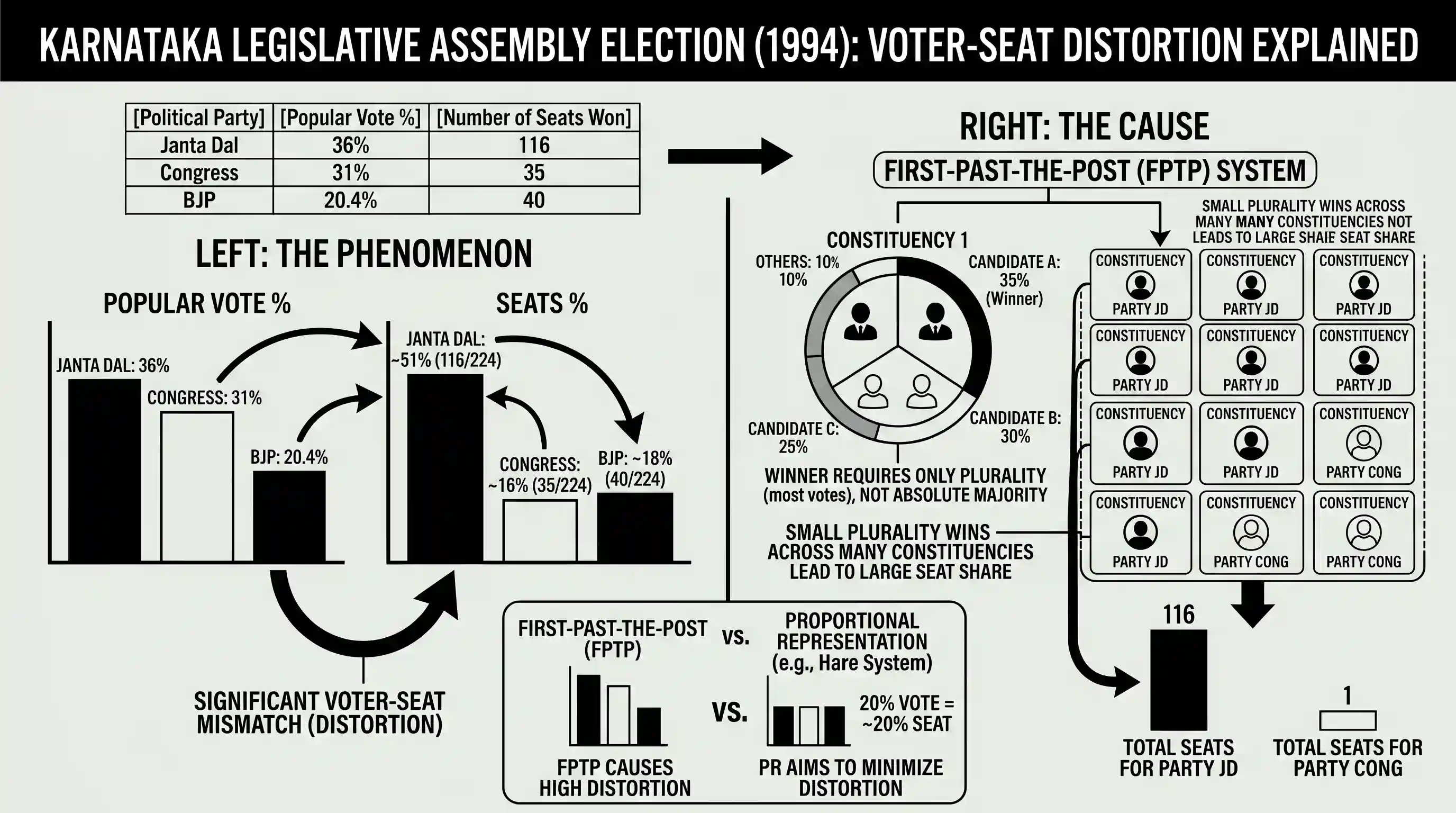
Consider the table given below providing some details of the results of the election to the Karnataka State Legislative: Assembly held in December, 1994. In terms of electoral analysis, the voter seat distortion is to be explained as the result of the adoption of the [Political Party Popular Votes | Percentage of Seats obtained | Number of secured ; Janta Dal | 36 | 116 ; Congress | 31 | 35 ; BJP | 20.4 | 40]

- AHare system
- BCumulative vote system
- CFirst-past-the-post systemCorrect
- DPlural vote system
Explanation
The correct option is C because the First past the post system often leads to a significant mismatch between the percentage of votes polled and the number of seats won. In this system, a candidate only needs to secure more votes than any other individual challenger in a specific constituency to win the seat.
As a result, a party that wins many constituencies by small margins can gain a disproportionately high number of seats compared to its total vote share. Conversely, a party with a high overall vote percentage that is spread thinly across many constituencies may win very few seats. This phenomenon is known as voter seat distortion, which is a hallmark of the First past the post system used in Indian legislative elections.
The other systems mentioned, such as the Hare system, are forms of proportional representation designed specifically to minimize such distortions.
Related questions
More UPSC Prelims practice from the same subject and topic.
- Prelims 1995GS1polity-and-governance
Which one of the following is correct in respect of the commencement of the election process in India?
- Prelims 1995GS1polity-and-governance
The Dinesh Goswami Committee was concerned with
- Prelims 1995GS1polity-and-governance
Examine the following statements: I. All children are inquisitive. II. Some children are inquisitive. III. No children are inquisitive. IV. Some children are not inquisitive. Among these statements, t…
- Prelims 1995GS1polity-and-governance
If in an election to a State Legislative Assembly the candidate who is declared elected loses his deposit, it means that
- Prelims 1995GS1polity-and-governance
Which of the following is/are extra-constitutional and extra-legal device(s) for securing cooperation and coordination between the States in India? I. The National Development Council II. The Governor…
- Prelims 1995GS1polity-and-governance
Which of the following are matters on which a constitutional amendment is possible only with the ratification of the legislatures of not less than one-half of the States? I. Election of the President …