Examine the following statements: I. All children are inquisitive. II. Some children are inquisitive. III. No children are inquisitive. IV. Some children are not inquisitive. Among these statements, the two statements which cannot both be true simultaneously but can both be false would be

- AI and IIICorrect
- BI and IV
- CII and III
- DIII and IV
Explanation
The correct answer is A because of the relationship between contrary statements in formal logic.
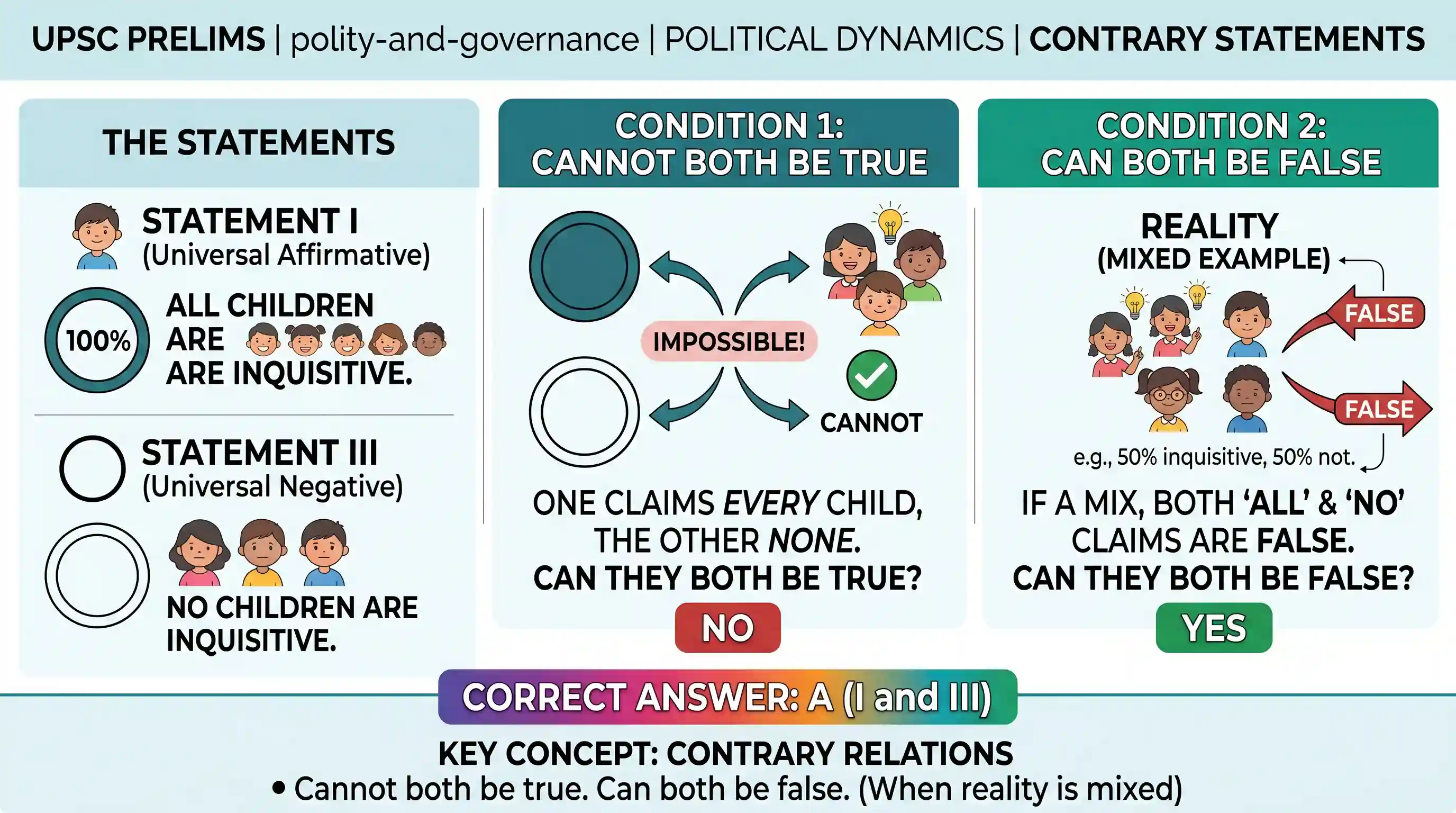
Statement I is a Universal Affirmative (All children are inquisitive) and Statement III is a Universal Negative (No children are inquisitive).
In logic, these two statements are called contraries. They cannot both be true at the same time because one claims every child has the quality while the other claims no child has it. However, they can both be false if some children are inquisitive and some are not.
For example, if in reality 50 percent of children are inquisitive, then the statement All children are inquisitive is false, and the statement No children are inquisitive is also false. Thus, they fulfill the criteria of being unable to be true together but capable of being false together.
Related questions
More UPSC Prelims practice from the same subject and topic.
- Prelims 1995GS1polity-and-governance
Consider the table given below providing some details of the results of the election to the Karnataka State Legislative: Assembly held in December, 1994. In terms of electoral analysis, the voter seat…
- Prelims 1995GS1polity-and-governance
Which one of the following is correct in respect of the commencement of the election process in India?
- Prelims 1995GS1polity-and-governance
The Dinesh Goswami Committee was concerned with
- Prelims 1995GS1polity-and-governance
If in an election to a State Legislative Assembly the candidate who is declared elected loses his deposit, it means that
- Prelims 1995GS1polity-and-governance
Which of the following is/are extra-constitutional and extra-legal device(s) for securing cooperation and coordination between the States in India? I. The National Development Council II. The Governor…
- Prelims 1995GS1polity-and-governance
Which of the following are matters on which a constitutional amendment is possible only with the ratification of the legislatures of not less than one-half of the States? I. Election of the President …