Who among the following have the right to vote in the elections to both Lok Sabha and Rajya Sabha?

- AElected members of the Lower House of the Parliament
- BElected members of the Upper House of the Parliament
- CElected members of the Upper House of the State Legislature
- DElected members of the Lower House of the State LegislatureCorrect
Explanation
The correct answer is D because of the following reasons:
-
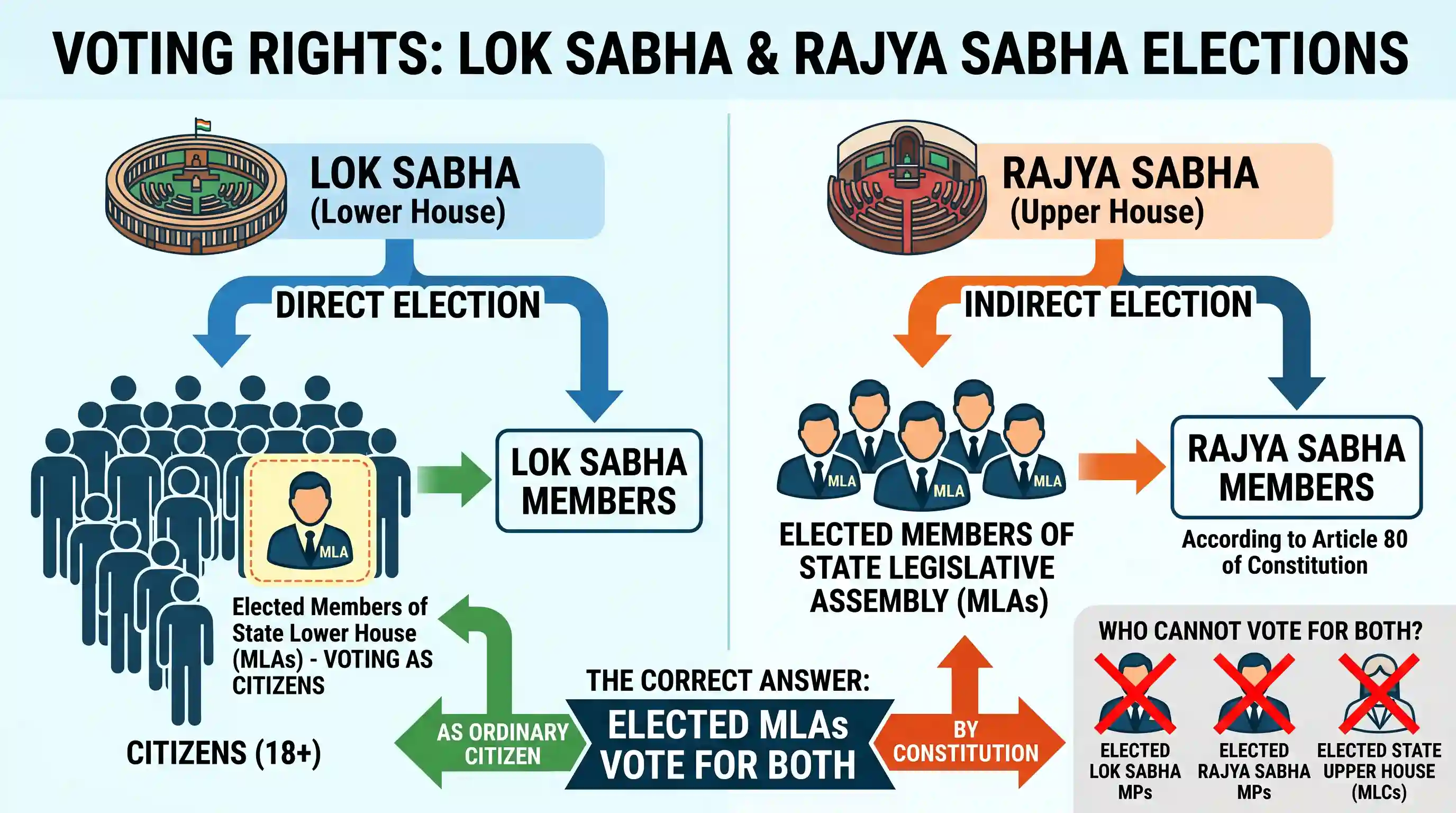
Voting in Lok Sabha Elections: All Indian citizens aged 18 and above, including elected members of the Lower House of the State Legislature (MLAs), have the right to vote as ordinary citizens in the general elections for the Lok Sabha.
-
Voting in Rajya Sabha Elections: According to Article 80 of the Constitution, members of the Rajya Sabha are elected by the elected members of the Legislative Assemblies of the States (MLAs).
Therefore, only the elected members of the Lower House of the State Legislature (MLAs) possess the right to vote in both sets of elections. Members of Parliament (Options A and B) cannot vote in Rajya Sabha elections, and members of the State Legislative Council (Option C) do not vote in Rajya Sabha elections.
Related questions
More UPSC Prelims practice from the same subject and topic.
- Prelims 1995GS1polity-and-governance
Consider the table given below providing some details of the results of the election to the Karnataka State Legislative: Assembly held in December, 1994. In terms of electoral analysis, the voter seat…
- Prelims 1995GS1polity-and-governance
Which one of the following is correct in respect of the commencement of the election process in India?
- Prelims 1995GS1polity-and-governance
Which of the following is/are extra-constitutional and extra-legal device(s) for securing cooperation and coordination between the States in India? I. The National Development Council II. The Governor…
- Prelims 1995GS1polity-and-governance
Which of the following are matters on which a constitutional amendment is possible only with the ratification of the legislatures of not less than one-half of the States? I. Election of the President …
- Prelims 1995GS1polity-and-governance
Which one of the following States of India does not have a Legislative Council so far even though the Constitution (Seventh Amendment) Act, 1956 provides for it?
- Prelims 1995GS1polity-and-governance
Article 156 of the Constitution of India provides that a Governor shall hold office for a term of five years from the date on which he enters upon his office. Which of the following can be deduced fro…