As part of the liberalisation programme and with a view to attracting foreign exchange, the Government and the RBI have devised two schemes known as FCNR-’A’ and FCNR-’B’. Which of the following is/are true regarding these two schemes? I. Under scheme ‘A’ RBI bears exchange rate fluctuations. II. Under scheme ‘B’, other banks are to meet out the difference in exchange rate fluctuations. III. Both the schemes stand withdrawn now. IV. Only scheme ‘A’ has been withdrawn. Select the correct answer from the codes given below: Codes:

- AIII only
- BI and II
- CI, II and III
- DI, II and IVCorrect
Explanation
The correct option is D because it accurately reflects the historical evolution and risk mechanisms of the Foreign Currency Non Resident FCNR accounts.
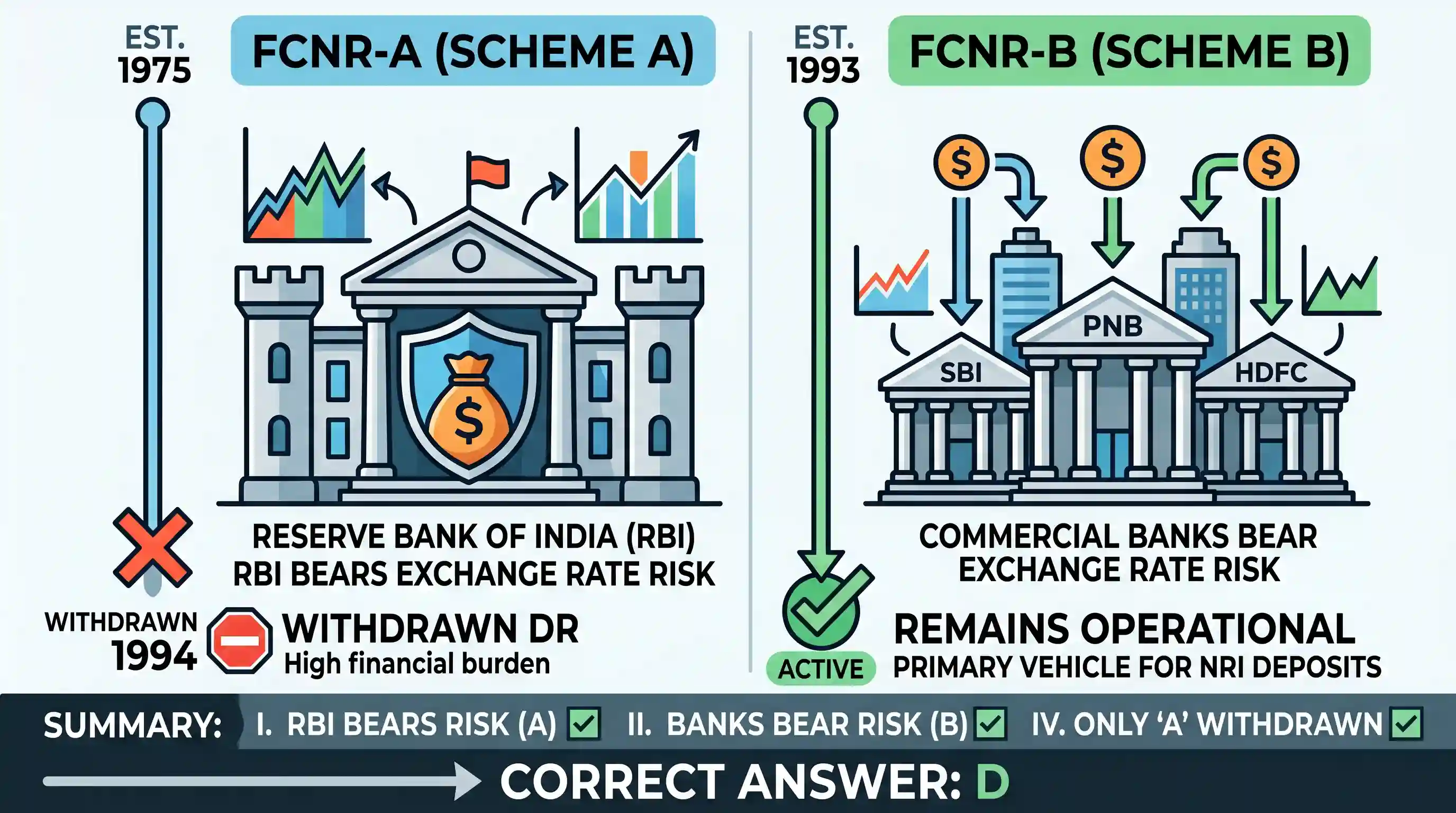
Statement I is correct because under the original FCNR A scheme introduced in 1975 the Reserve Bank of India bore the entire risk of exchange rate fluctuations. This meant the central bank guaranteed the value of the foreign currency against the Indian Rupee.
Statement II is correct because the FCNR B scheme was introduced in 1993 to shift this exchange risk away from the RBI. Under this scheme the commercial banks themselves are responsible for managing and meeting the differences arising from exchange rate fluctuations.
Statement III is incorrect because only the older version of the scheme was phased out.
Statement IV is correct because the FCNR A scheme was officially withdrawn and discontinued in 1994 due to the heavy financial burden it placed on the RBI. The FCNR B scheme remains operational as the primary vehicle for foreign currency deposits by Non Resident Indians.
Therefore statements I II and IV are true making D the correct answer.
Related questions
More UPSC Prelims practice from the same subject and topic.
- Prelims 1995GS1economy
To prevent recurrence of scams in Indian Capital Market, the Government of India has assigned regulatory powers to
- Prelims 1995GS1economy
Which one of the following is the largest mutual fund organisation in India?
- Prelims 1995GS1economy
Which one of the following is not an instrument of selective credit control in India?
- Prelims 1995GS1economy
Bank Rate implies the rate of interest
- Prelims 1995GS1economy
The Narasimham Committee for Financial Sector Reforms has suggested reduction in
- Prelims 1995GS1economy
Which one of the following Five-Year Plans recognised human development as the core of all developmental efforts?