Which one of the following is not an instrument of selective credit control in India?

- ARegulation of consumer credit
- BRationing of credit
- CMargin requirements
- DVariable cost reserve ratiosCorrect
Explanation
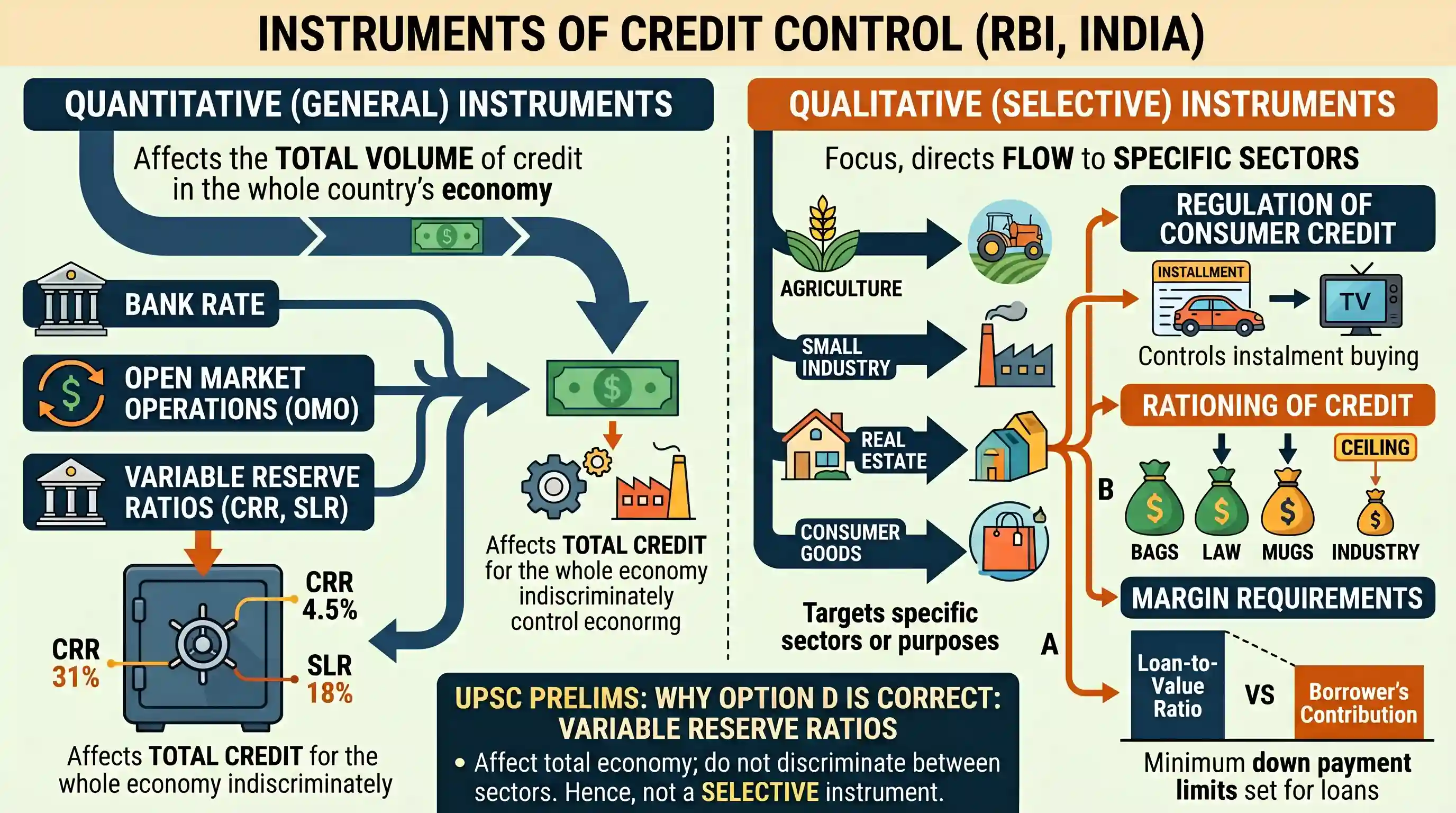
The correct answer is D because Variable cost reserve ratios such as Cash Reserve Ratio and Statutory Liquidity Ratio are instruments of Quantitative or General credit control. These measures affect the total volume of credit in the entire economy without discriminating between specific sectors.
In contrast, options A, B, and C are Qualitative or Selective credit control instruments. These are used by the Reserve Bank of India to regulate the flow of credit to specific sectors or for specific purposes. Regulation of consumer credit controls installment buying, rationing of credit limits the maximum amount of loans available to certain sectors, and margin requirements determine the percentage of a loan that a borrower must finance with their own funds. Since variable reserve ratios apply to the overall money supply rather than specific sectors, it is not a selective credit control instrument.
Related questions
More UPSC Prelims practice from the same subject and topic.
- Prelims 1995GS1economy
To prevent recurrence of scams in Indian Capital Market, the Government of India has assigned regulatory powers to
- Prelims 1995GS1economy
As part of the liberalisation programme and with a view to attracting foreign exchange, the Government and the RBI have devised two schemes known as FCNR-’A’ and FCNR-’B’. Which of the following is/ar…
- Prelims 1995GS1economy
Which one of the following is the largest mutual fund organisation in India?
- Prelims 1995GS1economy
Bank Rate implies the rate of interest
- Prelims 1995GS1economy
The Narasimham Committee for Financial Sector Reforms has suggested reduction in
- Prelims 1995GS1economy
Which one of the following Five-Year Plans recognised human development as the core of all developmental efforts?