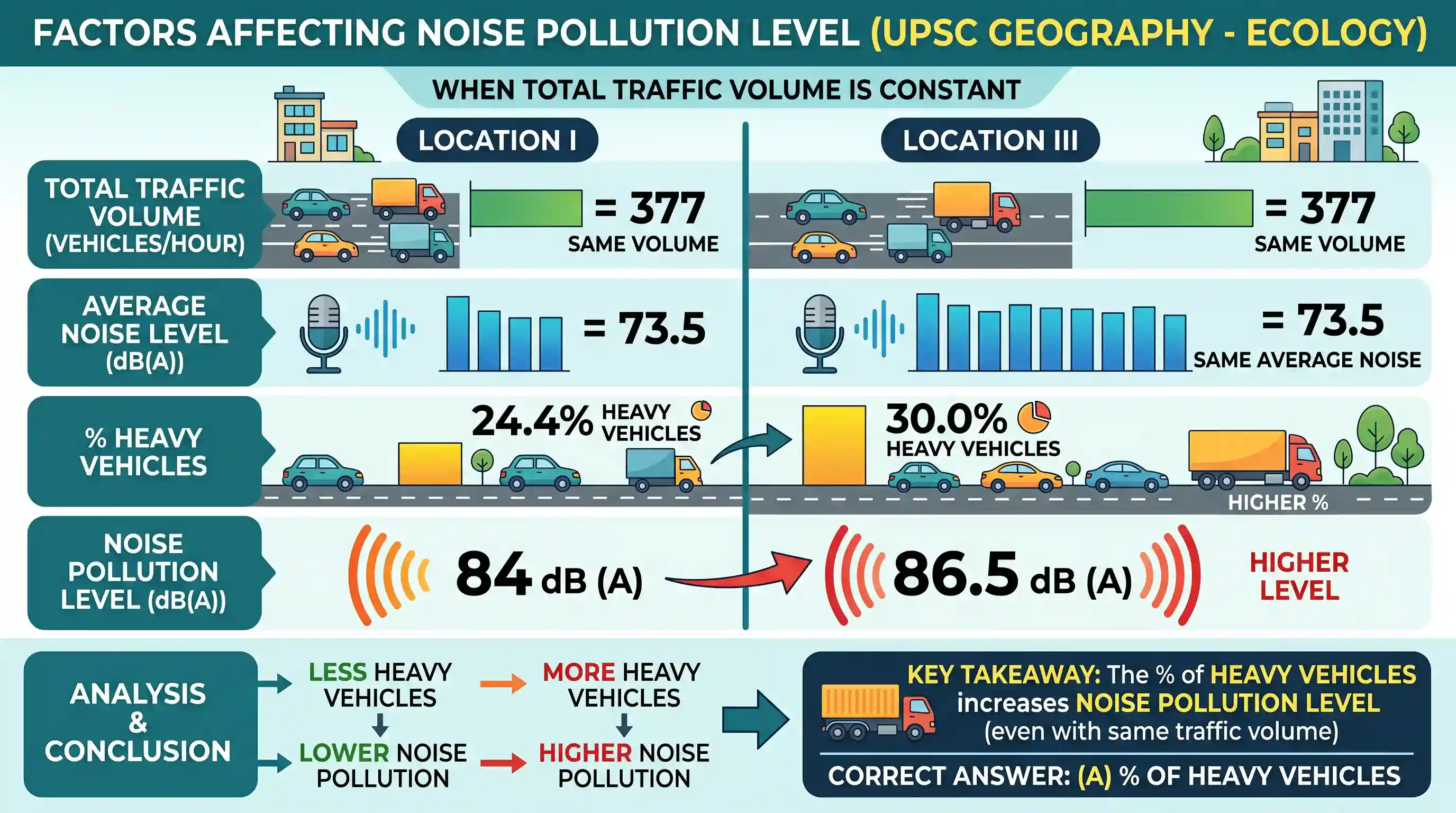
Consider the table given below providing details of traffic volume per hour for locations: | Location | Total traffic volume | % of Heavy Vehicles | Average noise level in dB (A) | Noise pollution level, in dB (A) | | :--- | :--- | :--- | :--- | :--- | | I | 377 | 24.4 | 73.5 | 84 | | II | 380 | 12.5 | 72.6 | 83 | | III | 377 | 30.0 | 73.5 | 86.5 | | IV | 225 | 12.5 | 72.98 | 80.9 | When the total traffic volume is the same, the factor(s) which affect(s) the noise pollution level is/are [Location | Total traffic volume | % of Heavy Vehicles | Average noise level in dB (A) | Noise pollution level, in (A) ; I | 377 | 24.4 | 73.5 | 84 ; II | 380 | 12.5 | 72.6 | 83 ; III | 377 | 30.0 | 73.5 | 86.5 ; IV | 225 | 12.5 | 72.98 | 80.9]

- A% of heavy vehiclesCorrect
- Bnoise pollution level and average noise level
- Caverage noise level and % of heavy vehicles
- Dindeterminable on the basis of details given
Explanation
To solve this question, we must look specifically at the locations where the total traffic volume is the same, as requested by the prompt.
Comparing Location I and Location III, both have an identical total traffic volume of 377. Despite having the same average noise level of 73.5, the final Noise Pollution Level is higher in Location III (86.5) than in Location I (84).
The only variable that changes between these two locations is the percentage of heavy vehicles. Location III has 30 percent heavy vehicles, while Location I has 24.4 percent. This demonstrates that when traffic volume is constant, the percentage of heavy vehicles is the factor that directly affects and increases the noise pollution level. Therefore, option A is the correct answer.
Related questions
More UPSC Prelims practice from the same subject and topic.
- Prelims 1995GS1geography
“Monoculture of commercially viable trees is destroying the unique natural profile of ...Thoughtless exploitation of timber, deforestation vast tracts for palm cultivation, destruction of mangroves, i…
- Prelims 1995GS1geography
Which one of the following does not belong to biosphere reserves set-up so far?
- Prelims 1995GS1geography
Which one of the following fuels causes minimum environmental pollution?
- Prelims 1995GS1geography
Most of the desert plants bloom during night time because
- Prelims 1995GS1geography
The only snake that builds a nest is
- Prelims 1995GS1geography
A meteor is