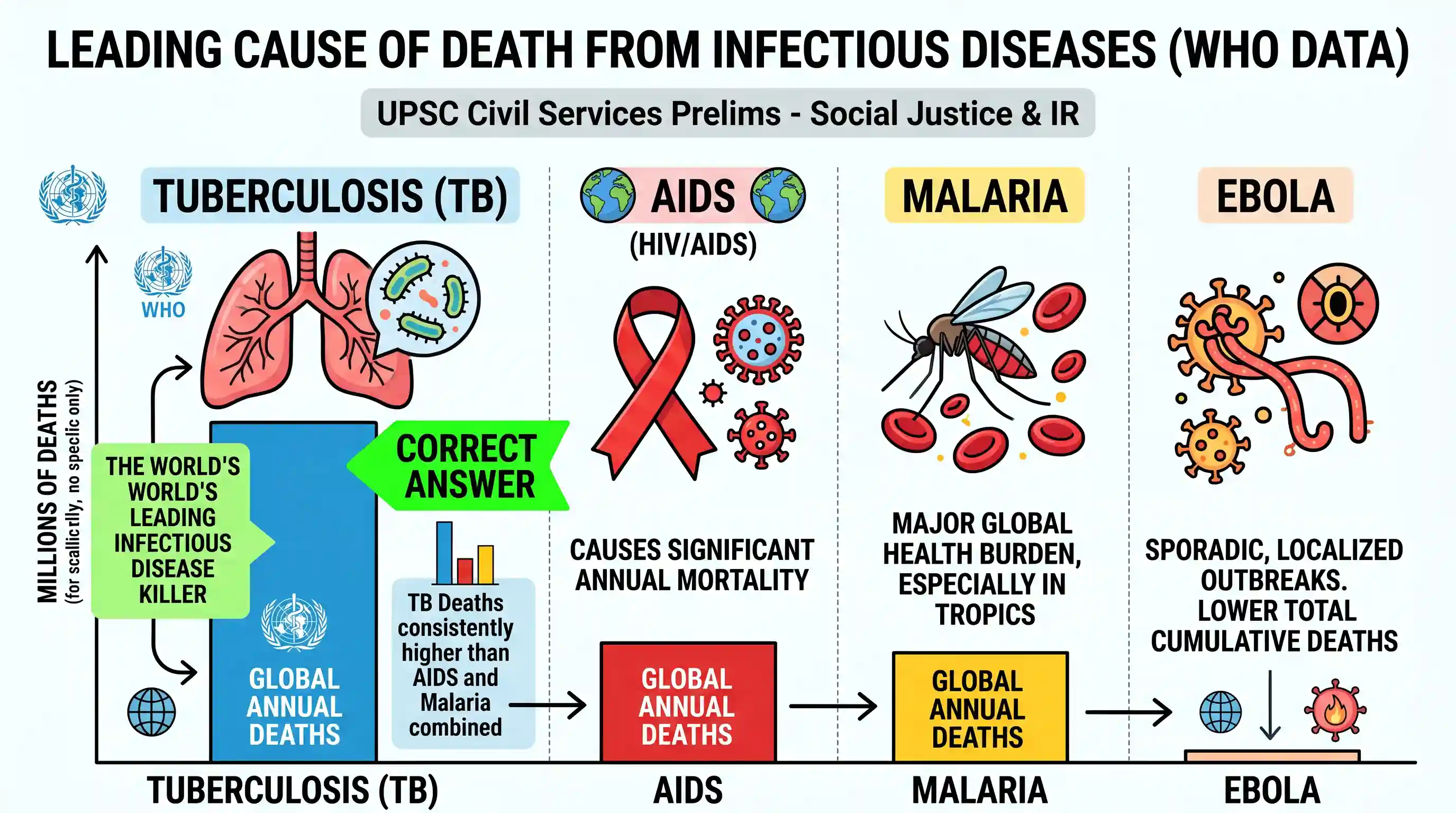
According to the World Health Organisation, the disease which causes the death of the largest number of people today is

- AAIDS
- BTuberculosisCorrect
- CMalaria
- DEbola
Explanation
Tuberculosis is currently the leading cause of death among the infectious diseases listed. According to the World Health Organization, it consistently results in more annual deaths globally than AIDS and Malaria combined. While Ebola is highly lethal, its outbreaks are sporadic and localized, resulting in a much lower total death toll compared to the millions of people who die from Tuberculosis each year. Therefore, Tuberculosis remains the most significant global health threat in terms of annual mortality among these options.
Related questions
More UPSC Prelims practice from the same subject and topic.
- Prelims 1996GS1polity-and-governance
In the Indian context the term De-notified tribes refers to
- Prelims 1996GS1polity-and-governance
If the number of seats allocated to a state in the Lok Sabha is 42, then the number of seats reserved for the Scheduled Castes in that state will be
- Prelims 1996GS1polity-and-governance
The power of the Supreme Court of India to decide disputes between the Centre and the States falls under its
- Prelims 1996GS1polity-and-governance
Which one of the following first mooted the idea of a constituent assembly to frame a constitution for India?
- Prelims 1996GS1polity-and-governance
When the Chief Justice of a High Court acts in an administrative capacity, he is subject to
- Prelims 1996GS1polity-and-governance
According to the Constitution of India, the term ‘district judge’ shall not include