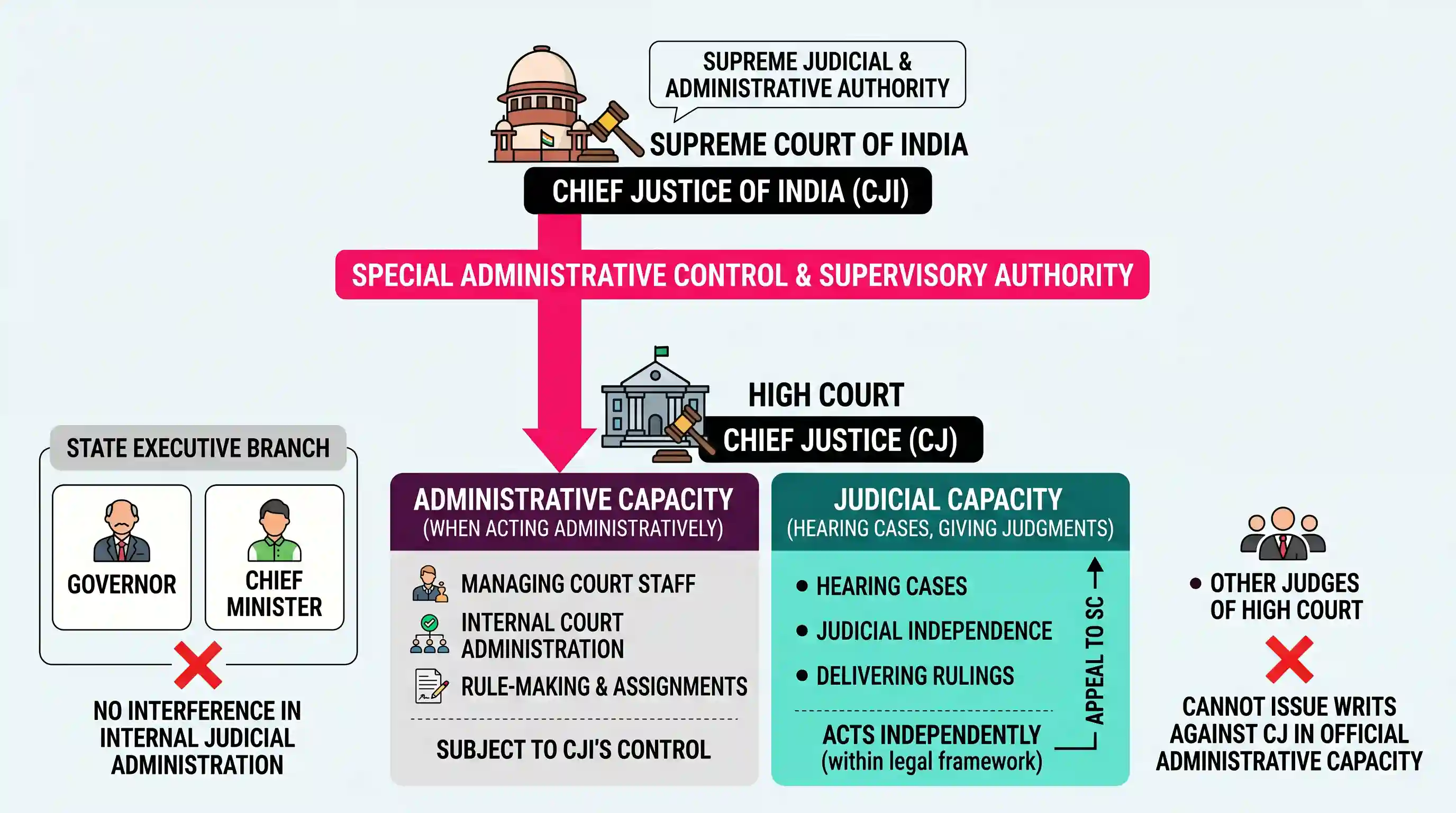
When the Chief Justice of a High Court acts in an administrative capacity, he is subject to

- Athe writ jurisdiction of any of the other judges of the High Court
- Bspecial control exercised by the Chief Justice of IndiaCorrect
- Cdiscretionary powers of the Governor of the state
- Dspecial powers provided to the Chief Minister in this regard
Explanation
The correct answer is B because of the administrative hierarchy within the Indian judiciary. While the Chief Justice of a High Court has judicial independence, their administrative actions regarding the management of the court and its staff are subject to the supervisory authority and special control of the Chief Justice of India. This ensures uniformity and accountability in judicial administration across the country. Options C and D are incorrect because the executive branch cannot interfere in the internal administration of the judiciary. Option A is incorrect because one judge cannot typically issue a writ against another judge of the same court acting in an official capacity.
Related questions
More UPSC Prelims practice from the same subject and topic.
- Prelims 1996GS1polity-and-governance
The power of the Supreme Court of India to decide disputes between the Centre and the States falls under its
- Prelims 1996GS1polity-and-governance
According to the Constitution of India, the term ‘district judge’ shall not include
- Prelims 1996GS1polity-and-governance
If the number of seats allocated to a state in the Lok Sabha is 42, then the number of seats reserved for the Scheduled Castes in that state will be
- Prelims 1996GS1polity-and-governance
In the Indian context the term De-notified tribes refers to
- Prelims 1996GS1polity-and-governance
According to the World Health Organisation, the disease which causes the death of the largest number of people today is
- Prelims 1996GS1polity-and-governance
Which one of the following first mooted the idea of a constituent assembly to frame a constitution for India?