Hawala transactions relate to payments

- Areceived in rupees against overseas currencies and vice versa without going through the official channelsCorrect
- Breceived for sale/transfer of shares without going through the established stock exchanges
- Creceived as commission for services rendered to overseas investors/buyers/sellers in assisting them to get over the red tape and/or in getting preferential treatment
- Dmade to political parties or to individuals for meeting election expenses
Explanation
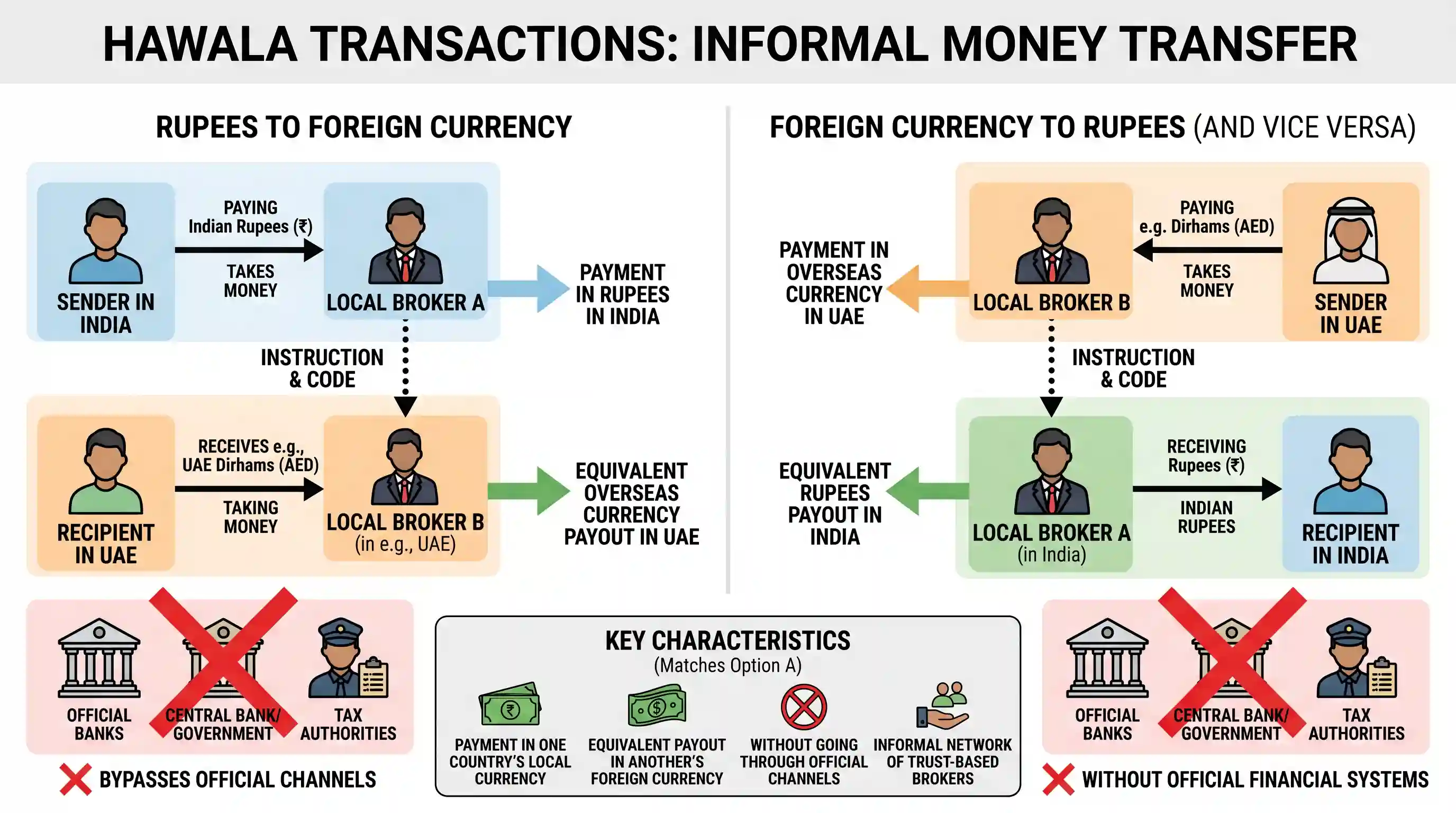
Hawala is an informal method of transferring money without any physical movement of cash or the use of formal banking systems. It works on a parallel network based on trust and a system of local brokers. In these transactions, money is paid in one country in its local currency, and an equivalent amount is paid out in another country in its respective currency through an unofficial agent. Since these payments bypass the official banking channels regulated by the government and central banks, they are often used to avoid taxes or move money across borders anonymously. Option A accurately describes this process of exchanging rupees for foreign currency outside the formal financial system.
Related questions
More UPSC Prelims practice from the same subject and topic.
- Prelims 1996GS1economy
A redistribution of income in a country can be best brought about through
- Prelims 1996GS1economy
The following Table shows the percentage distribution of revenue expenditure of Government of India in 1989-90 and 1994-95: | Years | Defence | Interest | Subsidies | Grants to | | :--- | :--- | :--- …
- Prelims 1996GS1economy
Which one of the following is correct regarding stabilization and structural adjustment as two components of the new economic policy adopted in India?
- Prelims 1996GS1economy
Assertion (A): An important policy instrument of economic liberalization is reduction in import duties on capital goods. Reason (R): Reduction in import duties would help the local entrepreneurs to im…
- Prelims 1996GS1economy
One of the important goals of the economic liberalisation policy is to achieve full convertibility of the Indian rupee. This is being advocated because
- Prelims 1996GS1economy
The emerging trading blocs in the world, such as NAFTA, ASEAN and the like, are expected to