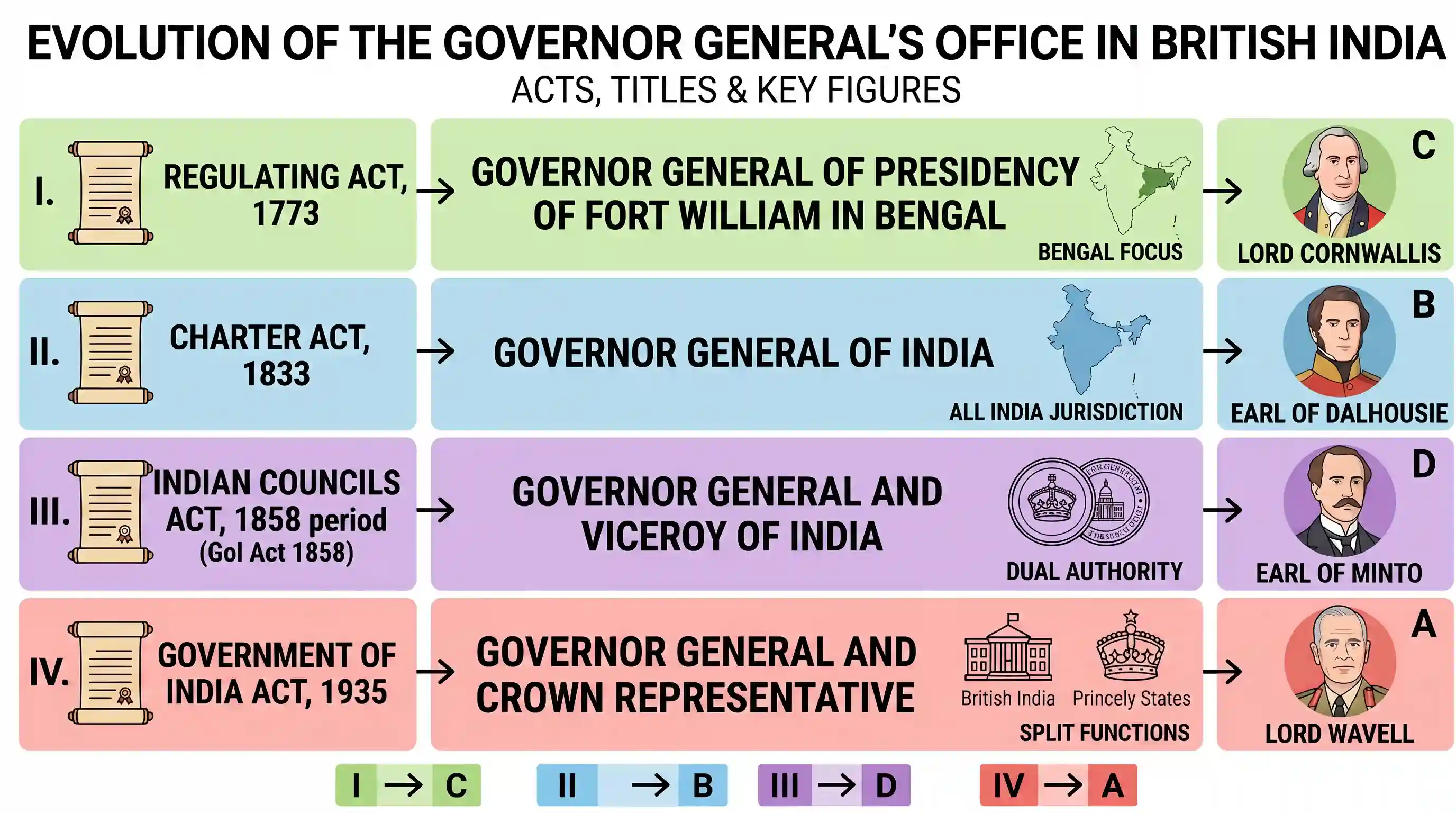
Match List I with List II and select the correct answer by using the codes given below the lists: List I List II I. Governor General of Presidency of Fort William in Bengal (under Regulating Act, 1773) A) Archibald Percival Wavell, Viscount and Earl Wavell II. Governor General of India (under Charter Act, 1833) B) James Andrew Broun Ramsay, Earl and Marquess of Dalhousie III. Governor General and Viceroy of India (under Indian Councils Act, 1858) C) Charles Cornwallis, 2nd Earl and first Marquess of Cornwallis IV. Governor General and Crown Representative (under Government of India Act. 1935) D) Gilbert John Elliot - Murray - Kynynmond, Earl of Minto E) Louis Mountbatten, Earl Mountbatten of Burma Codes:

- AI - C, II - B, III - D, IV - ACorrect
- BI - C, II - D, III - A, IV - E
- CI - B, II - C, III - D, IV - E
- DI - D, II - B, III - C, IV - A
Explanation
The correct answer is A because each person listed matches the specific legal title created by the corresponding Act.
I matches C: Lord Cornwallis served as the Governor General of the Presidency of Fort William in Bengal. The Regulating Act of 1773 established this title, and Cornwallis held this position during his first tenure starting in 1786.
II matches B: Lord Dalhousie served as the Governor General of India. This title was created by the Charter Act of 1833, which converted the Governor General of Bengal into the Governor General of India. Dalhousie held this office from 1848 to 1856.
III matches D: Lord Minto served as the Governor General and Viceroy of India. The Government of India Act 1858 or the Indian Councils Act period established the dual title of Viceroy. Minto served from 1905 to 1910 under this framework.
IV matches A: Lord Wavell served as the Governor General and Crown Representative. The Government of India Act 1935 split the functions of the representative of the British Crown, creating the specific designation of Crown Representative for dealings with the Princely States. Wavell held this position from 1943 to 1947.
Related questions
More UPSC Prelims practice from the same subject and topic.
- Prelims 1996GS1history
The meeting of Indian and British political leaders during 1930-32 in London has often been referred to as the First. Second and Third Round Table Conferences. It would be incorrect to refer to them a…
- Prelims 1996GS1history
Who among the following was a prominent leader of the Congress Socialist Party?
- Prelims 1996GS1history
Consider the following landmarks in Indian education: i) Hindu College, Calcutta ii) University of Calcutta iii) Adam’s Report iv) Wood’s Despatch The correct chronological order of these landmarks is
- Prelims 1996GS1history
Match List I with List II and select the correct answer by using the codes given below the lists: List I List II I. Surendranath Bannerjee A) Hind Swaraj II. M. K. Gandhi B) The Indian Struggle III. S…
- Prelims 1996GS1history
Consider the following statements about Jawaharlal Nehru: I. He was the President of the Congress Party in 1947. II. He presided over the Constituent Assembly. III. He formed the first Congress Minist…
- Prelims 1996GS1history
Which one of the following is not correct about the Cabinet Mission Plan?