Consider the following statements: No one can be compelled to sing the National Anthem since I. it will be violative of the Right to freedom of speech and expression. II. it will be violative of the Right to freedom of conscience and practise and propagation of religion. III. there is no legal provision obliging any one to sing the National Anthem. Of these statements

- AI and II are correct
- BII and III are correct
- CI, II and III are correctCorrect
- DNone is correct
Explanation
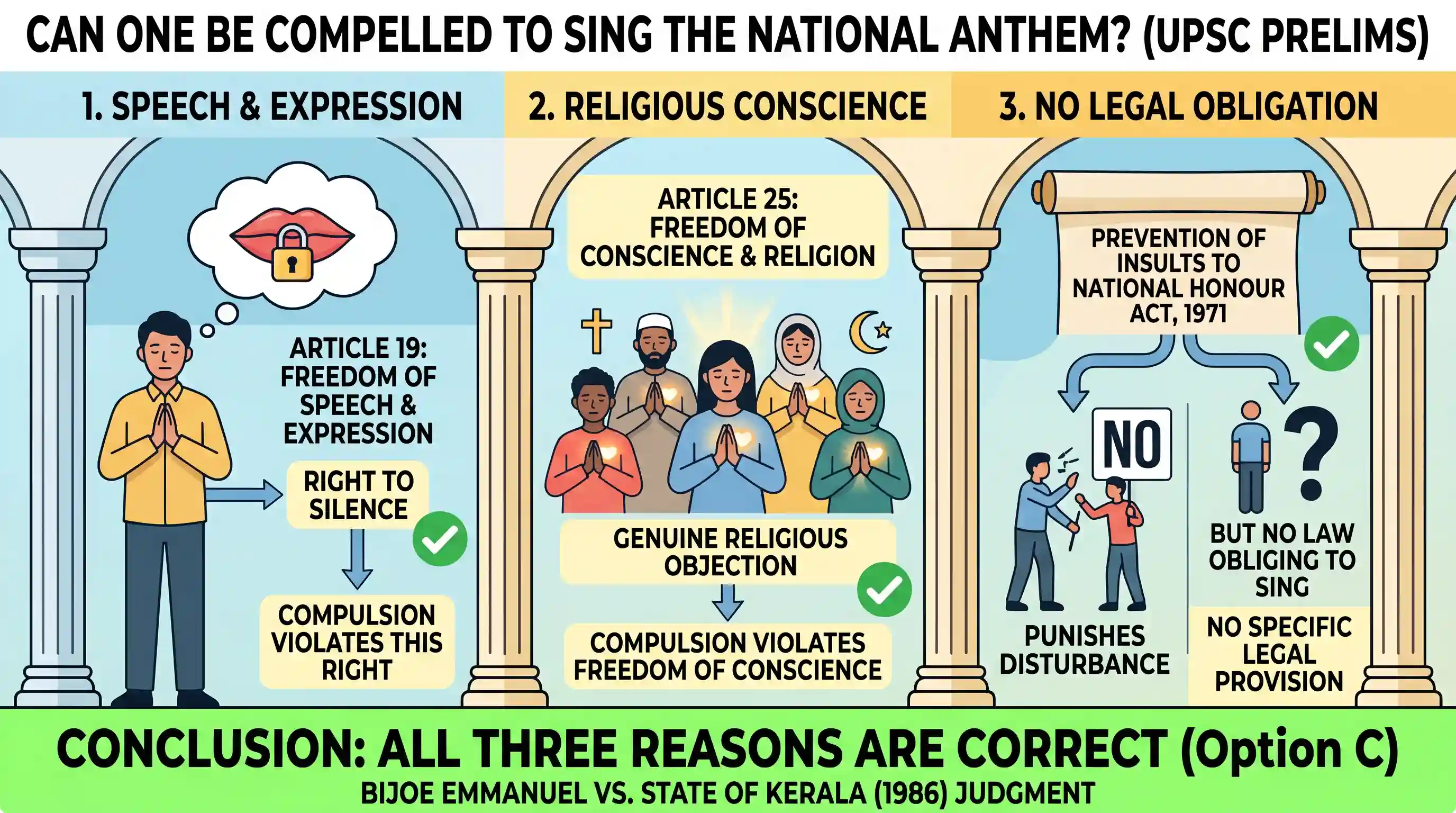
The correct answer is C because all three statements are based on the landmark Supreme Court judgment in the case of Bijoe Emmanuel vs. State of Kerala 1986.
Regarding statement I, the Court ruled that the right to remain silent is part of the freedom of speech and expression under Article 19. Compelling someone to sing against their will violates this right.
Regarding statement II, the Court held that if a person has a genuine religious objection to singing the anthem but shows proper respect by standing, forcing them to sing violates the freedom of conscience and religion under Article 25.
Regarding statement III, the Court noted that while the Prevention of Insults to National Honour Act 1971 punishes anyone who prevents the singing or causes disturbance to an assembly engaged in singing, there is no specific law that legally obliges an individual to sing the anthem.
Since all three points were upheld by the Supreme Court, option C is the correct choice.
Related questions
More UPSC Prelims practice from the same subject and topic.
- Prelims 1996GS1polity-and-governance
Which one of the following first mooted the idea of a constituent assembly to frame a constitution for India?
- Prelims 1996GS1polity-and-governance
Which one of the following is part of the electoral college for the election of the President of India but does not form part of the forum for his impeachment?
- Prelims 1996GS1polity-and-governance
B.R. Ambedkar was elected to the Constituent Assembly from
- Prelims 1996GS1polity-and-governance
If the number of seats allocated to a state in the Lok Sabha is 42, then the number of seats reserved for the Scheduled Castes in that state will be
- Prelims 1996GS1polity-and-governance
In the Indian context the term De-notified tribes refers to
- Prelims 1996GS1polity-and-governance
The power of the Supreme Court of India to decide disputes between the Centre and the States falls under its