Two important characteristics of a hypothesis are that it should be testable and that it should be stated in a manner that it can be refuted. Which one of the following hypotheses, fulfils these characteristics?

- AIntelligent persons have good memoryCorrect
- BSome birds are animals
- CSome businessmen are dishonest
- DAll men are mortal
Explanation
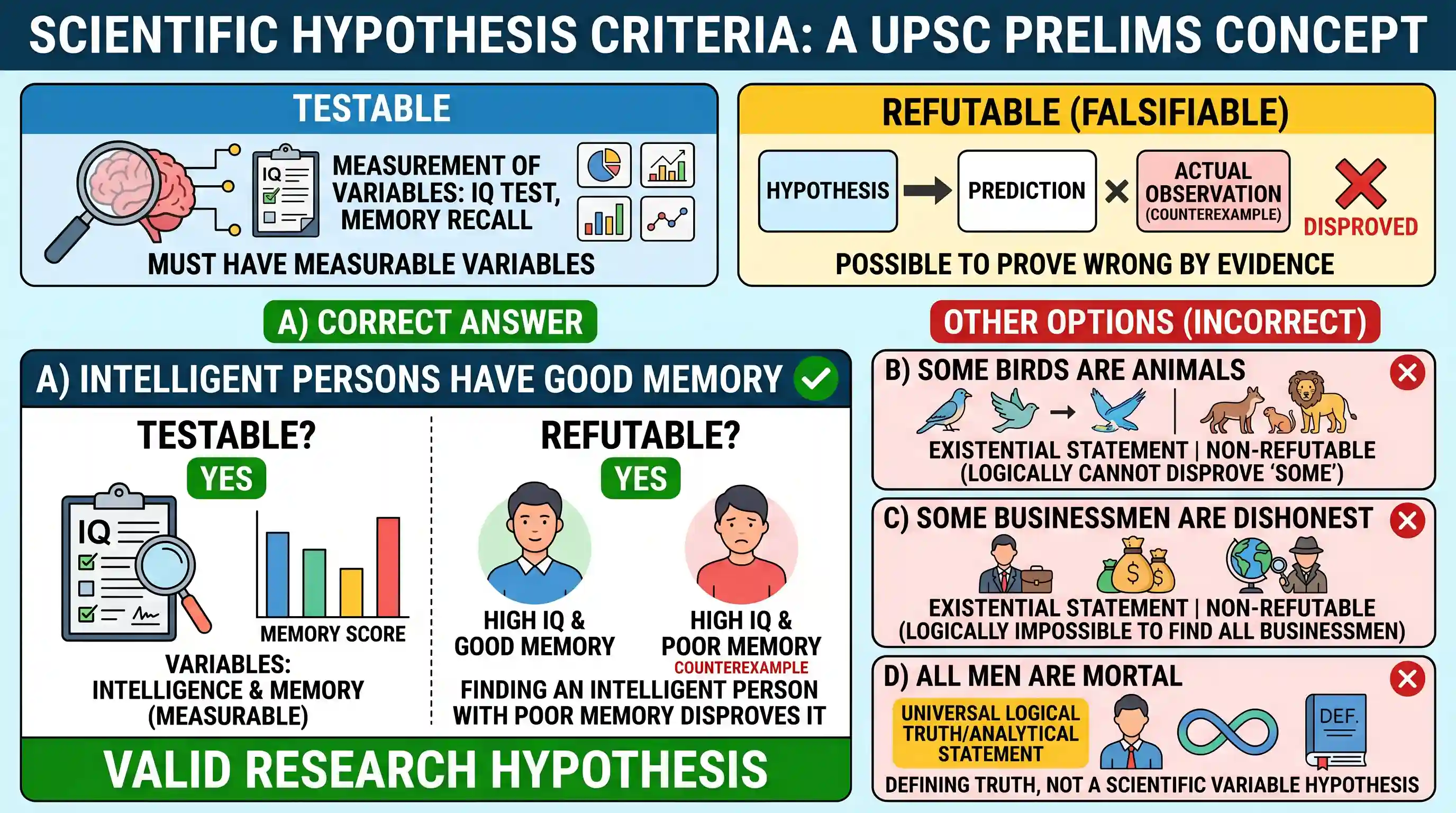
The correct answer is A because it presents a scientific hypothesis that is both testable and falsifiable.
In research, a hypothesis must define variables that can be measured. In option A, intelligence can be measured using IQ tests and memory can be measured through recall tests. This makes the statement testable. Furthermore, it is refutable because if a study finds a group of intelligent people with poor memory, the hypothesis is proven wrong.
Options B and C are existential statements starting with some. These are logically impossible to refute because you can never prove that no dishonest businessman exists anywhere in the world. Option D is considered a universal logical truth or an analytical statement rather than a scientific hypothesis that can be tested or refuted through empirical observation.
Related questions
More UPSC Prelims practice from the same subject and topic.
- Prelims 1996GS1science-and-technology
Which one of the following is a modified stem?
- Prelims 1996GS1science-and-technology
Fat present below the skin surface in our body, acts as a barrier against
- Prelims 1996GS1science-and-technology
Which of the following professional (s) are more likely to run the risk of a permanent change in their cell’s DNA? I. Researchers using carbon-14 isotope II. X-ray technician III. Coal miner IV. Dyer …
- Prelims 1996GS1science-and-technology
Which one of the following is not an essential micronutrient for plants?
- Prelims 1996GS1science-and-technology
Of the four landmarks in medical history given below, which one was the first to take place?
- Prelims 1996GS1science-and-technology
Living organisms require at least 27 elements of which 15 are metals. Among these, those required in major quantities include