A man starts walking in the north-easterly direction from a particular point. After walking a distance of 500 metres, he turns southward and walks a distance of 400 metres. At the end of this walk he is situated

- A300 metres north of the starting point
- B100 metres north-east of the starting point
- C300 metres east of the starting pointCorrect
- D100 metres north of the starting point
Explanation
This problem can be solved using the properties of a right angled triangle.
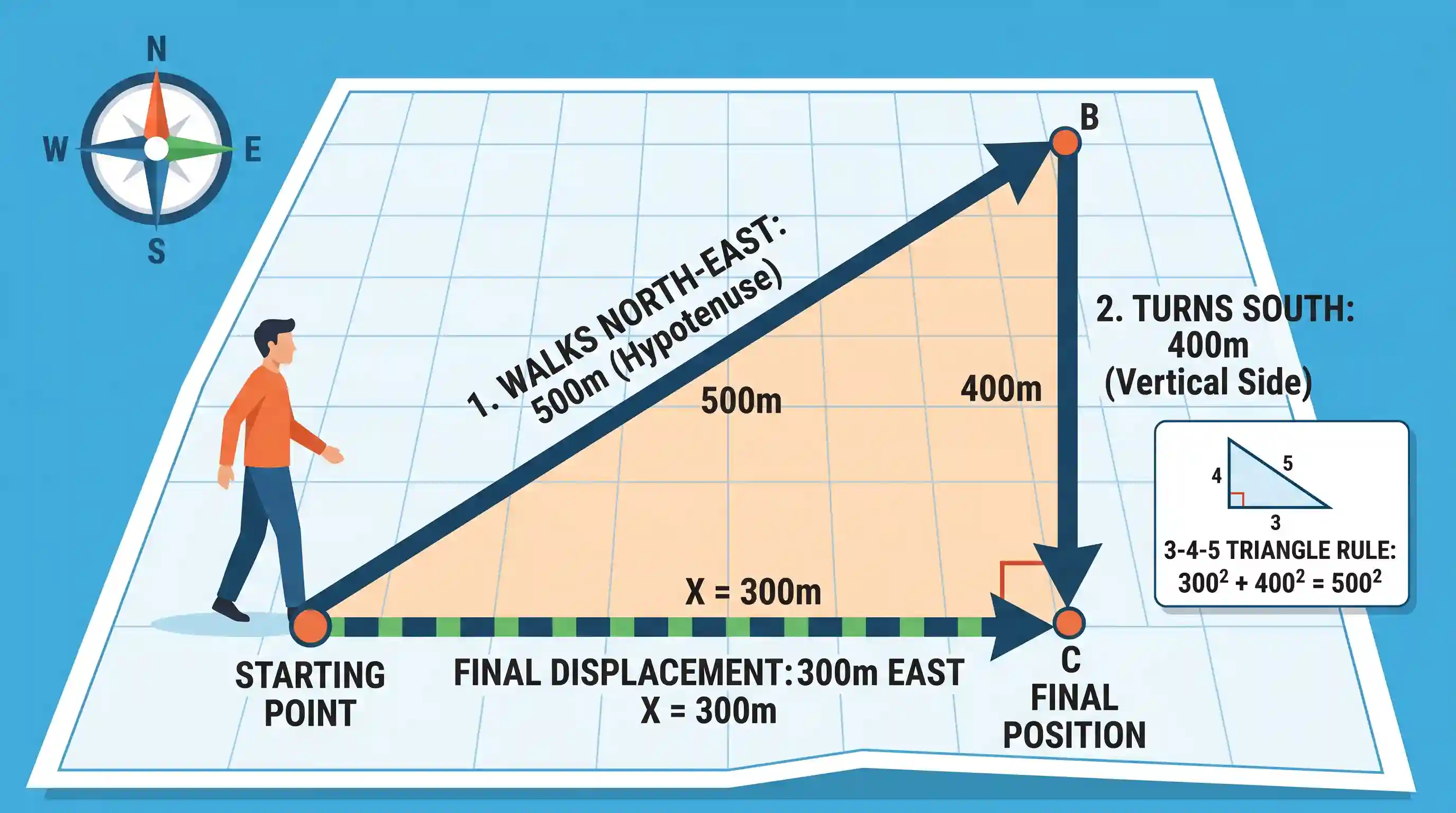
The man starts at the origin. Walking 500 metres in a north easterly direction represents the hypotenuse of a right angled triangle. When he turns south and walks 400 metres, this distance represents one side of the triangle specifically the vertical displacement.
To find his final position relative to the starting point, we use the Pythagorean theorem: base squared plus height squared equals hypotenuse squared.
Let the horizontal distance from the start be X. X squared plus 400 squared equals 500 squared. X squared plus 160000 equals 250000. X squared equals 90000. X equals 300.
Because the north easterly path and the southward turn form a right angle with the horizontal line extending from the starting point, he ends up exactly 300 metres east of his original position. The vertical climb of the north east walk is cancelled out by the 400 metre walk south, leaving him on the same horizontal axis as the starting point.
Therefore, the correct option is C.
Related questions
More UPSC Prelims practice from the same subject and topic.
- Prelims 1996GS1geography
Which of the following pairs of states and their important crops are correctly matched? I. Kerala: Tapioca II. Maharashtra: Cotton III. W. Bengal: Jute IV. Gujarat: Groundnut Select the correct answer…
- Prelims 1996GS1geography
As per the 1991 Census, the average size of households in terms of number of persons per household in respect of the given states follows the sequence (highest first, lowest last).
- Prelims 1996GS1geography
Which one of the following rivers thrice forks into two streams and reunites a few miles farther on, thus forming the islands of Srirangappattanam, Sivasamudram and Srirangam?
- Prelims 1996GS1geography
As per the 1991 Census, which one of the following states has a lower population density than the other three?
- Prelims 1996GS1geography
Which one of the following layers of the atmosphere is responsible for the deflection of radio waves?
- Prelims 1996GS1geography
Which one of the following regions of India is now regarded as an ‘ecological hot spot’?