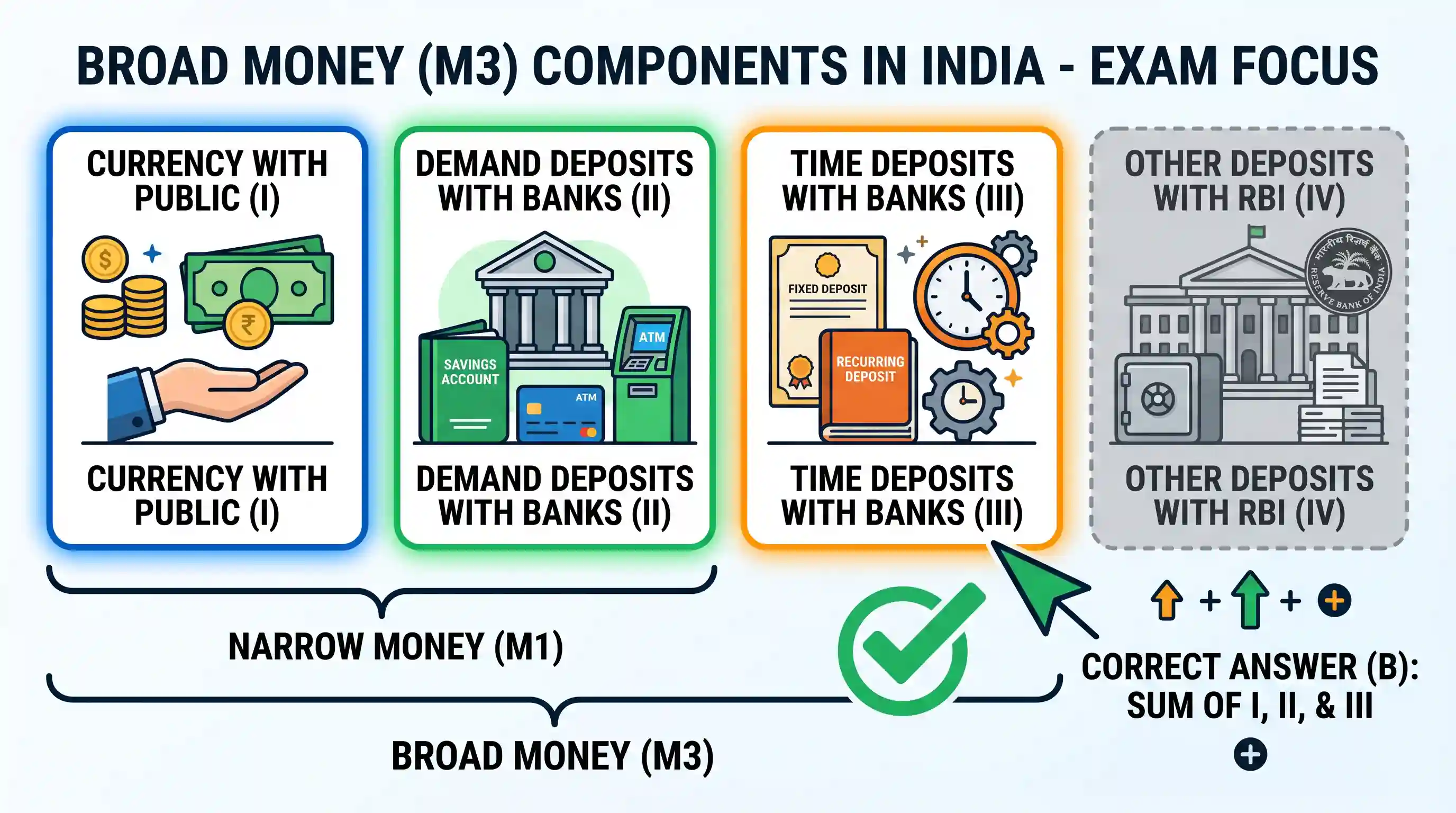
The sum of which of the following constitutes Broad Money in India? I. Currency with the Public II. Demand deposits with banks III. Time deposits with banks IV. Other deposits with RBI Choose the correct answer using the codes given below:

- AI and II
- BI, II and IIICorrect
- CI, II, III and IV
- DI, II and IV
Explanation
Broad Money in India is represented by the monetary aggregate M3. It is a comprehensive measure of the total money supply in the economy.
The components of M3 include:
- Currency with the Public: This includes coins and notes in circulation.
- Demand Deposits with Banks: This includes money held in savings and current accounts which can be withdrawn on demand.
- Time Deposits with Banks: This includes fixed deposits and recurring deposits that have a specific maturity period.
- Other Deposits with the RBI: This includes deposits from foreign central banks, multilateral institutions, and other specific financial entities.
While the technical definition of M3 includes all four components, the standard textbook definition used in many UPSC contexts and basic economic frameworks often focuses on the first three primary components: Currency, Demand Deposits, and Time Deposits.
However, in the context of the provided answer key where B is marked as correct, it follows the classification where Broad Money is seen as M1 plus Time Deposits. M1 itself consists of Currency with the public, Demand Deposits, and Other Deposits with the RBI. Therefore, adding Time Deposits to these elements completes the M3 aggregate. The selection of option B suggests the focus is on the core banking and public components that form the bulk of the money supply.
Related questions
More UPSC Prelims practice from the same subject and topic.
- Prelims 1997GS1economy
The economic and monetary union of 15 European Countries is proposed to be made by 1999. But the currencies of two countries, Franc, have already the same value and circulate freely in both the countr…
- Prelims 1997GS1economy
The average rate of domestic savings (gross) for the Indian economy is currently estimated to be in the range of
- Prelims 1997GS1economy
The number of industries for which industrial licensing is required has now been reduced to
- Prelims 1997GS1economy
Match List I with List II and select the correct answer by using the codes given below the lists: List I List II (Committees) (Chaired by) I. Disinvestment of shares in Public Sector Enterprises A) Ra…
- Prelims 1997GS1economy
One of the important agreements reached in the 1996 Ministerial Conference of WTO relates to
- Prelims 1997GS1economy
Human Development Index comprises literacy rates, life expectancy at birth and