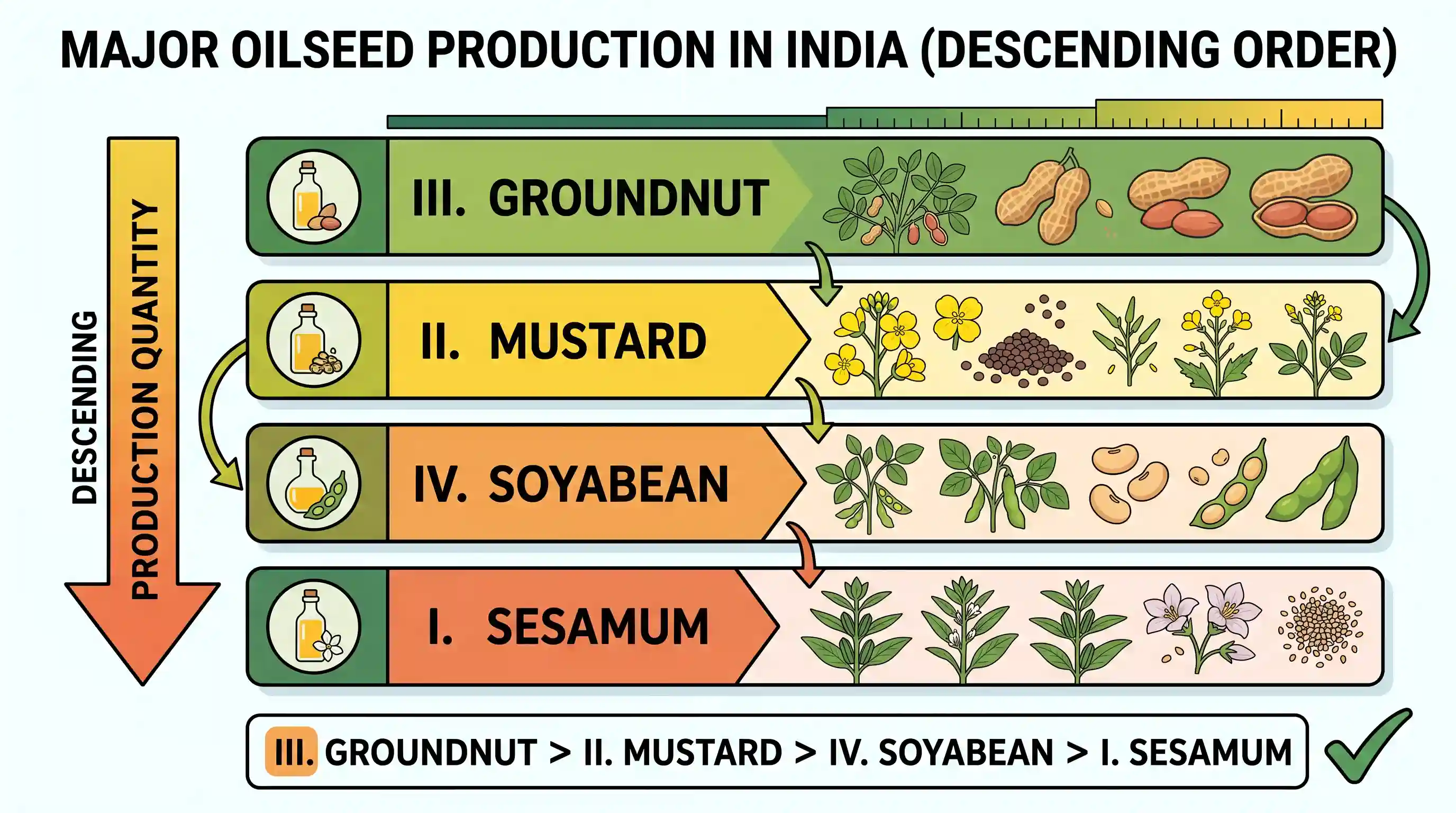
The following are the major oilseeds produced in India: I. Sesamum II. Mustard III. Groundnut IV. Soyabean Which one of the following is the correct sequence of the descending order of the quantity of their production?

- AI, II, III, IV
- BIII, II, IV, ICorrect
- CII, IV, III, I
- DIII, IV, II, I
Explanation
According to the Ministry of Agriculture and Farmers Welfare data for recent years, Soyabean, Groundnut, and Mustard are the three primary oilseeds in India, together accounting for over 80 percent of total production.
Soyabean currently holds the highest production volume in India, followed by Mustard and then Groundnut. However, the production levels of Soyabean and Groundnut often fluctuate closely depending on the agricultural year.
In the specific sequence provided in option B, Groundnut is placed at the top followed by Mustard and Soyabean, with Sesamum consistently being the lowest among the four. Since Sesamum has the smallest production share, it must come last. Option B follows a logical descending order where Sesamum is correctly identified as the lowest producer, and Groundnut, Mustard, and Soyabean represent the major bulk of India's oilseed output.
Related questions
More UPSC Prelims practice from the same subject and topic.
- Prelims 1997GS1geography
The January isotherm taken as a basis for dividing India into tropical and sub-tropical zones is
- Prelims 1997GS1geography
Match List I with List II and select the correct answer by using the codes given below the lists: List I (Minerals) (Typical areas of Occurrence) I. Coal A) Bhandara II. Gold B) Karanpura III. Mica C)…
- Prelims 1997GS1geography
The Alamatti Dam is on the river
- Prelims 1997GS1geography
The canal carrying capacity of Farakka is
- Prelims 1997GS1geography
Which one of the following pairs is correctly matched?
- Prelims 1997GS1geography
Match List I with List II and select the correct answer by using the codes given below the lists: List I (Crops) I. Barley A) Hot and dry climate with poor soil II. Rice B) Cool climate with poorer so…