Which of the following come under Non-plan expenditure? I. Subsidies II. Interest payments III. Defence expenditure IV. Maintenance expenditure for the infrastructure created in the previous plans Choose the correct answer using the codes given below: Codes:

- AI and II
- BI and III
- CII and IV
- DI, II, III and IVCorrect
Explanation
The correct option is D because all four items listed were classified as Non plan expenditure under the traditional budgeting system used in India before the distinction between Plan and Non plan expenditure was abolished in 2017 18.
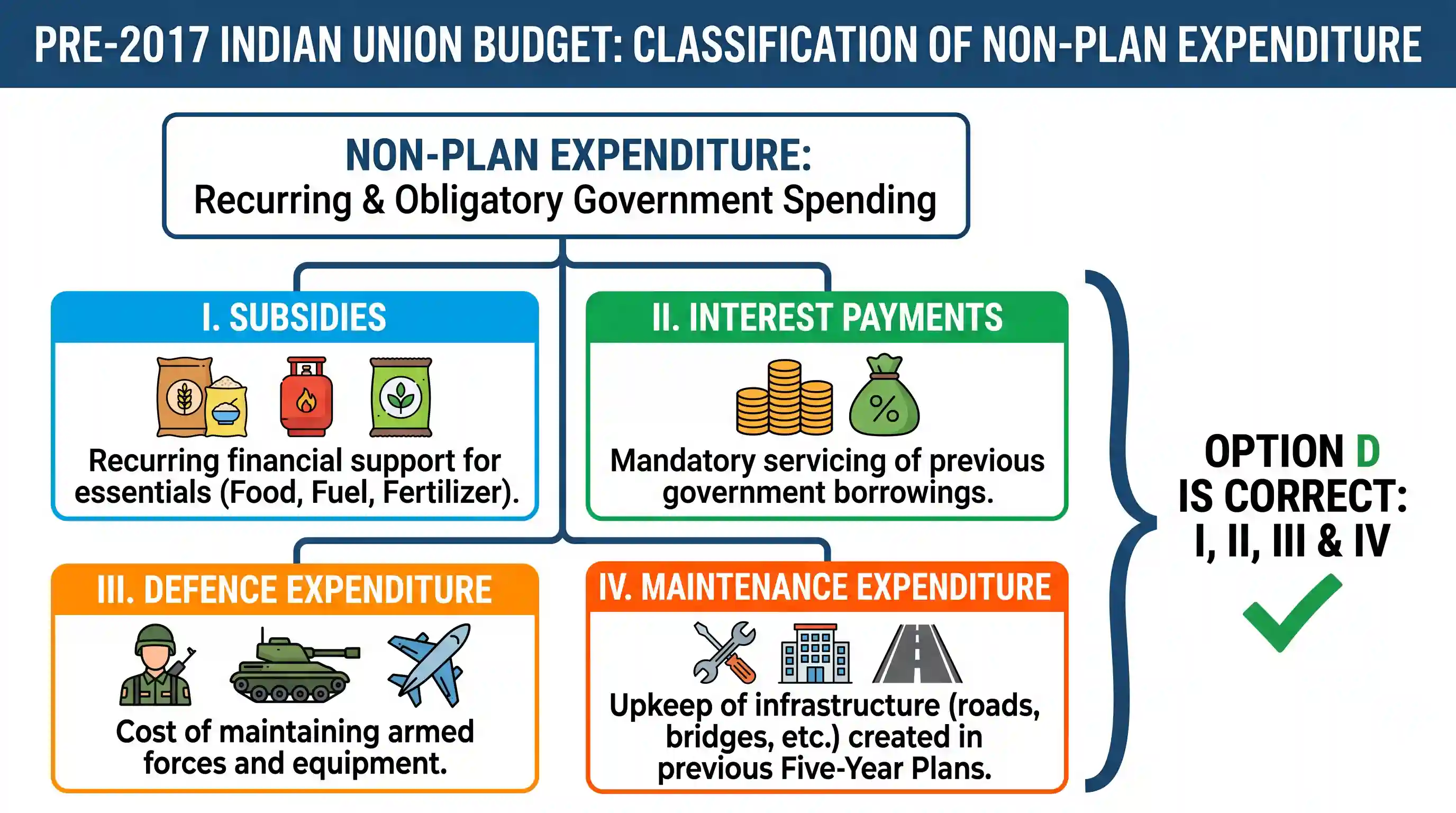
Non plan expenditure refers to the estimated expenditure of the government that is not part of the Five Year Plans. It primarily covers the recurring and obligatory costs required to maintain the status quo of the administration and existing assets.
- Subsidies: These are recurring financial supports for food, fuel, and fertilizers, falling under regular revenue expenditure.
- Interest payments: These are mandatory servicing costs for previous government borrowings and constitute the largest component of Non plan expenditure.
- Defence expenditure: This includes the maintenance of the armed forces and equipment, which is treated as a sovereign necessity outside the scope of developmental planning.
- Maintenance expenditure: While building new infrastructure is considered Plan expenditure, the money spent on maintaining assets created in previous plans is categorized as Non plan expenditure once the specific plan period ends.
Since all four categories represent these types of mandatory or recurring costs, they all come under Non plan expenditure.
Related questions
More UPSC Prelims practice from the same subject and topic.
- Prelims 1997GS1economy
The Minimum Alternative Tax (MAT) was introduced in the Budget of the Government of India for the year
- Prelims 1997GS1economy
The economic and monetary union of 15 European Countries is proposed to be made by 1999. But the currencies of two countries, Franc, have already the same value and circulate freely in both the countr…
- Prelims 1997GS1economy
The average rate of domestic savings (gross) for the Indian economy is currently estimated to be in the range of
- Prelims 1997GS1economy
The number of industries for which industrial licensing is required has now been reduced to
- Prelims 1997GS1economy
The sum of which of the following constitutes Broad Money in India? I. Currency with the Public II. Demand deposits with banks III. Time deposits with banks IV. Other deposits with RBI Choose the corr…
- Prelims 1997GS1economy
Match List I with List II and select the correct answer by using the codes given below the lists: List I List II (Committees) (Chaired by) I. Disinvestment of shares in Public Sector Enterprises A) Ra…