Consider the following statements: The price of any currency in international market is decided by the I. World Bank. II. demand for goods/services provided by the country concerned. III. stability of the government of the concerned country. IV. economic potential of the country in Q. Of these statements:

- AI, II, III and IV are correct
- BII and III are correctCorrect
- CIII and IV are correct
- DI and IV are correct
Explanation
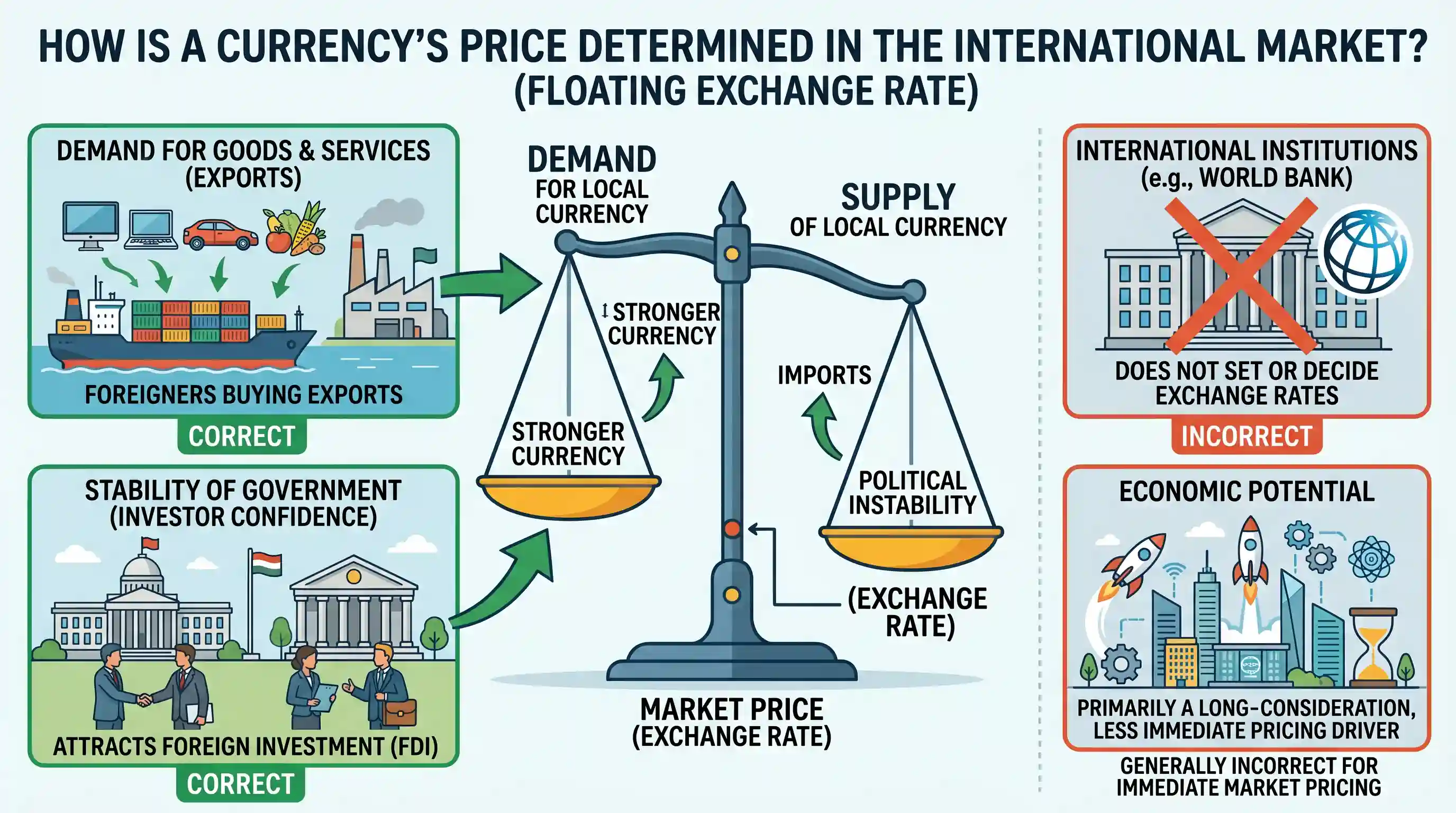
The correct answer is B because the price of a currency in a floating exchange rate system is determined by market forces rather than a central international organization.
Statement I is incorrect because the World Bank does not set or decide the exchange rates of currencies. It is an international financial institution that provides loans and grants.
Statement II is correct because the demand for a countrys goods and services directly creates a demand for its currency. When international buyers want to purchase exports from a specific country, they must buy that countrys currency, which increases its value.
Statement III is correct because political stability is a key factor for investor confidence. A stable government attracts foreign investment, leading to higher demand for the local currency. Conversely, political instability leads to capital flight and currency depreciation.
Statement IV is generally considered incorrect in the context of immediate market pricing because economic potential is a long term prospect. While potential matters, the international market reacts primarily to current economic indicators, interest rates, and actual performance rather than theoretical potential.
Therefore, statements II and III are the primary market drivers that decide the price of a currency in the international market.
Related questions
More UPSC Prelims practice from the same subject and topic.
- Prelims 1998GS1economy
Which one of the following regions of the world supplies the maximum of our imported commodities (in terms of rupee value)?
- Prelims 1998GS1economy
The currency of the proposed European Monetary Union will be
- Prelims 1998GS1economy
The economist who was associated with the WTO draft document is
- Prelims 1998GS1economy
Which one of the following is the correct sequence of decreasing order of the given currencies in terms of their value in Indian Rupees?
- Prelims 1998GS1economy
Capital Account Convertibility of the Indian Rupee implies
- Prelims 1998GS1economy
Some time back, the Government of India, decided to delicense ‘white goods’ industry. ‘White goods’ include