A consumer is said to be in equilibrium, if

- Ahe is able to fulfil his need with a given level of incomeCorrect
- Bhe is able to live in full comforts with a given level of income
- Che can fulfil his needs without consumption of certain items
- Dhe is able to locate new sources of income
Explanation
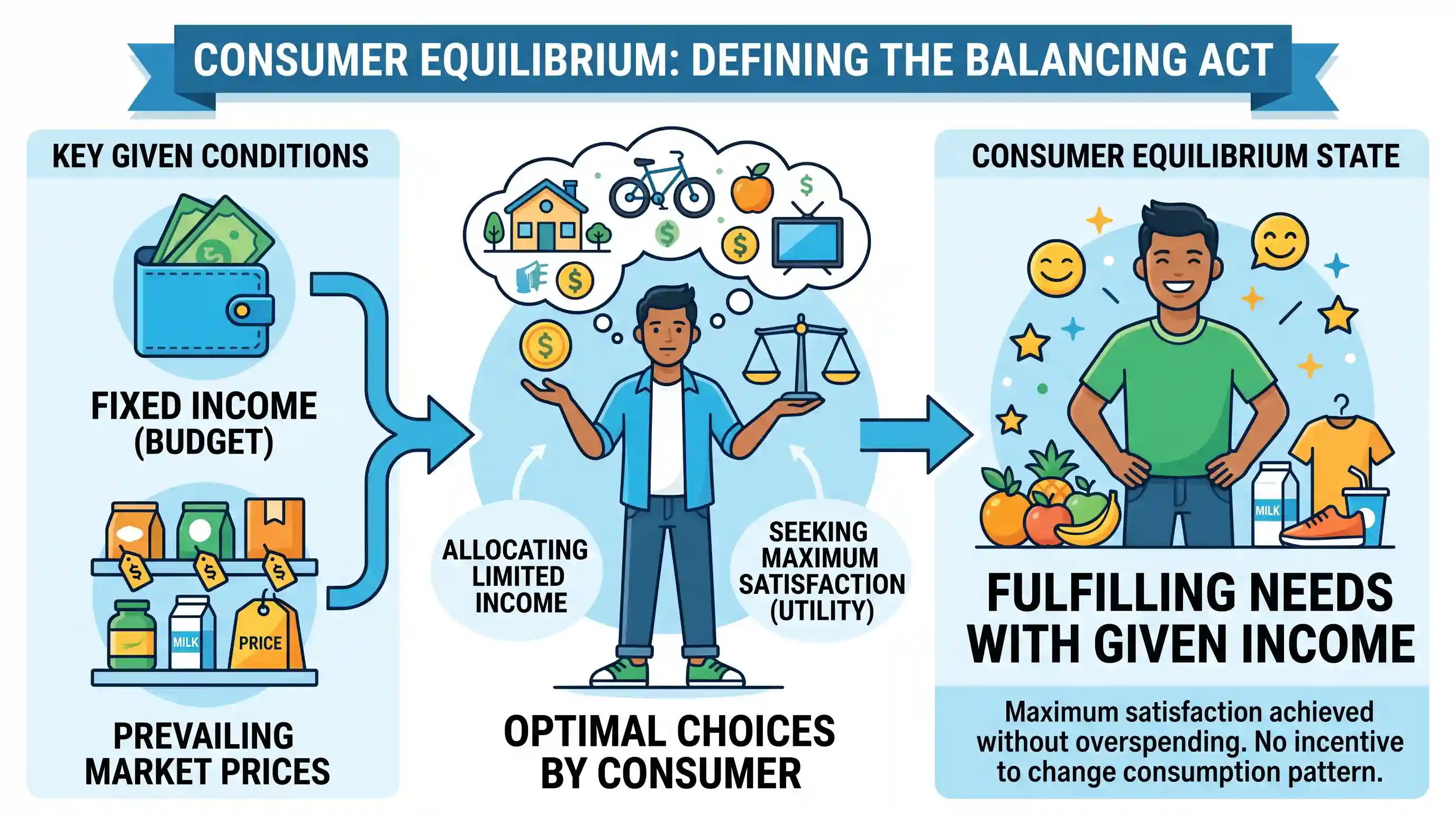
In economics, consumer equilibrium is a state where a consumer derives maximum satisfaction or utility from their expenditure. It occurs when a consumer, given their fixed level of income and the prevailing market prices of goods, allocates their spending in a way that fulfills their needs and wants optimally.
Option A is correct because it describes the situation where a consumer manages to maximize their utility and satisfy their requirements within the constraints of their specific budget. It signifies a point of balance where the consumer has no incentive to change their consumption pattern unless their income or the prices of goods change. Options B, C, and D are incorrect as they either refer to subjective levels of luxury, arbitrary restriction of consumption, or the acquisition of more wealth, none of which define the technical state of equilibrium.
Related questions
More UPSC Prelims practice from the same subject and topic.
- Prelims 1998GS1economy
The supply-side economics lays greater emphasis on the point of view of
- Prelims 1998GS1economy
Match List I with List II and select the correct answer using the codes given below the lists: List I List II I. Ringgit A) Indonesia II. Baht B) South Korea III. Rupiah C) Thailand IV. Won D) Malayas…
- Prelims 1998GS1economy
Human Poverty Index was introduced in the Human Development Report of the year
- Prelims 1998GS1economy
Which of the following pairs are correctly matched? I. Dow Jones: New York II. Hang Seng: Seoul III. FTSE - 100: London Select the correct answer using the codes given below:
- Prelims 1998GS1economy
According to the World Development Report, low-income economies are those for which the per capita GNP in 1994 was
- Prelims 1998GS1economy
Nobel Prize in Economics for the year 1997 was awarded for contribution in the area of