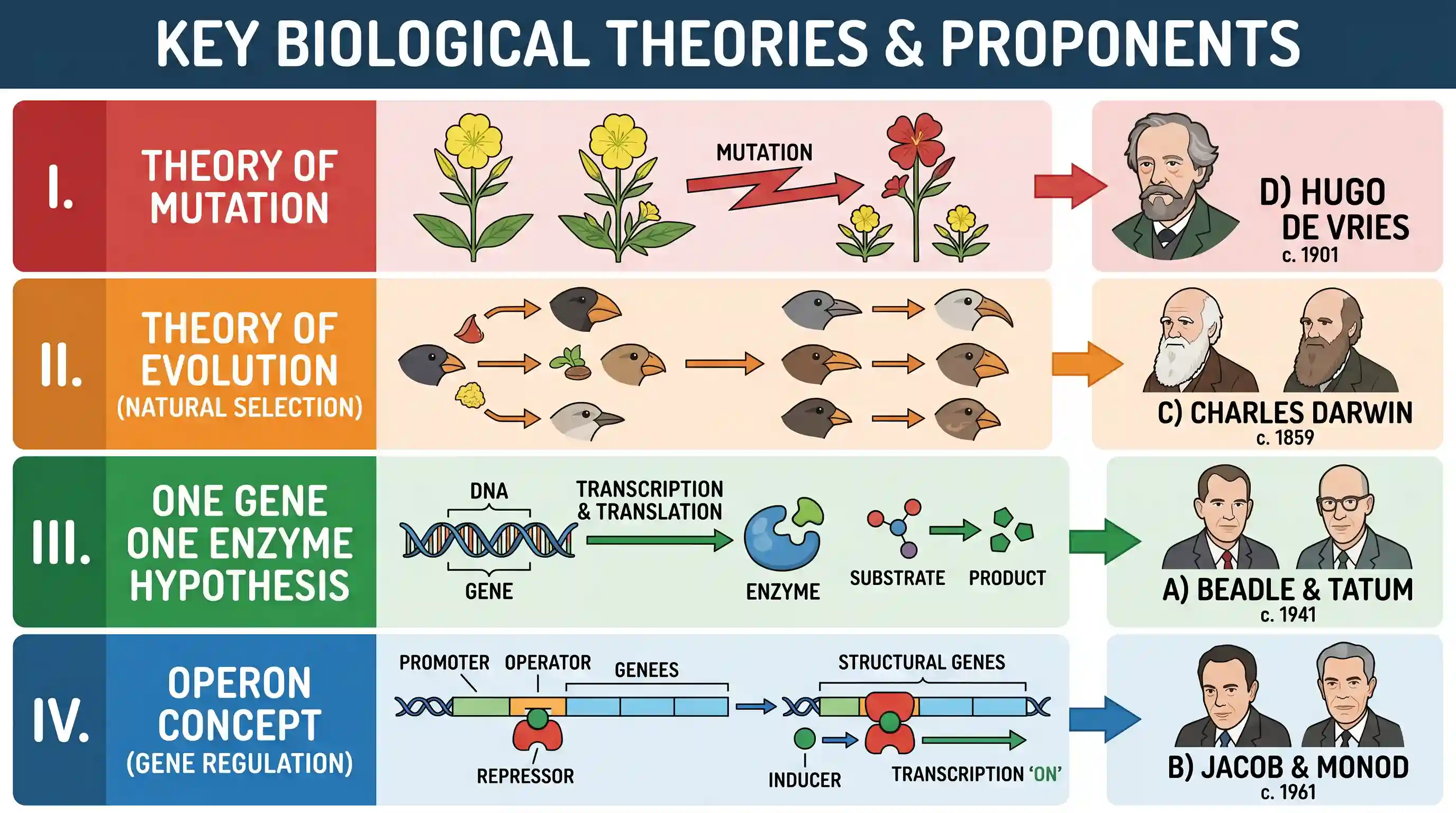
Match List I with List II and select the correct answer using the codes given below the lists: List I List II I. Theory of Mutation A) Beadk and Tatum II. Theory of Evolution B) Jacob and Monod III. One gene one enzyme hypothesis C) Darwin IV. Operon concept D) De Vries

- AI-C, II-D, III-A, IV-B
- BI-D, II-C, III-A, IV-BCorrect
- CI-D, II-C, III-B, IV-A
- DI-C, II-D, III-B, IV-A
Explanation
The correct answer is B because of the following matches:
I. Theory of Mutation: Hugo de Vries proposed that evolution occurs through sudden, large changes called mutations rather than gradual variations.
II. Theory of Evolution: Charles Darwin is renowned for the theory of evolution by natural selection, explaining how species change over generations.
III. One gene one enzyme hypothesis: George Beadle and Edward Tatum proposed this concept, suggesting that each gene is responsible for the production of a specific enzyme.
IV. Operon concept: Francois Jacob and Jacques Monod introduced this model to explain how genes are regulated and expressed in bacteria.
Matching these pairs leads directly to option B: I-D, II-C, III-A, IV-B.
Related questions
More UPSC Prelims practice from the same subject and topic.
- Prelims 1998GS1science-and-technology
A fuse is used in main electric supply as a safety device. Which one of the following statements about the fuse is correct?
- Prelims 1998GS1science-and-technology
Match List I with List II and select the correct answer using the codes given below the lists: List I (Disease) (Organism) I. Malaria A) Fungi II. Poliomyelitis B) Bacteria III. Tuberculosis C) Virus …
- Prelims 1998GS1science-and-technology
Haemophilia is a genetic disorder which leads to
- Prelims 1998GS1science-and-technology
A ball is dropped from the top of a high building with a constant acceleration of 9.8 m/s². What will be its velocity after 3 seconds?
- Prelims 1998GS1science-and-technology
Which one of the following types of micro-organisms is most widely used in industries?
- Prelims 1998GS1science-and-technology
Match the names of outstanding Indian scientists given in List I with area of their specialised work given in List II and select the correct answer using the codes given below the lists: List I List I…