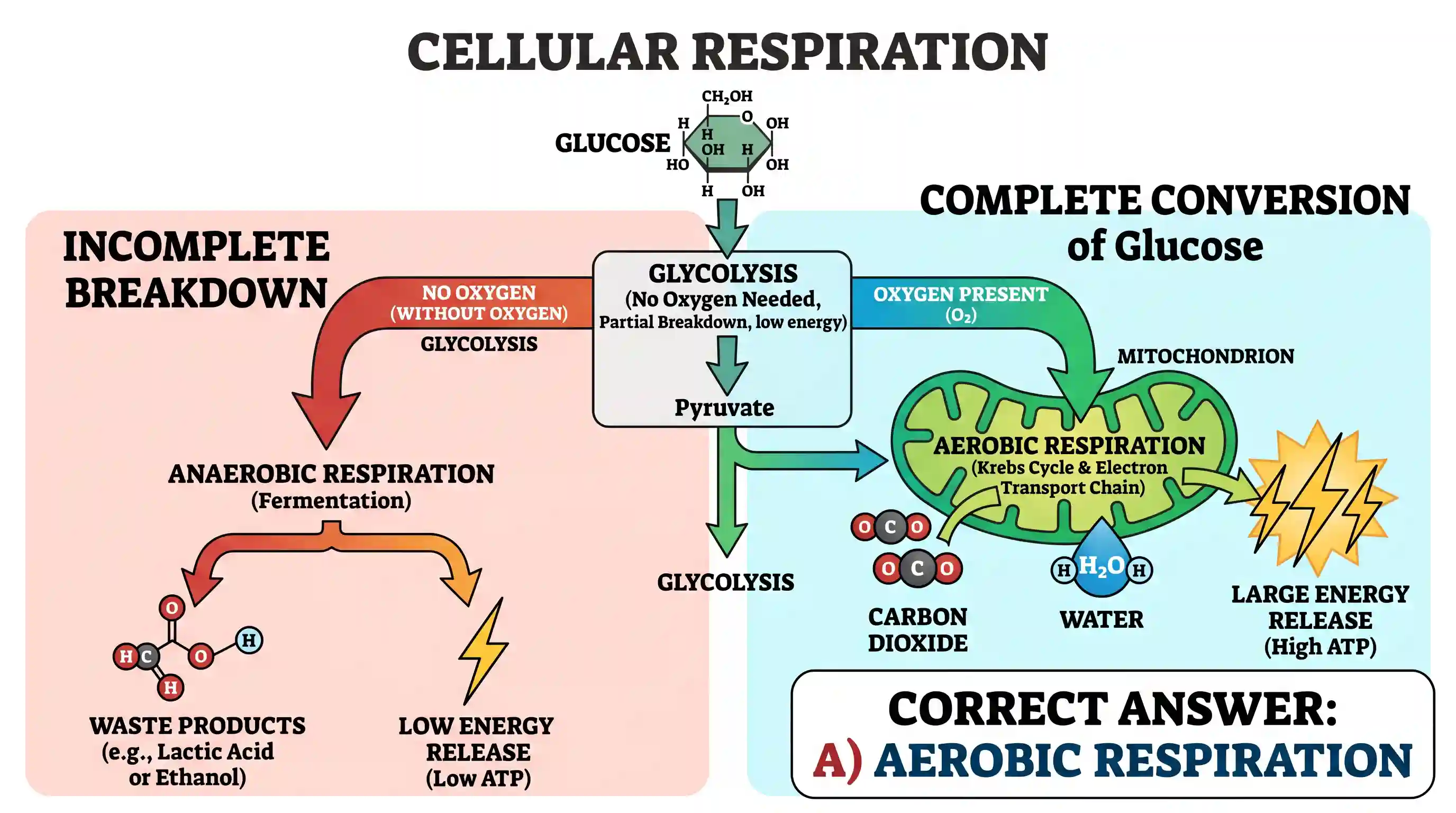
The complete conversion of glucose in the presence of oxygen into carbon dioxide and water with release of energy is called

- Aaerobic respirationCorrect
- Banaerobic respiration
- Cglycolysis
- Dhydrolysis
Explanation
Aerobic respiration is the process where cells use oxygen to break down glucose completely. This chemical reaction produces carbon dioxide and water as waste products and releases a large amount of energy in the form of ATP.
The other options are incorrect because anaerobic respiration occurs without oxygen, glycolysis is only the initial stage of glucose breakdown that does not require oxygen or result in complete conversion, and hydrolysis is a chemical reaction involving water to break bonds rather than a respiratory process for energy release.
Related questions
More UPSC Prelims practice from the same subject and topic.
- Prelims 1998GS1science-and-technology
A fuse is used in main electric supply as a safety device. Which one of the following statements about the fuse is correct?
- Prelims 1998GS1science-and-technology
Match List I with List II and select the correct answer using the codes given below the lists: List I (Disease) (Organism) I. Malaria A) Fungi II. Poliomyelitis B) Bacteria III. Tuberculosis C) Virus …
- Prelims 1998GS1science-and-technology
Haemophilia is a genetic disorder which leads to
- Prelims 1998GS1science-and-technology
A ball is dropped from the top of a high building with a constant acceleration of 9.8 m/s². What will be its velocity after 3 seconds?
- Prelims 1998GS1science-and-technology
Which one of the following types of micro-organisms is most widely used in industries?
- Prelims 1998GS1science-and-technology
Match the names of outstanding Indian scientists given in List I with area of their specialised work given in List II and select the correct answer using the codes given below the lists: List I List I…