A man purchases two clocks A and B at a total cost of Rs. 650. He sells A with 20% profit and B at a loss of 25% and gets the same selling price for both the clocks. What are the purchasing prices of A and B respectively?

- ARs. 225; Rs. 425
- BRs. 250; Rs. 400Correct
- CRs. 275; Rs. 375
- DRs. 300; Rs. 350
Explanation
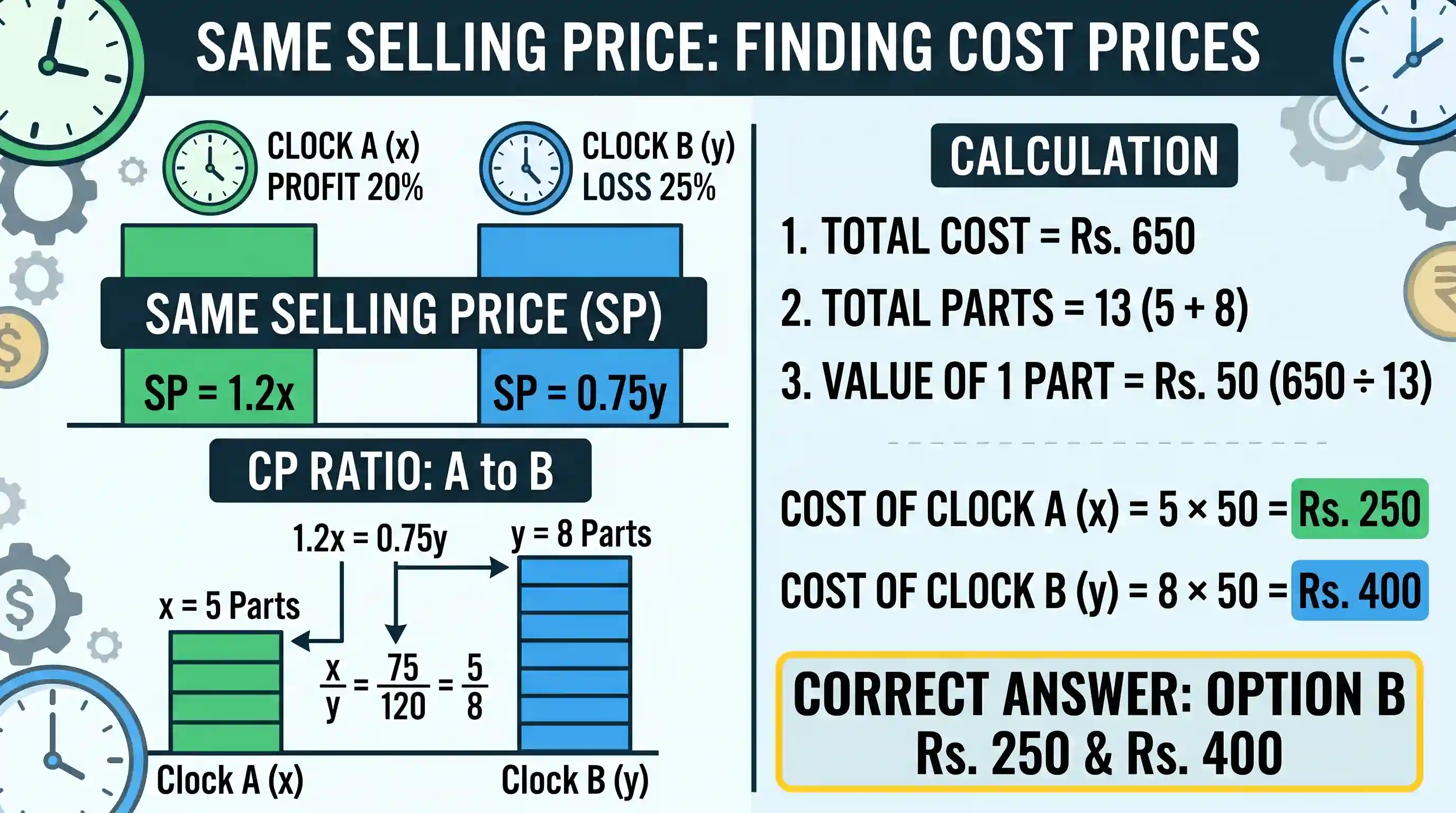
Let the cost price of clock A be x and clock B be y. We are given that x plus y equals 650.
Clock A is sold at a 20 percent profit, so its selling price is 120 percent of x, which is 1.2x. Clock B is sold at a 25 percent loss, so its selling price is 75 percent of y, which is 0.75y.
Since the selling prices are the same, we set 1.2x equal to 0.75y. Simplifying this ratio, we get x divided by y equals 0.75 divided by 1.2, which simplifies to 75 divided by 120, or 5 divided by 8.
The total cost 650 is divided in the ratio 5 to 8. The sum of the parts is 13. One part equals 650 divided by 13, which is 50.
The cost of clock A is 5 multiplied by 50, which is 250. The cost of clock B is 8 multiplied by 50, which is 400.
Therefore, the purchasing prices are Rs. 250 and Rs. 400. Option B is correct.
Related questions
More UPSC Prelims practice from the same subject and topic.
- Prelims 1998GS1economy
A consumer is said to be in equilibrium, if
- Prelims 1998GS1economy
The supply-side economics lays greater emphasis on the point of view of
- Prelims 1998GS1economy
Match List I with List II and select the correct answer using the codes given below the lists: List I List II I. Ringgit A) Indonesia II. Baht B) South Korea III. Rupiah C) Thailand IV. Won D) Malayas…
- Prelims 1998GS1economy
Human Poverty Index was introduced in the Human Development Report of the year
- Prelims 1998GS1economy
Which of the following pairs are correctly matched? I. Dow Jones: New York II. Hang Seng: Seoul III. FTSE - 100: London Select the correct answer using the codes given below:
- Prelims 1998GS1economy
According to the World Development Report, low-income economies are those for which the per capita GNP in 1994 was