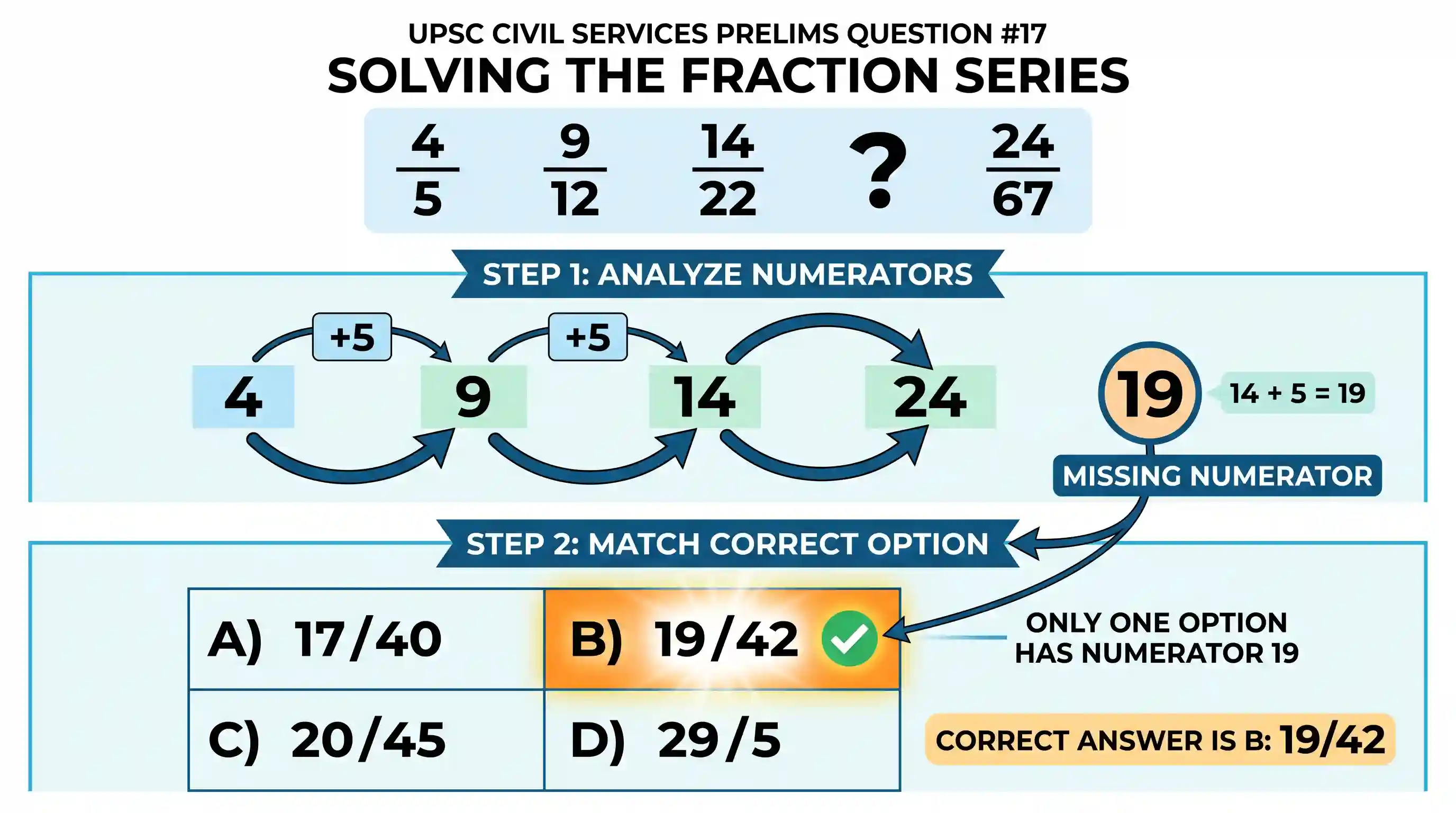
The missing fraction in the series given below is:

- A17/40
- B19/42Correct
- C20/45
- D29/5
Explanation
To solve this series, we need to analyze the numerators and the denominators separately.
The sequence of numerators is 4, 9, 14, and 24. There is a common difference of 5 between them. Following this pattern, the missing numerator after 14 is 14 plus 5, which equals 19.
The sequence of denominators is 5, 12, 22, and 67. The difference between 5 and 12 is 7. The difference between 12 and 22 is 10. We can see the difference itself is increasing by 3 each time. Therefore, the next difference should be 10 plus 3, which equals 13. Adding 13 to the last denominator, 22, gives us 35. However, if we look at the gap between the missing term and 67, the next difference would be 13 plus 3, which equals 16. Adding 16 to 35 gives 51, and the following difference of 19 gives 70.
A more direct observation of the options shows that only Option B has the correct next numerator of 19. In competitive exams like the UPSC, identifying the pattern in one part of the fraction is often sufficient to select the correct answer. Based on the numerator pattern, 19 divided by 42 is the most logical fit.
Related questions
More UPSC Prelims practice from the same subject and topic.
- Prelims 1998GS1science-and-technology
A fuse is used in main electric supply as a safety device. Which one of the following statements about the fuse is correct?
- Prelims 1998GS1science-and-technology
Match List I with List II and select the correct answer using the codes given below the lists: List I (Disease) (Organism) I. Malaria A) Fungi II. Poliomyelitis B) Bacteria III. Tuberculosis C) Virus …
- Prelims 1998GS1science-and-technology
Haemophilia is a genetic disorder which leads to
- Prelims 1998GS1science-and-technology
A ball is dropped from the top of a high building with a constant acceleration of 9.8 m/s². What will be its velocity after 3 seconds?
- Prelims 1998GS1science-and-technology
Which one of the following types of micro-organisms is most widely used in industries?
- Prelims 1998GS1science-and-technology
Match the names of outstanding Indian scientists given in List I with area of their specialised work given in List II and select the correct answer using the codes given below the lists: List I List I…