Indian farmers are unhappy over the introduction of “Terminator Seed Technology” because the seeds produced by this technology are expected to

- Ashow poor germination
- Bform low yielding plants despite the high quality
- Cgive rise to sexually sterile plants
- Dgive rise to plants incapable of forming viable seedsCorrect
Explanation
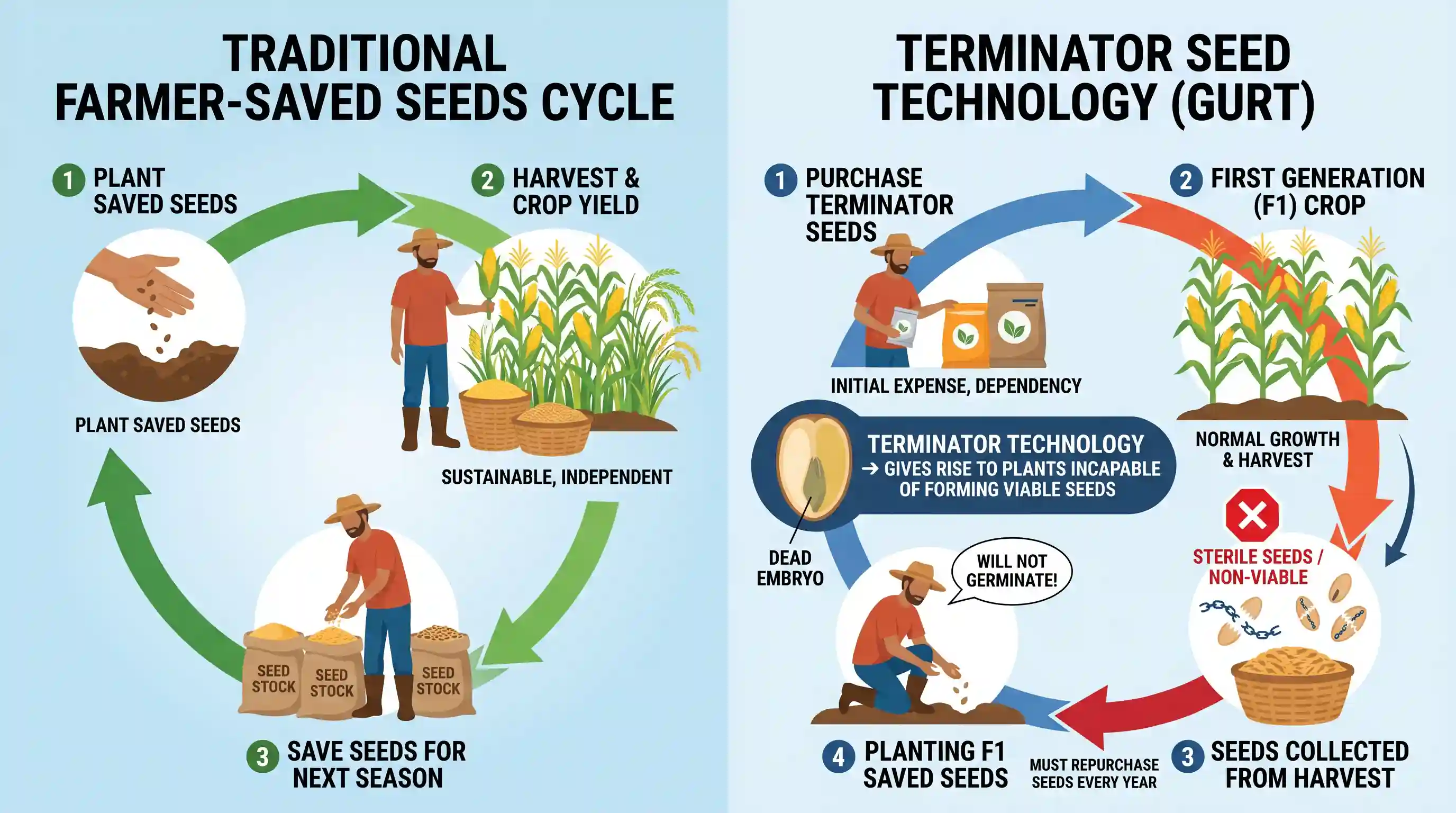
The correct option is D because Terminator Seed Technology, technically known as Genetic Use Restriction Technology, involves genetically modifying plants to produce sterile seeds at harvest. This means that while the first crop grows normally, the seeds collected from that crop will not germinate if planted again.
Farmers are unhappy because this technology prevents them from following the traditional practice of saving seeds for the next season. Instead, it forces them to purchase new, expensive seeds from seed companies every year, creating a cycle of dependency and increasing the cost of cultivation. Unlike option C, the plants themselves are not sterile as they do produce a crop, but the seeds they yield are biologically incapable of further reproduction.
Related questions
More UPSC Prelims practice from the same subject and topic.
- Prelims 1999GS1science-and-technology
Neem tree has acquired industrial importance as a source of
- Prelims 1999GS1science-and-technology
Which one of the following genetic diseases is sex-linked?
- Prelims 1999GS1science-and-technology
Assertion (A): Insect resistant transgenic cotton has been produced by inserting Bt gene. Reason (R): The Bt gene is derived from a bacterium.
- Prelims 1999GS1science-and-technology
Assertion (A): Dolly was the first cloned mammal. Reason (R): Dolly was produced by in vitro fertilization.
- Prelims 1999GS1science-and-technology
Assertion (A): Information technology is fast becoming a very important field of activity in India. Reason (R): Software is one of the major exports of the country and India has a very strong base in …
- Prelims 1999GS1science-and-technology
In eye donation, which one of the following parts of donor’s eye is utilised?