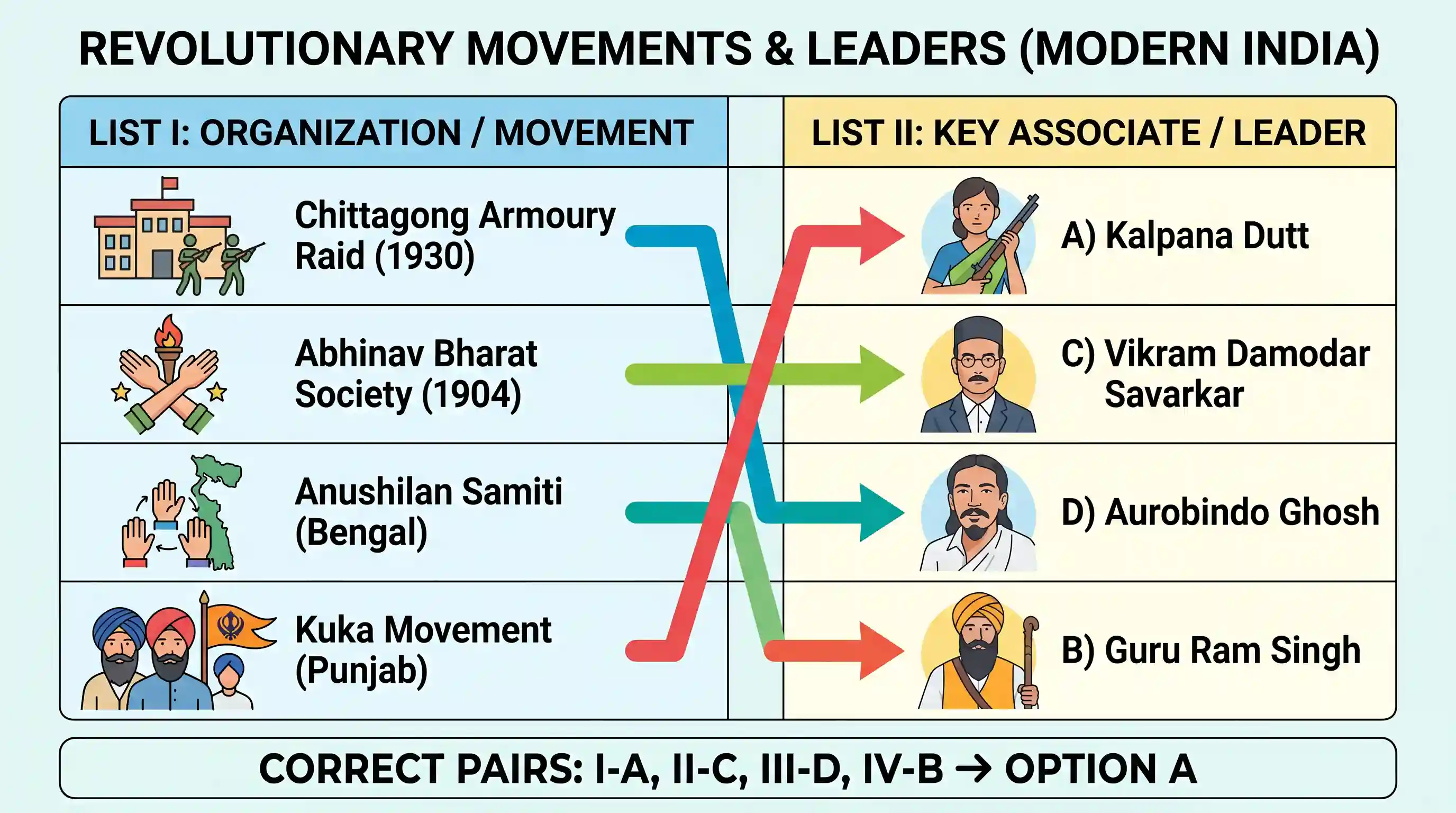
Match List I with List II and select the correct answer using the codes given below the Lists: List I List II I. Chittagong Armoury Raid A) Kalpana Dutt II. Abhinav Bharat B) Guru Ram Singh III. Anushilan Samiti C) Vikram Damodar Savarkar IV. Kuka Movement D) Aurobindo Ghosh Codes:

- AI-A, II-C, III-D, IV-BCorrect
- BI-A, II-C, III-B, IV-D
- CI-C, II-A, III-B, IV-D
- DI-C, II-A, III-D, IV-B
Explanation
The correct option is A because each historical movement or organization is accurately paired with its prominent leader or associate.
I. Chittagong Armoury Raid A. Kalpana Dutt: Kalpana Dutt was a prominent revolutionary who worked closely with Surya Sen during the Chittagong Armoury Raid in 1930.
II. Abhinav Bharat C. Vikram Damodar Savarkar: V.D. Savarkar founded the Abhinav Bharat Society, a secret revolutionary organization, in 1904.
III. Anushilan Samiti D. Aurobindo Ghosh: Aurobindo Ghosh was one of the key figures and ideological leaders behind the Anushilan Samiti, which was an influential revolutionary group in Bengal.
IV. Kuka Movement B. Guru Ram Singh: Guru Ram Singh was the most important leader of the Kuka Movement, which was a socio-religious and political revolt in the Punjab region.
Matching these pairs leads directly to Option A.
Related questions
More UPSC Prelims practice from the same subject and topic.
- Prelims 2000GS1history
At the time of partition of India, which one of the following provinces of the British India came forward with a plan for a united and independent existence?
- Prelims 2000GS1history
The Balkan Plan for fragmentation of India was the brain-child of
- Prelims 2000GS1history
Consider the following statements about the Indian National Congress I. Sarojini Naidu was the first woman to be the President of the Congress. II. C.R. Das was in prison when he functioned as the Pre…
- Prelims 2000GS1history
“In this instance we could not play off the Mohammedans against the Hindus”. To which one of the following events did this remark of Aitchison relate?
- Prelims 2000GS1history
The Indian National Army (INA) came into existence in 1943 in
- Prelims 2000GS1history
The last major extension of British Indian territory took place during the time of