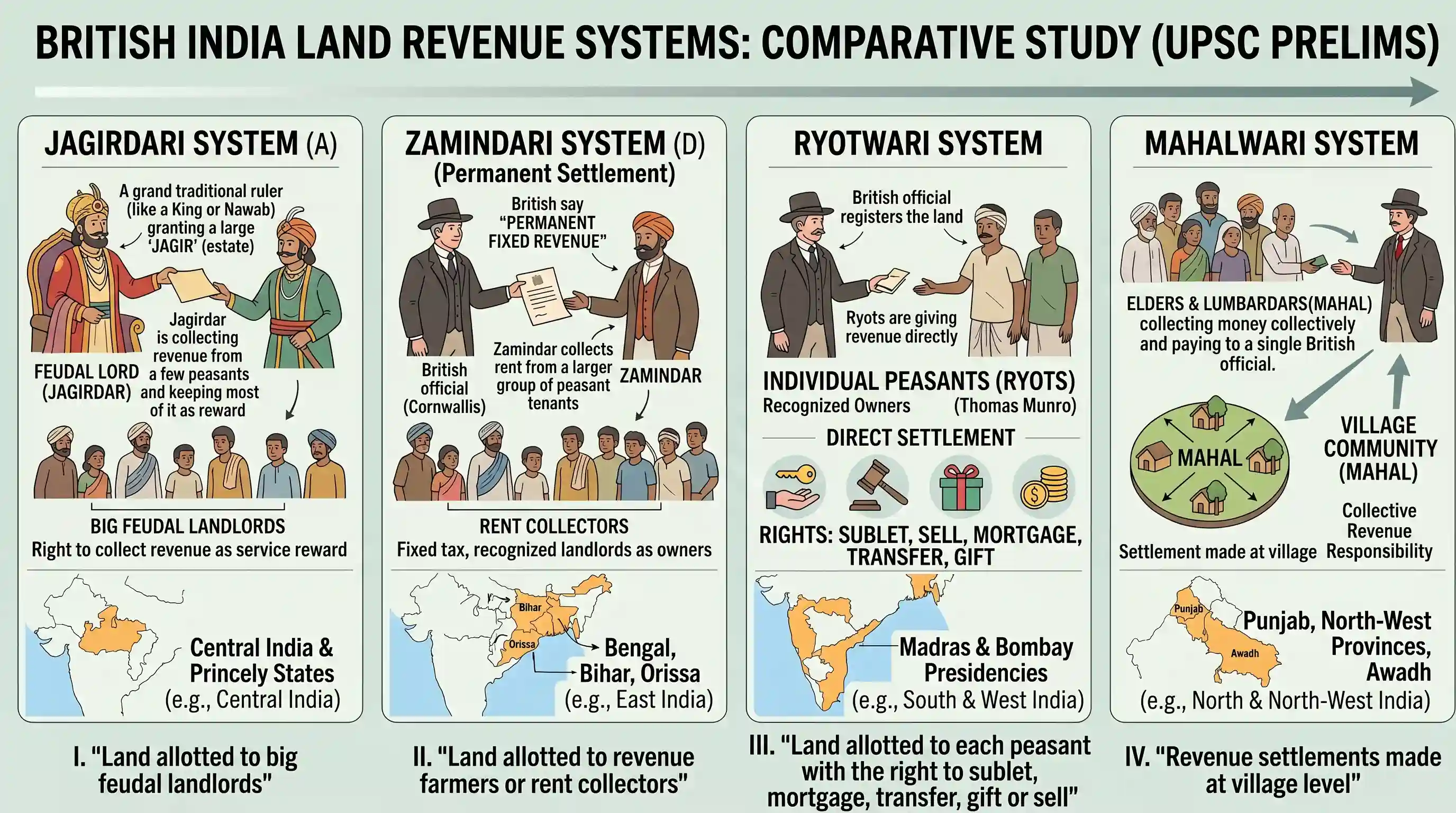
Match List I with List II and select the correct answer using the codes given below the Lists: List I List II I. Land allotted to big feudal landlords A) Jagirdari System II. Land allotted to revenue farmers or rent collectors B) Ryotwari System III. Land allotted to each peasant with the right to sublet, mortgage, transfer, gift or sell C) Mahalwari System IV. Revenue settlements made at village level D) Zamindari System

- AI-A, II-C, III-B, IV-D
- BI-A, II-D, III-B, IV-CCorrect
- CI-C, II-D, III-A, IV-B
- DI-B, II-A, III-C, IV-D
Explanation
The correct option is B based on the following characteristics of the land revenue systems in British India:
I matches with A: The Jagirdari System involved allotting land to big feudal landlords known as Jagirdars who had the right to collect revenue as a reward for their services to the state.
II matches with D: The Zamindari System, also known as the Permanent Settlement, recognized landlords as the owners of the land. They acted as revenue farmers or rent collectors for the British government.
III matches with B: Under the Ryotwari System, the land was allotted directly to the individual peasant or Ryot. The peasant was recognized as the owner with the rights to sublet, mortgage, transfer, gift, or sell the land.
IV matches with C: In the Mahalwari System, the revenue settlement was made at the village level. The village unit was called a Mahal, and the entire community was held collectively responsible for revenue payment.
Related questions
More UPSC Prelims practice from the same subject and topic.
- Prelims 2000GS1history
At the time of partition of India, which one of the following provinces of the British India came forward with a plan for a united and independent existence?
- Prelims 2000GS1history
The Balkan Plan for fragmentation of India was the brain-child of
- Prelims 2000GS1history
Consider the following statements about the Indian National Congress I. Sarojini Naidu was the first woman to be the President of the Congress. II. C.R. Das was in prison when he functioned as the Pre…
- Prelims 2000GS1history
“In this instance we could not play off the Mohammedans against the Hindus”. To which one of the following events did this remark of Aitchison relate?
- Prelims 2000GS1history
The Indian National Army (INA) came into existence in 1943 in
- Prelims 2000GS1history
The last major extension of British Indian territory took place during the time of