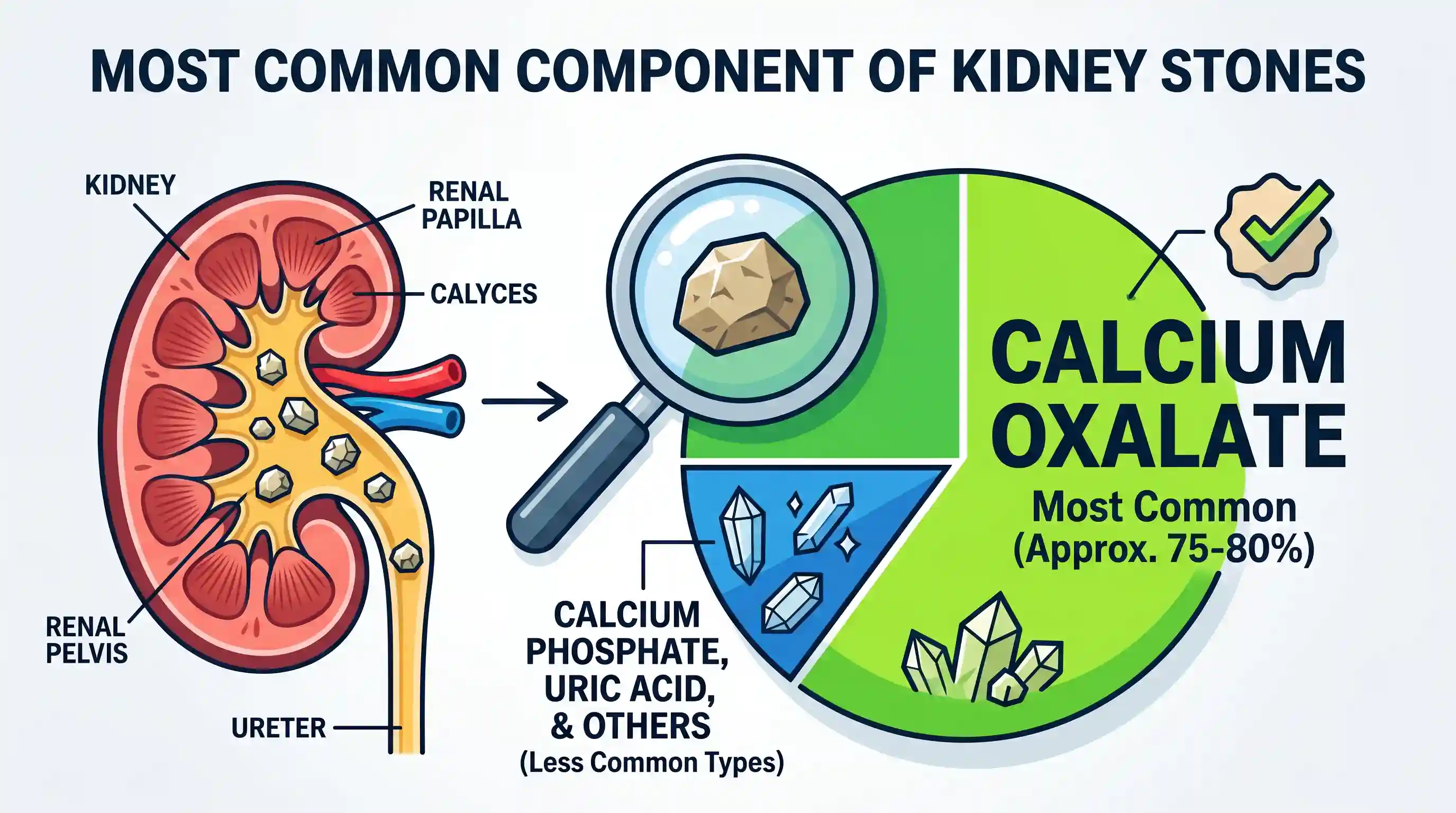
The stones formed in human kidney consist mostly of

- Acalcium oxalateCorrect
- Bsodium acetate
- Cmagnesium sulphate
- Dcalcium
Explanation
The correct answer is A. Kidney stones, also known as renal calculi, are most commonly composed of calcium oxalate. This occurs when urine contains more calcium and oxalate than the fluid can dilute, leading to the formation of hard crystals. Calcium oxalate stones account for approximately 75 to 80 percent of all kidney stone cases. Calcium phosphate is another common component, but oxalate is the predominant substance found in these stones. Sodium acetate, magnesium sulphate, and pure calcium do not typically form the structural mass of human kidney stones.
Related questions
More UPSC Prelims practice from the same subject and topic.
- Prelims 2000GS1science-and-technology
A noise level of 100 decibels would correspond to
- Prelims 2000GS1science-and-technology
A ‘black hole’ is a body in space which does not allow any radiation to come out. This property is due to its
- Prelims 2000GS1science-and-technology
Consider the following features of newer models of motor cars: I. Radial tyres II. Streamlined body III. Multipoint fuel injection IV. Catalytic converter with exhaust Which of these features make the…
- Prelims 2000GS1science-and-technology
Fluorescent tubes are fitted with a choke. The choke coils
- Prelims 2000GS1science-and-technology
When a CD (Compact Disc used in audio and video systems) is seen in sunlight, rainbow like colours is seen. This can be explained on the basis of the phenomenon of
- Prelims 2000GS1science-and-technology
Assertion (A): A man standing on a completely frictionless surface can propel himself by whistling. Reason (R): If no external force acts on a system, its momentum cannot change.