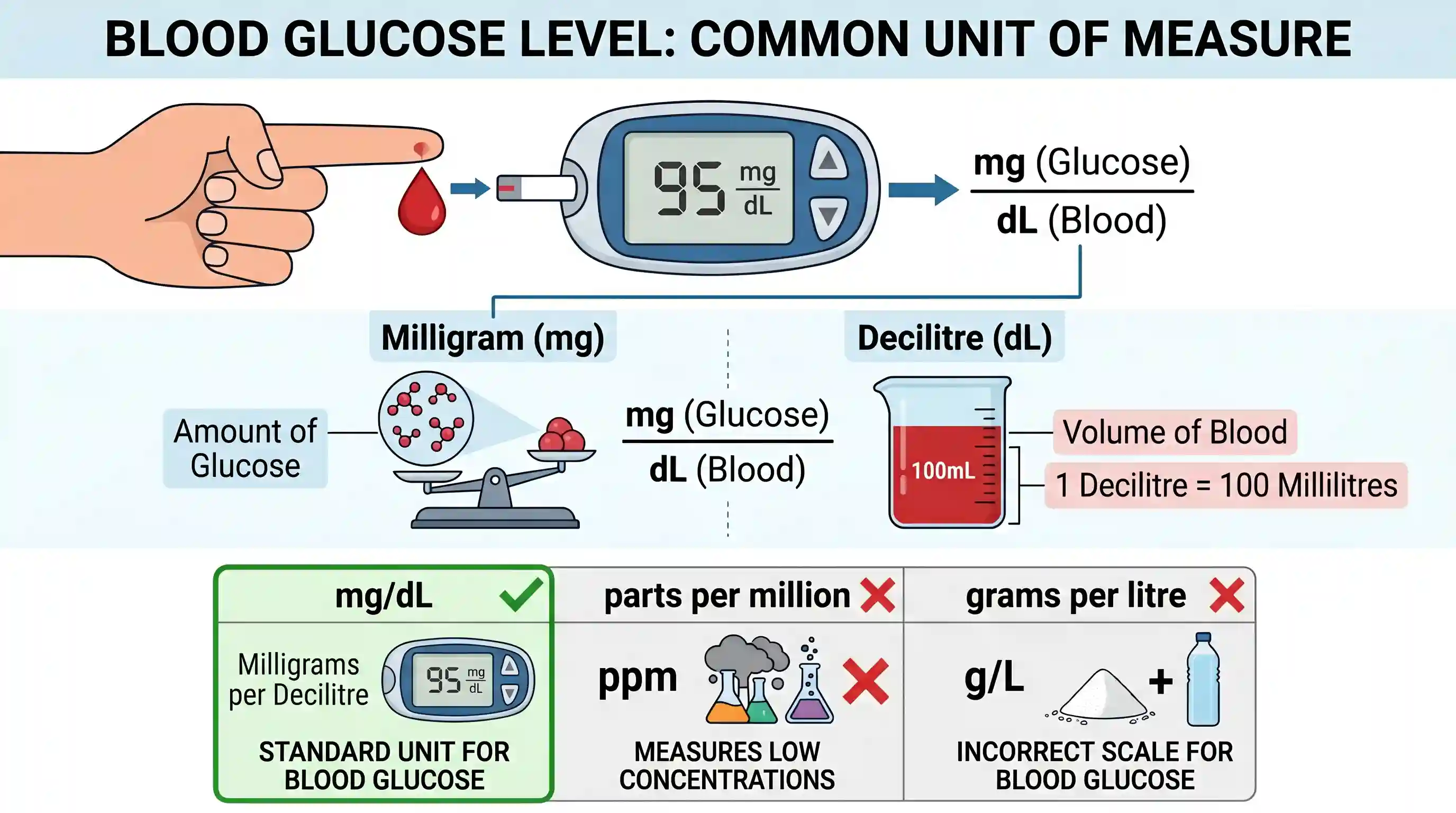
The blood glucose level is commonly expressed as

- Amm of Hg
- Bmilligram per decilitreCorrect
- Cparts per million
- Dgrams per litre
Explanation
The correct option is B because blood glucose concentration is most frequently measured and reported in milligrams of glucose per decilitre of blood. In clinical settings, a decilitre represents 100 millilitres. While other units like millimoles per litre are used in some countries, milligram per decilitre is the standard convention used in India and many other regions for medical diagnostics. The other options are incorrect because millimetres of mercury is a unit for blood pressure, parts per million is used for chemical concentrations in solutions or gases, and grams per litre is too large a scale for standard blood sugar readings.
Related questions
More UPSC Prelims practice from the same subject and topic.
- Prelims 2000GS1science-and-technology
A noise level of 100 decibels would correspond to
- Prelims 2000GS1science-and-technology
A ‘black hole’ is a body in space which does not allow any radiation to come out. This property is due to its
- Prelims 2000GS1science-and-technology
Consider the following features of newer models of motor cars: I. Radial tyres II. Streamlined body III. Multipoint fuel injection IV. Catalytic converter with exhaust Which of these features make the…
- Prelims 2000GS1science-and-technology
Fluorescent tubes are fitted with a choke. The choke coils
- Prelims 2000GS1science-and-technology
When a CD (Compact Disc used in audio and video systems) is seen in sunlight, rainbow like colours is seen. This can be explained on the basis of the phenomenon of
- Prelims 2000GS1science-and-technology
Assertion (A): A man standing on a completely frictionless surface can propel himself by whistling. Reason (R): If no external force acts on a system, its momentum cannot change.