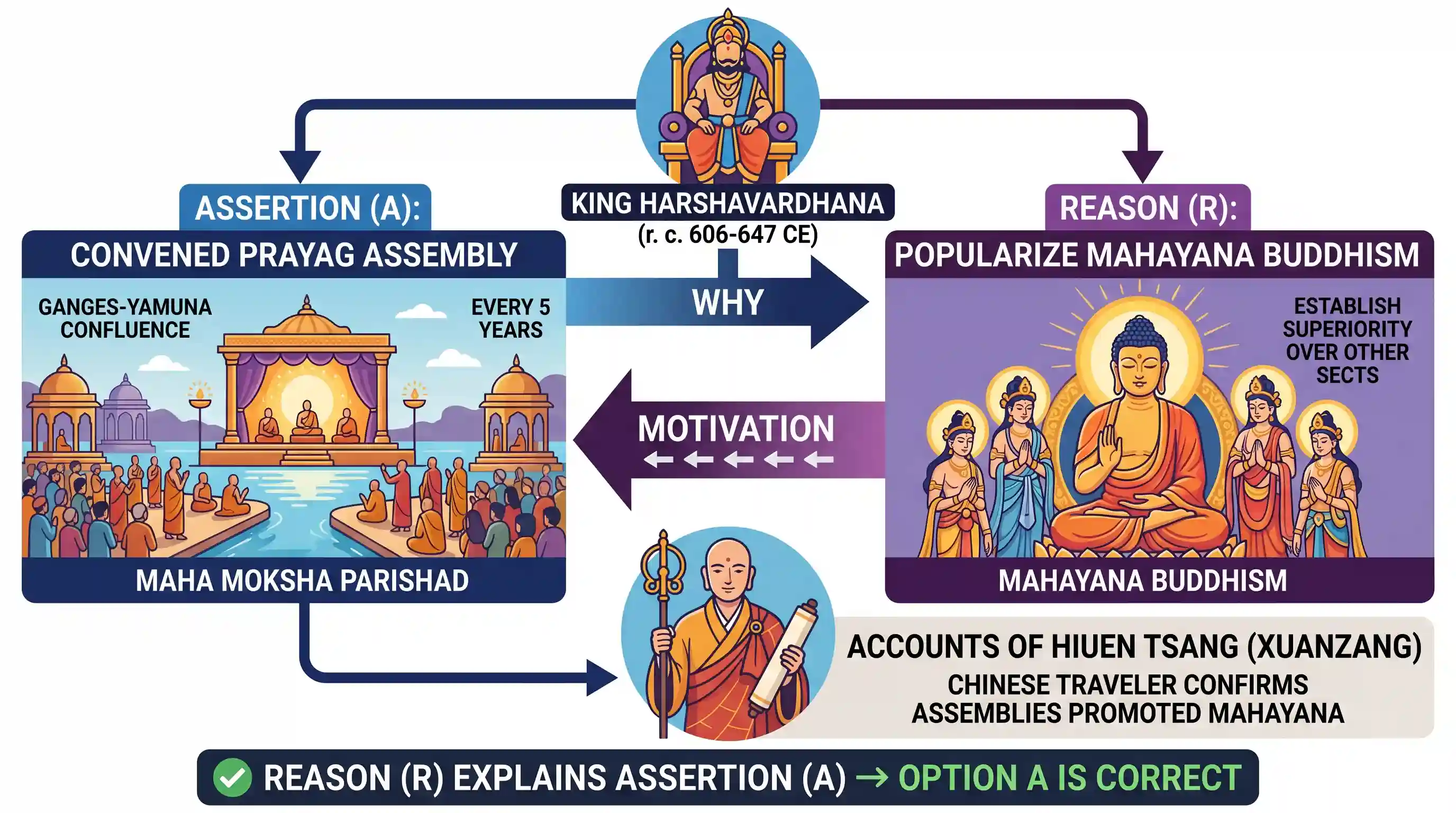
Assertion (A): Harshavardhana convened the Prayag Assembly. Reason (R): He wanted to popularise only the Mahayana form of Buddhism.

- ABoth A and R are individually true, and R is the correct explanation of ACorrect
- BBoth A and R are individually true, but R is NOT a correct explanation of A
- CA is true, but R is false
- DA is false, but R is true
Explanation
The correct option is A because both statements are true and the reason explains the assertion. Harshavardhana convened the Prayag Assembly, also known as the Maha Moksha Parishad, which he held every five years. While he was a tolerant ruler who respected various faiths, the primary objective of his major assemblies, including the one at Kannauj and the subsequent gathering at Prayag, was to highlight and popularize the doctrines of Mahayana Buddhism. Hiuen Tsang, the Chinese traveler who attended these events, confirms that Harsha used these grand platforms to establish the superiority of Mahayana Buddhism over other sects and religions, making the promotion of this specific faith the underlying reason for organizing such large scale religious assemblies.
Related questions
More UPSC Prelims practice from the same subject and topic.
- Prelims 2001GS1history
Who amongst the following Englishmen, first translated Bhagavad-Gita into English?
- Prelims 2001GS1history
Which one of the Chola kings conquered Ceylon?
- Prelims 2001GS1history
Who among the following presided over the Buddhist Council held during the reign of Kanishka at Kashmir?
- Prelims 2001GS1history
Which one of the following animals was NOT represented on the seals and terracotta art of the Harappan culture?
- Prelims 2001GS1history
Who amongst the following was the first to state that the Earth was spherical?
- Prelims 2001GS1history
In 1930, a person’s age was 8 times that of his son. In 1938, the father’s age became ten times that of his son’s age in 1930. The ages of the son and father in 1940 were, respectively.