In an atom, the order of filling up of the orbitals is governed by

- AAufbau principleCorrect
- BHeisenberg’s uncertainty principle
- CHund’s rule
- DPauli’s exclusion principle
Explanation
The correct answer is A.
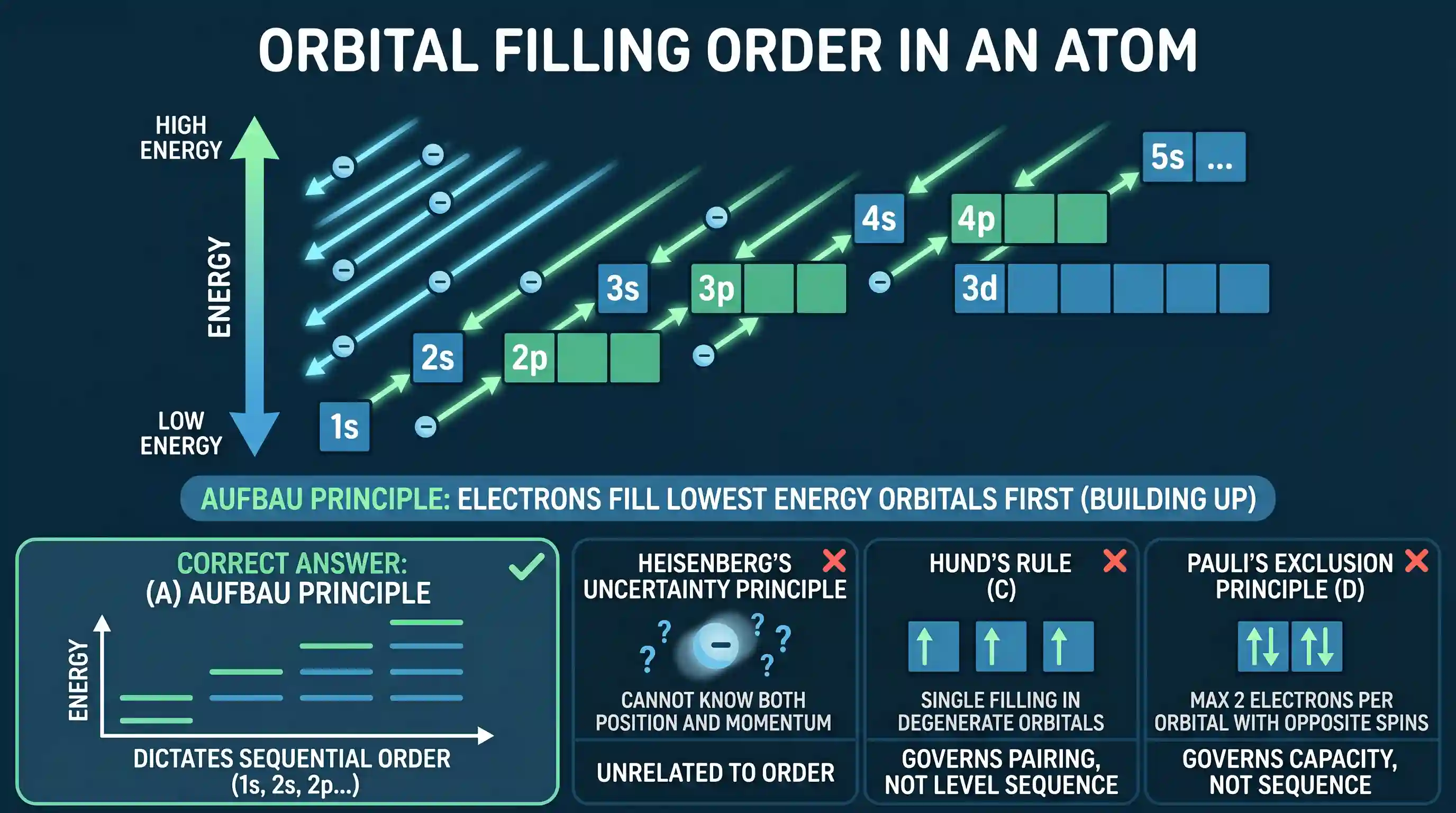
The Aufbau principle states that in the ground state of an atom, electrons fill atomic orbitals of the lowest available energy levels first before occupying higher levels. The word Aufbau is German for building up. This principle establishes the specific sequence such as 1s, 2s, 2p, and so on, based on the increasing energy levels of the orbitals.
While the other principles are related to atomic structure, they govern different aspects. Paulis exclusion principle states that no two electrons can have the same four quantum numbers. Hunds rule deals with the doubling up of electrons in orbitals of the same energy. Heisenbergs uncertainty principle relates to the impossibility of simultaneously knowing the exact position and momentum of an electron. Only the Aufbau principle directly dictates the sequential order of filling.
Related questions
More UPSC Prelims practice from the same subject and topic.
- Prelims 2001GS1science-and-technology
The theme of Indian Science Congress, 2001 was
- Prelims 2001GS1science-and-technology
Match List I with List II and select the correct answer using the codes given below the Lists: List I List II (Institute) (Location) I. Central Institute of Medicinal and Aromatic Plants A) Chandigarh…
- Prelims 2001GS1science-and-technology
Two wires have their lengths, diameters and resistivities, all in the ratio of 1: 2. If the resistance of the thinner wire is 10 ohms, the resistance of the thicker wire is
- Prelims 2001GS1science-and-technology
Assertion (A): A stick is dipped in water in a slanting position. If observed sideways, the stick appears short and bent at the surface of water. Reason (R): The light coming from the stick undergoes …
- Prelims 2001GS1science-and-technology
When light waves pass from air to glass, the variables affected are
- Prelims 2001GS1science-and-technology
When water is heated from 0°C to 10°C, its volume