An aqueous solution of copper sulphate is acidic in nature because the salt undergoes

- Adialysis
- Belectrolysis
- ChydrolysisCorrect
- Dphotolysis
Explanation
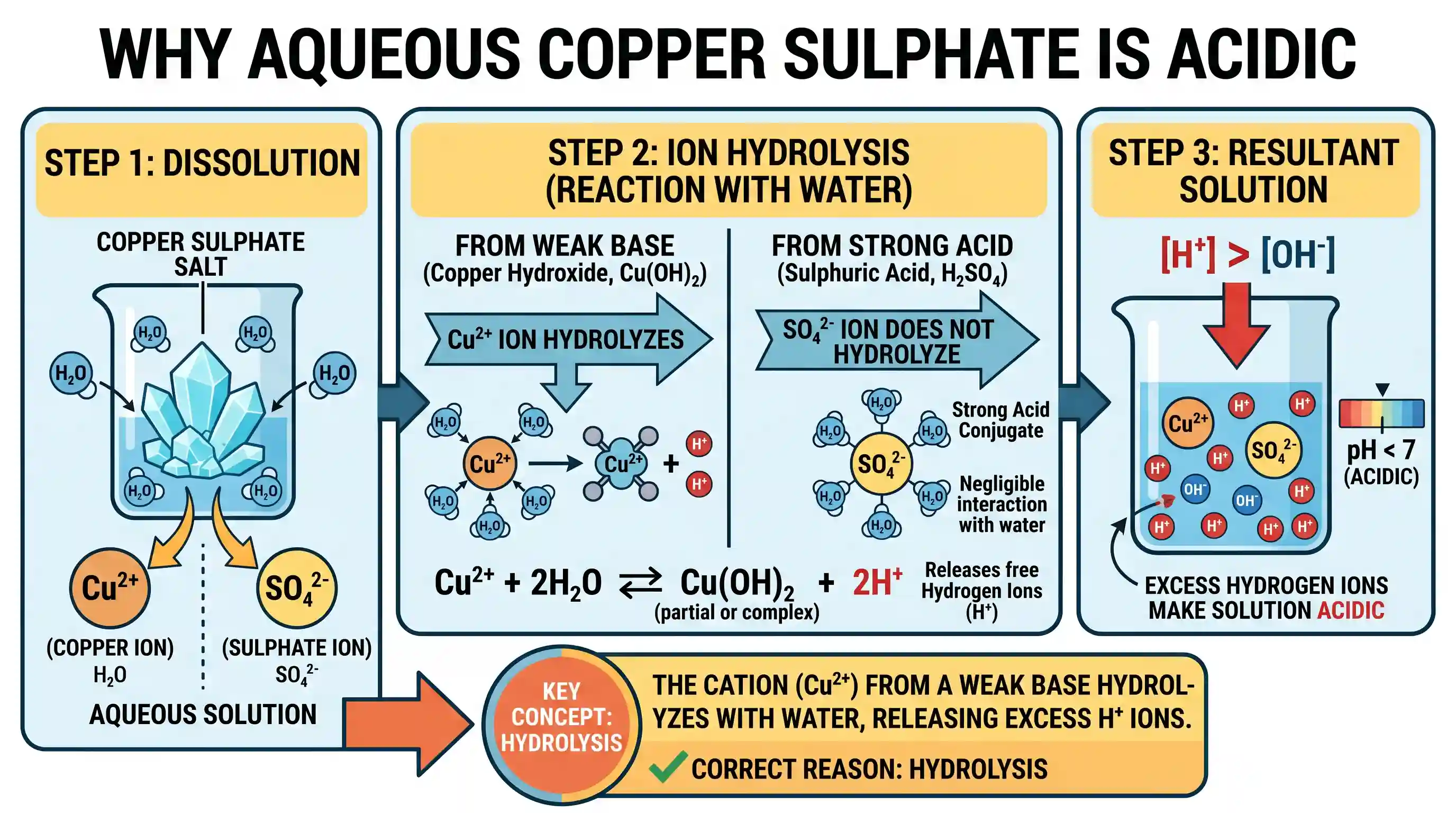
Copper sulphate is a salt derived from a strong acid, sulphuric acid, and a weak base, copper hydroxide. When dissolved in water, it undergoes hydrolysis, which is a chemical reaction with water. During this process, the copper ions react with water to release free hydrogen ions into the solution. Since the concentration of hydrogen ions increases, the solution becomes acidic. Dialysis is a separation process, electrolysis involves decomposition using electricity, and photolysis is decomposition by light, none of which explain the resulting pH of the solution. Therefore, hydrolysis is the correct reason.
Related questions
More UPSC Prelims practice from the same subject and topic.
- Prelims 2001GS1science-and-technology
The theme of Indian Science Congress, 2001 was
- Prelims 2001GS1science-and-technology
Match List I with List II and select the correct answer using the codes given below the Lists: List I List II (Institute) (Location) I. Central Institute of Medicinal and Aromatic Plants A) Chandigarh…
- Prelims 2001GS1science-and-technology
Two wires have their lengths, diameters and resistivities, all in the ratio of 1: 2. If the resistance of the thinner wire is 10 ohms, the resistance of the thicker wire is
- Prelims 2001GS1science-and-technology
Assertion (A): A stick is dipped in water in a slanting position. If observed sideways, the stick appears short and bent at the surface of water. Reason (R): The light coming from the stick undergoes …
- Prelims 2001GS1science-and-technology
When light waves pass from air to glass, the variables affected are
- Prelims 2001GS1science-and-technology
When water is heated from 0°C to 10°C, its volume