When one gene control two or more different characters simultaneously, the phenomenon is called

- AApomixis
- BPleiotropyCorrect
- CPolyploidy
- DPolytony
Explanation
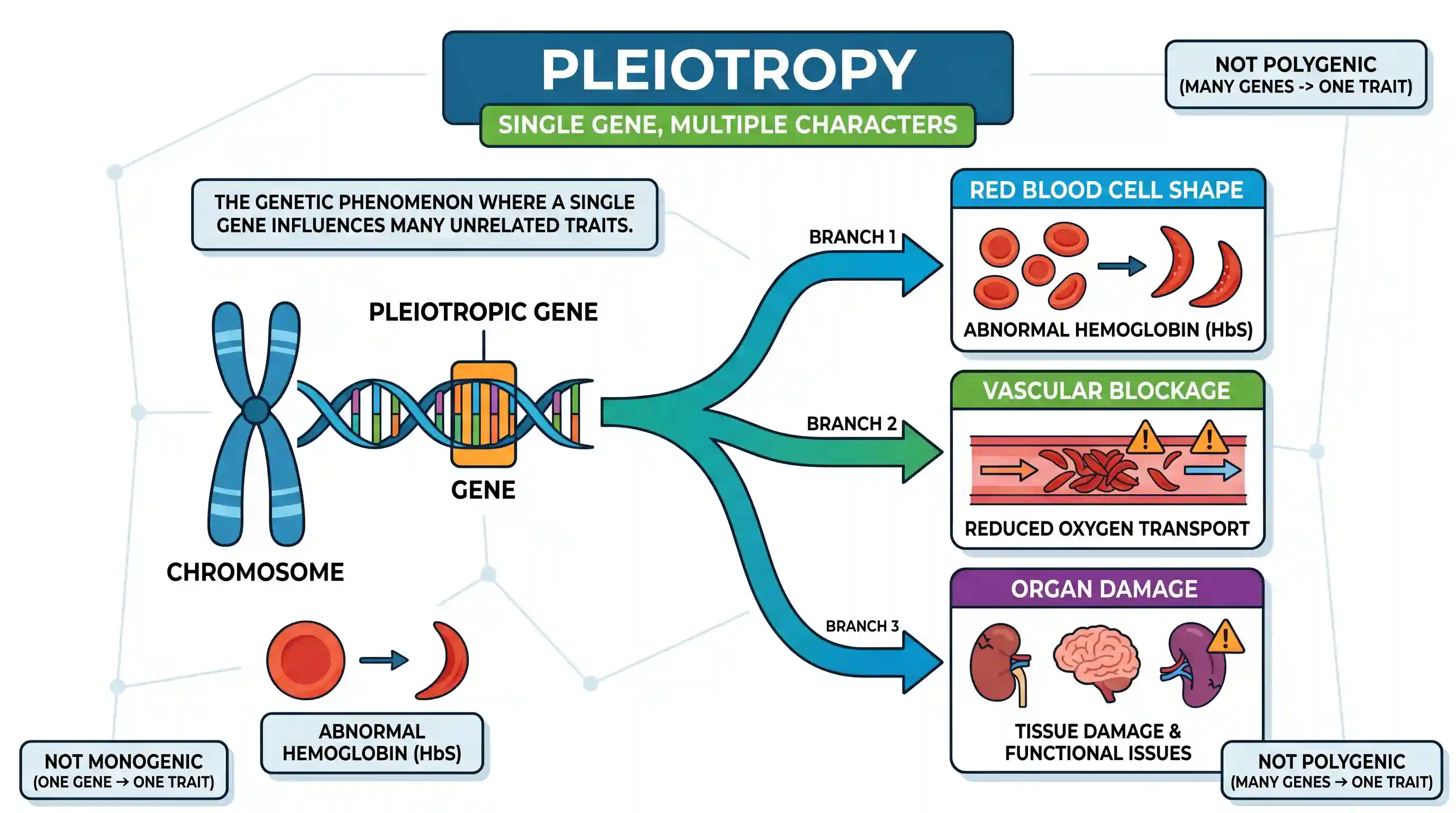
Pleiotropy is the correct answer because it describes the genetic phenomenon where a single gene influences multiple, seemingly unrelated phenotypic traits or characters. A classic example in humans is sickle cell anemia, where a mutation in one gene affects red blood cell shape, blood flow, and various organ functions simultaneously.
As for the other options: Apomixis refers to asexual seed formation without fertilization. Polyploidy is a condition where an organism has more than two complete sets of chromosomes. Polytony is a musical or linguistic term and is not a standard genetic phenomenon related to gene control of characters.
Related questions
More UPSC Prelims practice from the same subject and topic.
- Prelims 2002GS1science-and-technology
With reference to the latest developments in stem cell research, consider the following statements: 1. The only source of human stem cells are the embryos at blastocyst stage 2. The stem cells can be …
- Prelims 2002GS1science-and-technology
Match List I (Scientists) with List II (Achievement) and select the correct answer using the codes given below the lists: List I List II (Scientists) (Achievement) A. Arber and Smith 1. Developed tran…
- Prelims 2002GS1science-and-technology
A complete cycle of a traffic light takes 60 seconds. During each cycle the light is green for 25 second, yellow for 5 second and red for 30 second. At a randomly chosen time, the probability that the…
- Prelims 2002GS1science-and-technology
A solid cube just gets completely immersed in water when a 0.2 kg mass is placed on it. If the mass is removed, the cube is 2 cm about the water level. What is the length of each side of the cube?
- Prelims 2002GS1science-and-technology
In the year 2001, NASA launched a spacecraft to Mars named
- Prelims 2002GS1science-and-technology
Consider the volumes of the following: 1. A parallelepiped of length 5 cm, breadth 3 cm and height 4 cm 2. A cube of each side 4 cm 3. A cylinder of radius 3 cm and length 3 cm 4. A sphere of radius 3…