If the radius of the earth were shrunk by one per cent, its mass remaining the same, the value of ‘g’ on the earth’s surface would

- Aincrease by 0.5%
- Bincrease by 2%Correct
- Cdecrease by 0.5%
- Ddecrease by 2%
Explanation
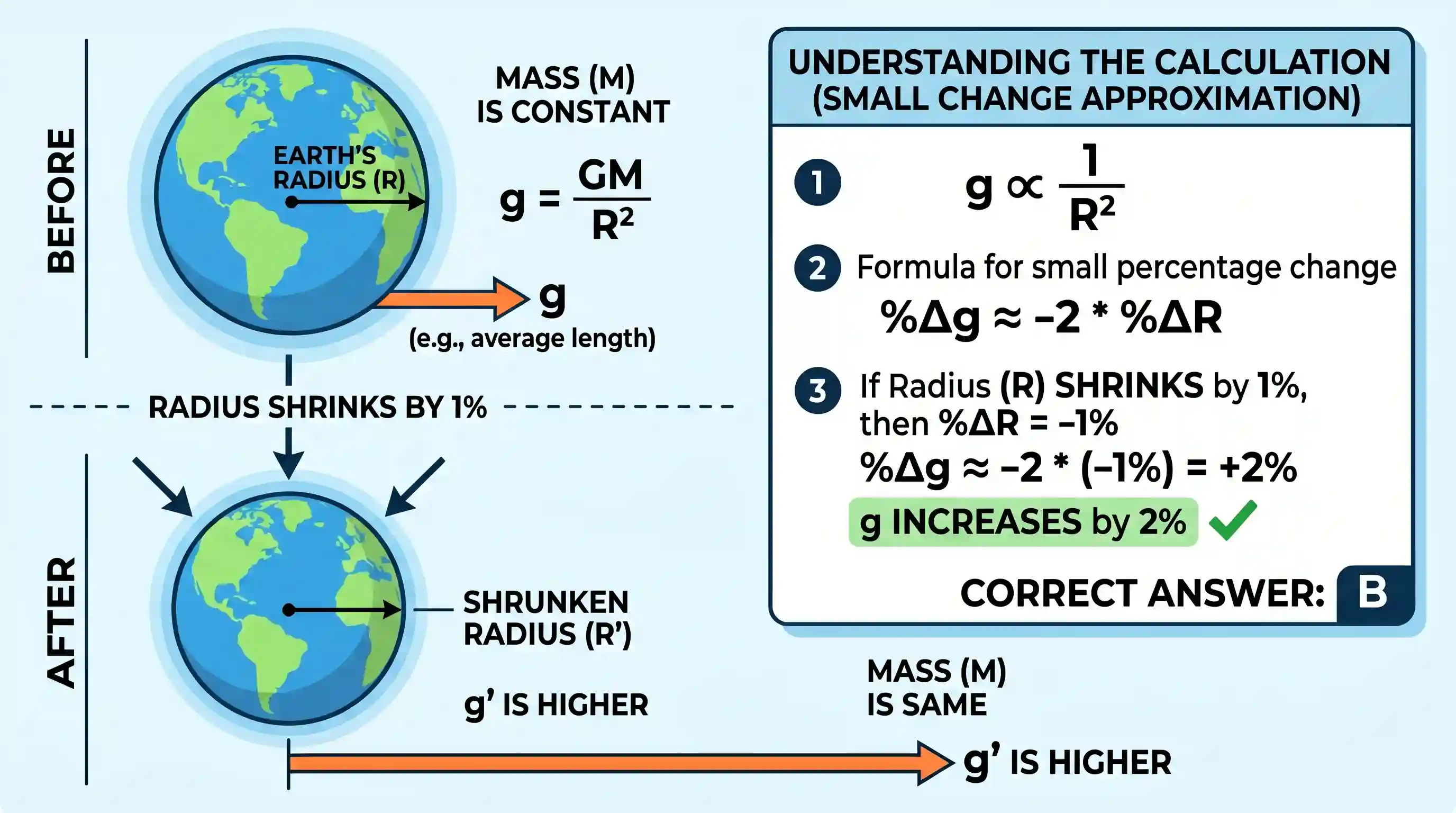
The value of acceleration due to gravity g is calculated using the formula g equals G times M divided by R squared, where G is the gravitational constant, M is the mass of the earth, and R is its radius.
Since the mass M remains constant, g is inversely proportional to the square of the radius R. In physics, for small percentage changes, the percentage change in g is approximately equal to minus two times the percentage change in R.
If the radius R shrinks by 1 percent, the change is negative 1 percent. Multiplying this by negative 2 results in a positive 2 percent. Therefore, the value of g increases by 2 percent. This happens because as the surface moves closer to the center of mass while the mass stays the same, the gravitational pull becomes stronger.
Related questions
More UPSC Prelims practice from the same subject and topic.
- Prelims 2003GS1science-and-technology
With reference to the work of human kidney, consider the following statements: 1. After the waste is removed in the kidney, the cleaner blood is sent back through renal artery. 2. From Bowman’s capsul…
- Prelims 2003GS1science-and-technology
Consider the following statements: 1. Steam at 100° C and boiling water at 100° C contain same amount of heat. 2. Latent heat of fusion of ice is equal to the latent heat of vaporization of water. 3. …
- Prelims 2003GS1science-and-technology
Consider the following statements: A 4-wheel vehicle moving a sharp circular path at high speed will 1. Overturn about its outer wheels 2. Overturn about its inner wheels 3. Skid outwards 4. Skid inwa…
- Prelims 2003GS1science-and-technology
Four different candles, which can last for 5 hours, 4 hours. 3 hours and 2 hours of burning, respectively, are lit in a room at the same instant and allowed to burn till such time that the three candl…
- Prelims 2003GS1science-and-technology
Which one of the following statements is correct?
- Prelims 2003GS1science-and-technology
Which one of the following statements is correct?